

Your QA Engineer is one of the most valuable people on your team. They possess a rare combination of technical depth, domain knowledge, and the analytical patience to trace a subtle regression through 40 code changes and find the one commit that broke a checkout flow that only fails on Samsung Galaxy devices running Android 12 in portrait mode.
Now imagine that capability operating 24 hours a day, across every test case simultaneously, with machine-speed execution and zero context-switching overhead. That is not a fantasy — it is the ideyaLabs QA Agent, the autonomous quality intelligence engine at the core of the AiLabs platform.
This post is a technical deep-dive into exactly how the QA Agent works, what it can and cannot do, and why it represents a fundamental leap beyond traditional test automation frameworks — not just a faster way to run Selenium scripts.
“80% faster test setup. Machine-speed execution. Closed-loop defect resolution. The QA Agent does not automate testing — it autonomously engineers quality.”
1. The Problem with Traditional Test Automation (And Why It’s Not Enough)
Before understanding what the QA Agent does differently, it’s worth being precise about what traditional automation frameworks — Selenium, Cypress, Playwright, Appium — are actually good at: executing predefined scripts against known application states. They are excellent execution engines. But they are fundamentally dumb about quality.
Here is what traditional frameworks cannot do:
❌ They cannot read a requirements document and generate a test plan. A human QA engineer must write every script.
❌ They cannot adapt when UI elements change — every locator update requires a manual fix.
❌ They cannot understand business context — they test code behavior, not user value delivery.
❌ They cannot generate synthetic test data for edge cases they were not explicitly programmed to anticipate.
❌ They cannot learn from defect history and proactively increase coverage in historically fragile areas.
❌ They cannot manage bug tracking, verify fixes, and close the resolution loop without human orchestration.
The result is that traditional automation requires a skilled QA engineer to be the intelligence layer — writing scripts, maintaining locators, managing test data, triaging failures, and chasing developers on bugs. The automation handles execution. The human handles everything else.
The ideyaLabs QA Agent replaces the manual intelligence layer with Cognitive Quality Intelligence — an AI engine that handles requirement analysis, test generation, adaptive execution, and closed-loop resolution end-to-end.
“Traditional automation is a fast runner without a brain. The QA Agent is the brain and the runner — together.”
2. QA Agent Architecture — The Four-Phase Intelligence Loop
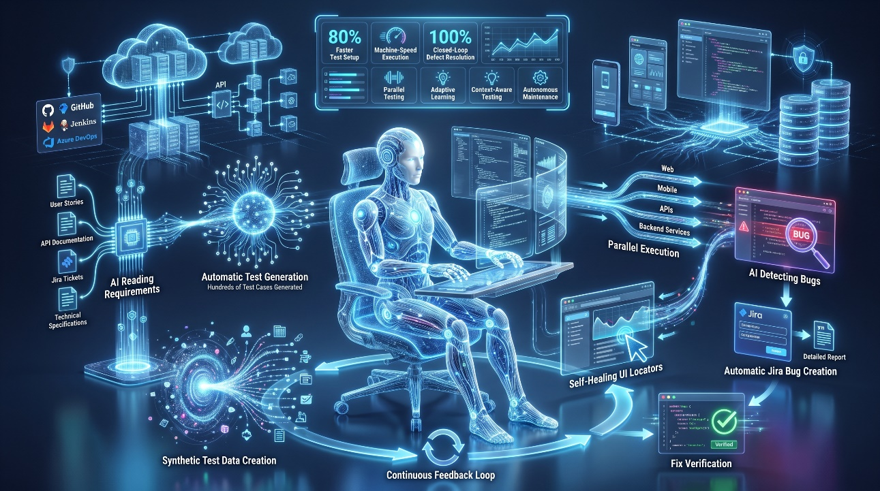
The QA Agent operates on a continuous four-phase Intelligent Validation Loop that covers the entire testing lifecycle from a single trigger:
📥 Phase 1 — Requirement Analysis & Cognitive Parsing
The QA Agent ingests raw project requirements — user stories, acceptance criteria, API specs, Jira tickets, Confluence docs — and performs deep semantic parsing to understand the full scope of what needs to be validated. It identifies functional boundaries, risk areas, business-critical workflows, and edge-case scenarios that manual testers often miss under deadline pressure. Output: a structured quality scope map that drives every subsequent phase.
⚙️ Phase 2 — Autonomous Test Case & Data Generation
From the quality scope map, the QA Agent autonomously generates comprehensive test cases covering: happy path flows, boundary value scenarios, negative input testing, integration contract scenarios, regression anchors, and chaos engineering edge cases. Simultaneously, it generates synthetic test data — realistic, privacy-safe datasets that target the specific boundary conditions identified in Phase 1. This phase alone eliminates 80% of the manual QA setup time in traditional workflows.
▶️ Phase 3 — Parallel Execution & Adaptive Validation
The QA Agent executes the full test suite using multi-threaded parallel execution — running hundreds of test cases simultaneously across unit, integration, functional, and regression layers. Unlike static scripts, the Agent is context-aware during execution: it adapts to UI changes using self-healing locator logic, adjusts test sequencing based on failure patterns, and applies adaptive learning from previous execution cycles to improve coverage focus in high-risk areas.
🔁 Phase 4 — Closed-Loop Defect Management & Fix Verification
When a defect is discovered, the QA Agent does not simply log a test failure. It creates a detail-rich bug report — complete with validation steps, expected vs. actual results, environment metadata, and log excerpts — and automatically files it in your bug tracker (Jira, Linear, etc.). When the development team pushes a fix, the Agent triggers targeted re-execution to verify the resolution and officially closes the defect loop. Zero manual chase. Zero dropped balls.
80% Faster Test Setup — AI parses requirements into executable test plans automatically
100% Closed-Loop Resolution — Every defect tracked from discovery through verified fix
∞ Parallel Execution — Hundreds of test cases run simultaneously, not sequentially
3. Testing Capabilities — What the QA Agent Covers
The QA Agent is not a single-method testing tool. It operates across the full testing spectrum:
| Testing Type | What the QA Agent Does | Key Differentiator vs. Traditional |
| Unit & Integration | Validates components and their interactions end-to-end | Auto-generates tests from code contracts and specs |
| Functional Testing | Validates every feature against defined requirements | Requirement-driven test generation, not script-writing |
| Regression Testing | Auto-reruns full suite on every code commit | CI/CD triggered, self-healing locators, zero maintenance |
| Edge Case Coverage | Generates boundary-value and chaos engineering scenarios | AI-predicted edge cases beyond manual imagination |
| Test Data Generation | Creates synthetic realistic datasets at scale | Privacy-safe, scalable, boundary-condition targeted |
| Parallel Execution | Runs hundreds of tests simultaneously | Minutes vs. days — feedback loop dramatically compressed |
| Bug Tracking | Auto-logs, tracks, and verifies fix resolution | Full closed-loop — no manual triage or developer chasing |
| Self-Healing | Adapts locators when UI elements change | Zero script maintenance on UI updates |
4. Cognitive Quality Intelligence — What Makes This Different
The term Cognitive Quality Intelligence is not marketing language. It describes three specific technical capabilities that separate the QA Agent from all prior automation approaches:
🔵 Adaptive Learning
The QA Agent analyzes patterns across test execution cycles — identifying which areas of the application have the highest defect density, which test scenarios have historically been fragile, and which code change types trigger the most regressions. It adapts its testing strategy with each cycle, increasing coverage focus where evidence suggests highest risk. Static automation scripts cannot do this — they execute the same tests regardless of what history has revealed.
🔵 Context Awareness
Traditional automation validates code behavior. The QA Agent validates user value delivery. Because it parses requirements before generating tests, it understands the business intent behind each feature — ensuring that tests verify not just that a function executes, but that it delivers the outcome the requirement specified. This closes the gap between “the code works” and “the feature works as intended.”
🔵 Autonomous Maintenance
In any active development environment, UI elements change constantly. Traditional automation requires a QA engineer to manually update every broken locator — a maintenance burden that consumes a significant portion of QA team capacity. The QA Agent’s self-healing locator engine detects UI changes, recalculates optimal locator strategies, and updates test scripts autonomously. Your CI/CD pipeline keeps moving. Your QA team stays focused on strategy, not script maintenance.
“Adaptive Learning + Context Awareness + Autonomous Maintenance = a testing system that gets smarter, more accurate, and lower-maintenance with every release cycle.”
5. CI/CD Integration — The QA Agent Inside Your Pipeline
The QA Agent is designed to be a native citizen of your CI/CD pipeline — not an external tool that runs independently. It integrates seamlessly with every major pipeline platform and triggers automatically on code commits:
GitHub Actions / GitLab CI / Jenkins / Azure DevOps — native pipeline trigger integration.
Every commit triggers the Agent: requirement-aware test selection, targeted execution, instant feedback.
Failure gates: configurable pass/fail thresholds that block promotion of unstable builds.
Real-time execution dashboards visible to devs, QA leads, and product stakeholders simultaneously.
Jira integration: defects auto-created, linked to the triggering commit, and assigned to the right owner.
Fix verification: when a dev pushes a fix branch, the Agent auto-triggers targeted regression and closes the Jira ticket on pass.
The result: developers get quality feedback in minutes, not days. QA teams spend time on strategic exploratory testing, not pipeline maintenance. Release managers get a live quality signal at every commit rather than a summary at the end of the sprint.
Human-in-the-Loop — The Strategic Partnership Model
A concern we hear from QA engineers when they first encounter the QA Agent: “Does this replace me?” The honest, considered answer is: it replaces the work that was never a good use of your expertise in the first place.
The QA Agent is designed for a Human-in-the-Loop model that allocates human QA expertise to where it genuinely cannot be replaced:
| Activity | QA Agent | Human QA Engineer |
| Requirement parsing | ✅ Autonomous | ✅ Strategic review & refinement |
| Test case generation | ✅ Autonomous | ✅ Approval of generated plan |
| Regression execution | ✅ Fully automated | 🔍 Anomaly investigation |
| Edge case coverage | ✅ AI-predicted | ✅ Domain-specific additions |
| Bug logging & tracking | ✅ Autonomous | 🔍 Priority & severity review |
| Exploratory testing | ❌ Not applicable | ✅ Irreplaceable human insight |
| UX & usability judgment | ❌ Not applicable | ✅ Deep user empathy required |
| Release sign-off | ⚡ Evidence package ready | ✅ Final approval decision |
| Test strategy design | 🔍 Data-informed suggestions | ✅ Expert architectural design |
The QA Agent handles the high-volume, repeatable, speed-critical work. Human engineers apply judgment, creativity, and domain expertise to the dimensions of quality that AI cannot replicate. Together, the output is better than either could achieve alone.
“The best QA teams of the next decade will not be the largest — they will be the ones who paired their human expertise with autonomous AI intelligence most effectively.”
The New Standard of Software Quality
Software testing has not fundamentally changed since the introduction of test automation frameworks two decades ago. The tools got faster and more expressive — but the model remained the same: humans write scripts, humans maintain scripts, humans manage bugs, humans decide when to release.
The ideyaLabs QA Agent breaks that model. For the first time, the full intelligence layer of software testing — requirement analysis, test design, adaptive execution, defect management, fix verification — runs autonomously, continuously, and at machine speed.
This is not the future of QA. It is the present — available today, on the ideyaLabs AiLabs platform, for teams ready to stop testing manually and start delivering with confidence.
Test Design to Release. Seamlessly. This is the QA Agent promise — and it is already in production for teams that chose to move first.
