

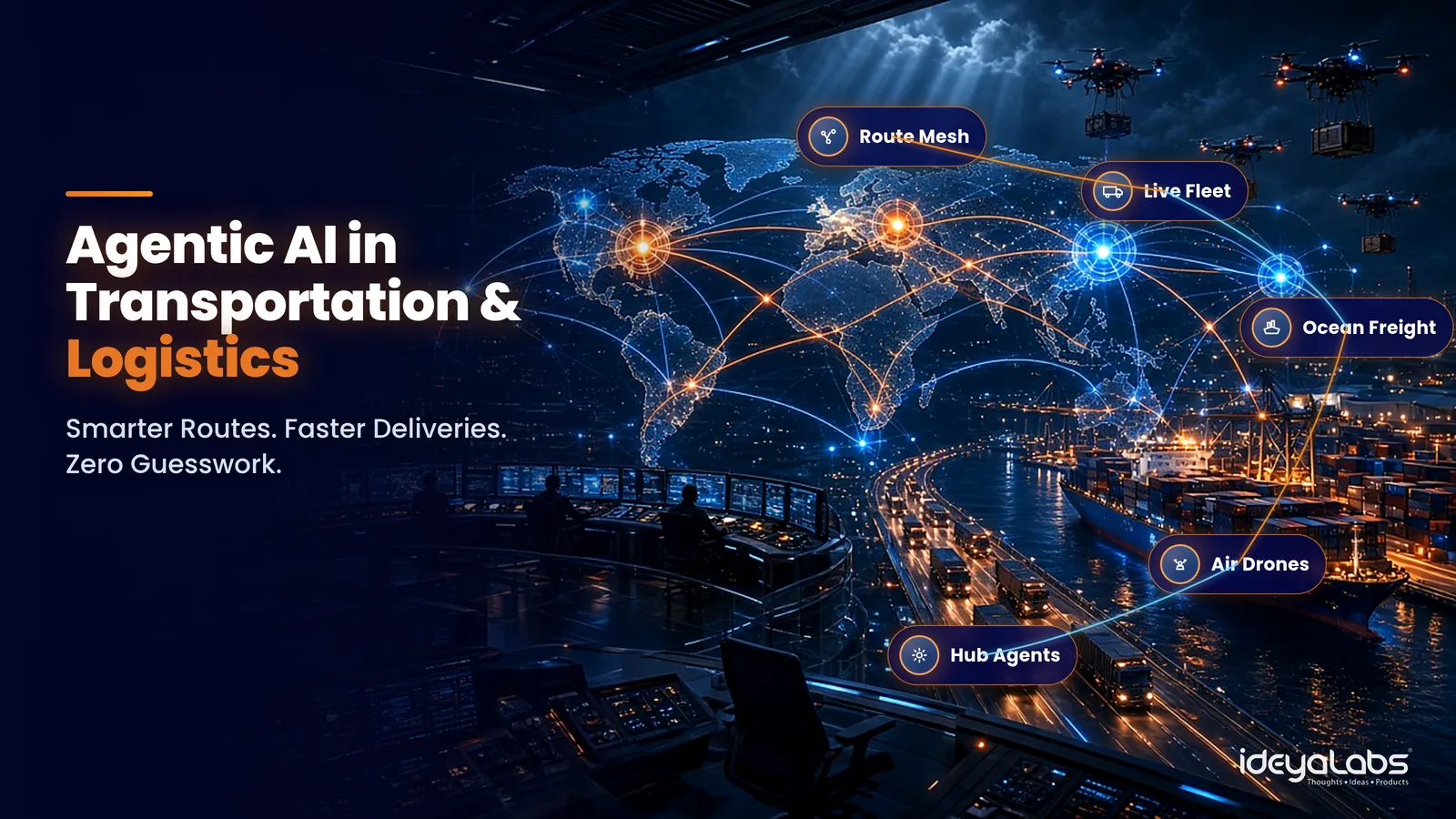
TL;DR: Agentic AI in Transportation & Logistics means AI agents that sense live network data, decide the next best action and execute inside systems such as TMS, WMS and ERP — within rules you set. Unlike rule bots, they pursue outcomes like on-time delivery or lower freight cost. Leading 3PLs already run dozens of agents. The winning pattern is governed autonomy with humans approving high-risk moves.
Last updated: November 6, 2026
What is agentic AI in transportation & logistics? Agentic AI in Transportation & Logistics is a system of specialised AI agents that monitor shipments, capacity, inventory and documents, then plan and act toward goals such as lower cost, reliable ETAs and clean billing. Agents work across TMS, WMS and carrier tools, escalate when rules break, and keep people accountable for spend, safety and customer promises.
Freight networks move too much data for dashboards alone. Planners chase exceptions. Brokers rekey quotes. Warehouses lose hours to gap time. That is why Agentic AI in Transportation & Logistics has become the practical next step after predictive analytics. Agents do not only alert. They complete defined work and hand hard cases to humans.
This guide explains the concept, compares traditional automation, maps use cases, shares verified examples and shows safe adoption. It also covers how ideyaLabs, an AI agent development company, helps logistics teams build governed multi-agent systems.
Key takeaways
- Agentic AI in Transportation & Logistics turns goals into multi-step actions across TMS, WMS, ERP and carrier channels.
- It differs from RPA because agents reason over context, choose tools and adapt when conditions change.
- High-ROI starts include ETA monitoring, freight exceptions, quoting, appointments, routing and warehouse gap management.
- Operators such as C.H. Robinson, DHL Supply Chain, Worldwide Express and CJ Logistics already run production agents.
- Governance beats raw autonomy: map each action to observe, prepare, execute or escalate.
- ideyaLabs agents help build, test, release, analyse and support logistics platforms without a black-box “do everything” bot.
Table of contents
- What is Agentic AI in Transportation & Logistics?
- How is agentic AI different from traditional logistics automation?
- How does Agentic AI in Transportation & Logistics work?
- What are the highest-value use cases?
- Which companies already use AI agents in logistics?
- What benefits should leaders expect?
- What challenges and guardrails matter?
- How do you adopt agentic AI step by step?
- How does ideyaLabs help logistics and transportation teams?
- FAQ
What is Agentic AI in Transportation & Logistics?
Agentic AI in Transportation & Logistics is the use of goal-driven AI agents that perceive operational data, reason across systems and take permitted actions to improve freight, warehouse and customer outcomes. A single agent may own quoting, exception clearing or ETA recovery. A multi-agent system splits roles and checks each handoff.
Deloitte describes agentic AI as an autonomous system that perceives its environment, decides and acts with limited human intervention, shifting work from task automation to outcome delegation. In logistics, that outcome might be “keep service level while cutting accessorial leakage,” not “open this ticket queue.”
Three traits make the model useful in transport networks:
- Goal orientation. Agents pursue measurable outcomes such as on-time delivery, clean invoices or faster tender acceptance.
- Tool use. They call TMS APIs, read contracts, check telematics, draft messages or update appointments.
- Bounded autonomy. Policy decides what runs alone, what needs review and what must stop for a named owner.
How is agentic AI different from traditional logistics automation?
Traditional automation executes fixed rules. Agentic AI plans multi-step work when the path is unclear. Rule engines and RPA excel at stable, structured steps. Freight reality is messier: carrier tariffs differ, weather moves ETAs, and invoices fail three-way match for many reasons. Agents handle that variability inside guardrails.
| Dimension | Traditional automation / RPA | Agentic AI in Transportation & Logistics |
|---|---|---|
| Trigger | If X, then Y | Pursue a goal when signals change |
| Context | Structured fields only | Contracts, events, messages and live status |
| Exception handling | Stops or opens a ticket | Diagnoses, proposes or resolves within policy |
| Adaptation | Breaks when UI or rules change | Retrieves new context and retries with limits |
| Human role | Maintain scripts and clear queues | Set policy, approve high risk, handle true exceptions |
| Example | Post a pre-mapped EDI status code | Requote, rebook or dispute an accessorial with evidence |
Trimble’s Transporeon team puts the contrast cleanly: automation books a carrier at a fixed rate, while agentic AI aims to optimise freight cost while holding service levels. That is the operating shift leaders should design for.
How does Agentic AI in Transportation & Logistics work?
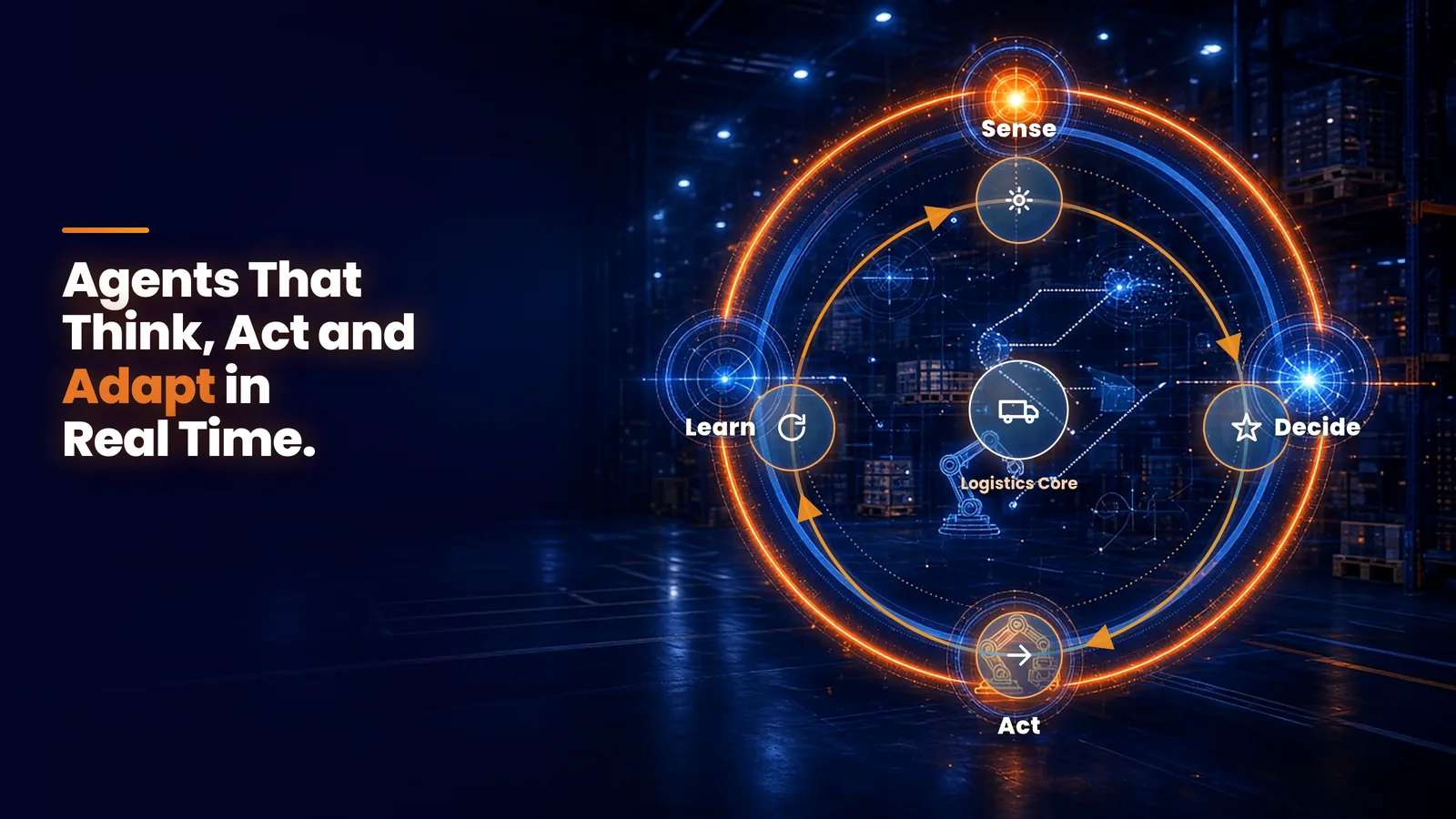
Most production designs follow a simple loop: sense, reason, act and escalate. The loop runs continuously on live operational data rather than on a nightly batch report.
1. Sense: connect the operational truth
Agents read TMS, WMS, ERP, EDI, telematics, weather and customer portals. Without reliable feeds, autonomy fails. McKinsey’s 2026 State of Digital Logistics Survey found nearly 90 percent of shippers already run at least one transportation AI use case, so data foundations are spreading even before full agent rollouts.
2. Reason: choose the next best action
The agent compares the goal with constraints such as contracted rates, service windows, carrier panels and safety rules. It may simulate options, score risk and produce a plain-language recommendation with evidence.
3. Act: write back into systems of record
Permitted actions include updating a shipment record, sending an approved reminder, matching an invoice, scheduling an appointment or opening a dispute. The best designs reuse the same APIs human operators use, so audit trails stay intact.
4. Escalate: keep humans on high-stakes moves
When data conflicts, spend crosses a threshold or a customer promise changes, the agent stops and routes a packaged case to a named owner. Shipflow’s control model — observe, prepare, execute, escalate — is a practical way to assign authority per action rather than one global “auto” switch.
What are the highest-value use cases for AI agents in logistics?
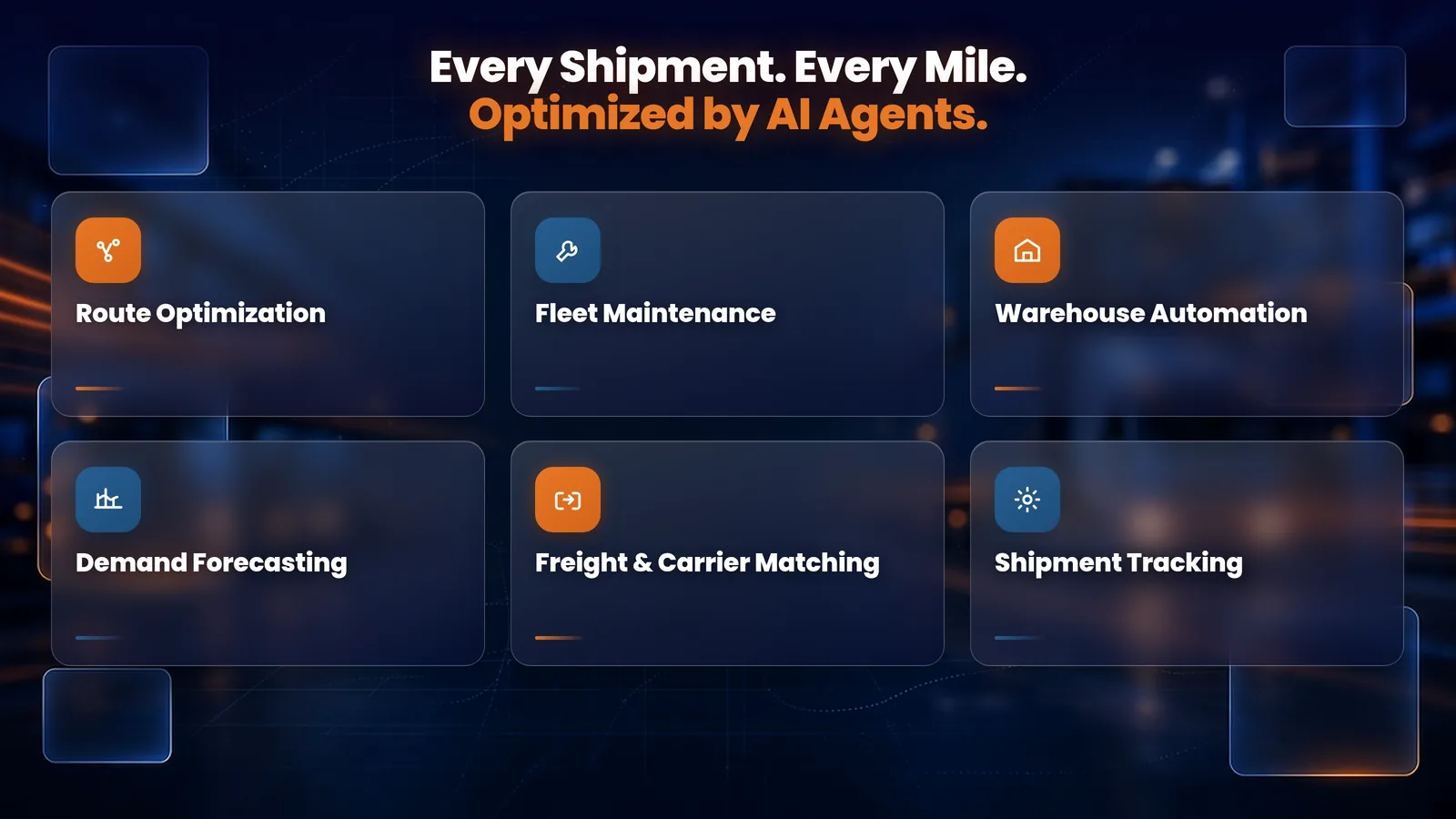
For Agentic AI in Transportation & Logistics, start where volume is high, rules are documentable and value is measurable. Transporeon’s Transportation Pulse Report 2026 highlights ETA monitoring, tendering and routing as strong entry points for shippers and carriers. Below are the use cases that show up most often in production stories.
Freight quoting, planning and capacity
Agents price loads, match capacity, consolidate shipments and secure cover in seconds instead of hours. This is central to freight brokerage workflows where margins are thin and response speed wins the tender.
Real-time ETA monitoring and disruption recovery
Track-and-trace agents — a core Agentic AI in Transportation & Logistics use case — watch deviations, temperature excursions, missed pickups and theft risk. McKinsey notes that connecting detection to intervention cuts stalled loads and manual follow-ups. Agents can propose reroutes or carrier swaps inside approved panels.
Freight bill exceptions and settlement
Invoice matching, pricing variance and accessorial validation are ideal specialised agents inside Agentic AI in Transportation & Logistics. They retrieve carrier tariffs, compare charges with shipment events and write an explainable resolution note for FinOps review.
Appointments, calls and warehouse coordination
In Agentic AI in Transportation & Logistics programmes, voice and messaging agents schedule dock appointments, chase drivers and coordinate priority warehouse work. Humans then focus on relationship work and true exceptions rather than repetitive dialling.
Warehouse productivity and daily management cadence
Warehouse agents can surface gap time, coach supervisors and audit compliance using WMS and sensor data. The win is a tighter morning operating rhythm, not a dashboard that nobody opens.
Customer shipment support
Support agents for Agentic AI in Transportation & Logistics answer “where is my shipment?” across email, chat and voice by reading live status and policy docs. They escalate billing or claims disputes with a draft reply and full context.
Which companies already use AI agents in logistics?
Agentic AI in Transportation & Logistics is already in production at major operators, not only in slideware. These examples are useful because they name the workflow and the measured result.
- C.H. Robinson: Transport Topics reported more than 30 AI agents handling millions of freight tasks across pricing, planning, appointments, matching, tracking, documents and invoicing. Mark Albrecht said agentic systems helped push automation past 90 percent on workflows that previously stalled around 50–60 percent.
- DHL Supply Chain: With HappyRobot, DHL uses agents for routine phone and email work, including driver follow-ups and appointment scheduling, so staff become “guardians of exception.”
- Worldwide Express: An AWS Machine Learning Blog case study describes a multi-agent Amazon Bedrock solution inside the SpeedShip TMS. In six months, active exceptions fell about 75 percent ($15M to $4M backlog), with $1M annual savings, ~$10M unlocked cash and ~10,000 weekly closures under 1 percent error.
- CJ Logistics America: OneTrack reports agentic AI across 40+ warehouses with 45 percent less gap time and 18 percent more units per hour.
- North American retail network (Locus): An agentic TMS decision layer across ocean, rail, yard and last mile delivered more than $1M in savings while keeping ERP and WMS as systems of record.
Adoption of Agentic AI in Transportation & Logistics is broadening. McKinsey’s 2026 survey found a third of shippers already run five or more transportation AI use cases, and 88 percent say results met or exceeded expectations. Trimble cites Gartner: by 2030 half of supply chain solutions should include autonomous decision-making, yet only about 1 percent of shippers use advanced autonomous TMS decision-making today.
What benefits should transportation leaders expect?
The benefits of Agentic AI in Transportation & Logistics show up as faster cycle times, lower leakage and better use of scarce planners. Exact ROI for Agentic AI in Transportation & Logistics depends on data quality and a tight first workflow.
- Speed: quotes, appointments and exception notes move from hours or days to seconds or minutes.
- Cash and cost: cleaner settlement and fewer expedites free working capital, as Worldwide Express showed.
- Service reliability: continuous ETA watch reduces late surprises for customers and stores.
- Labour leverage: people spend time on negotiation, safety and unusual cases instead of rekeying.
- Auditability: good agents leave evidence for every automated decision, which finance and compliance need.
AWS ProServe’s A*STAR ARTC Logistics Agent work reported up to 50 percent less manual lookup work and a 3–5 percent expedite-cost target. Prove those numbers on your own baseline before you scale.
What challenges and guardrails matter for agentic AI?
The hardest part of Agentic AI in Transportation & Logistics is not the model. It is authority, data and recovery. Logistics Business argues oversight fails when leaders treat “the AI” as one switch instead of dozens of decisions with different blast radii.
Common challenges
- Data readiness: siloed TMS, WMS and carrier files produce wrong actions.
- Rubber-stamp approvals: hundreds of daily clicks train people to approve without reading.
- Unclear ownership: shared inboxes are not controls; every escalation needs a named owner and backup.
- Workforce tools: agents that assign or score people can trigger stricter employment and AI rules, especially in the EU.
- Cost drift: many model calls without observability can erase the savings case.
Guardrails that work in production
- Map each action to observe, prepare, execute or escalate.
- Require human approval for spend, customer promise changes, safety and compliance.
- Log every tool call, recommendation and override.
- Package escalations with evidence, alternatives and a recommended next step.
- Test a manual fallback before go-live, including who can shut the agent off for a site.
- Measure automation rate, error rate, override rate and time-to-cash — not vanity chat metrics.
How do you adopt Agentic AI in Transportation & Logistics?
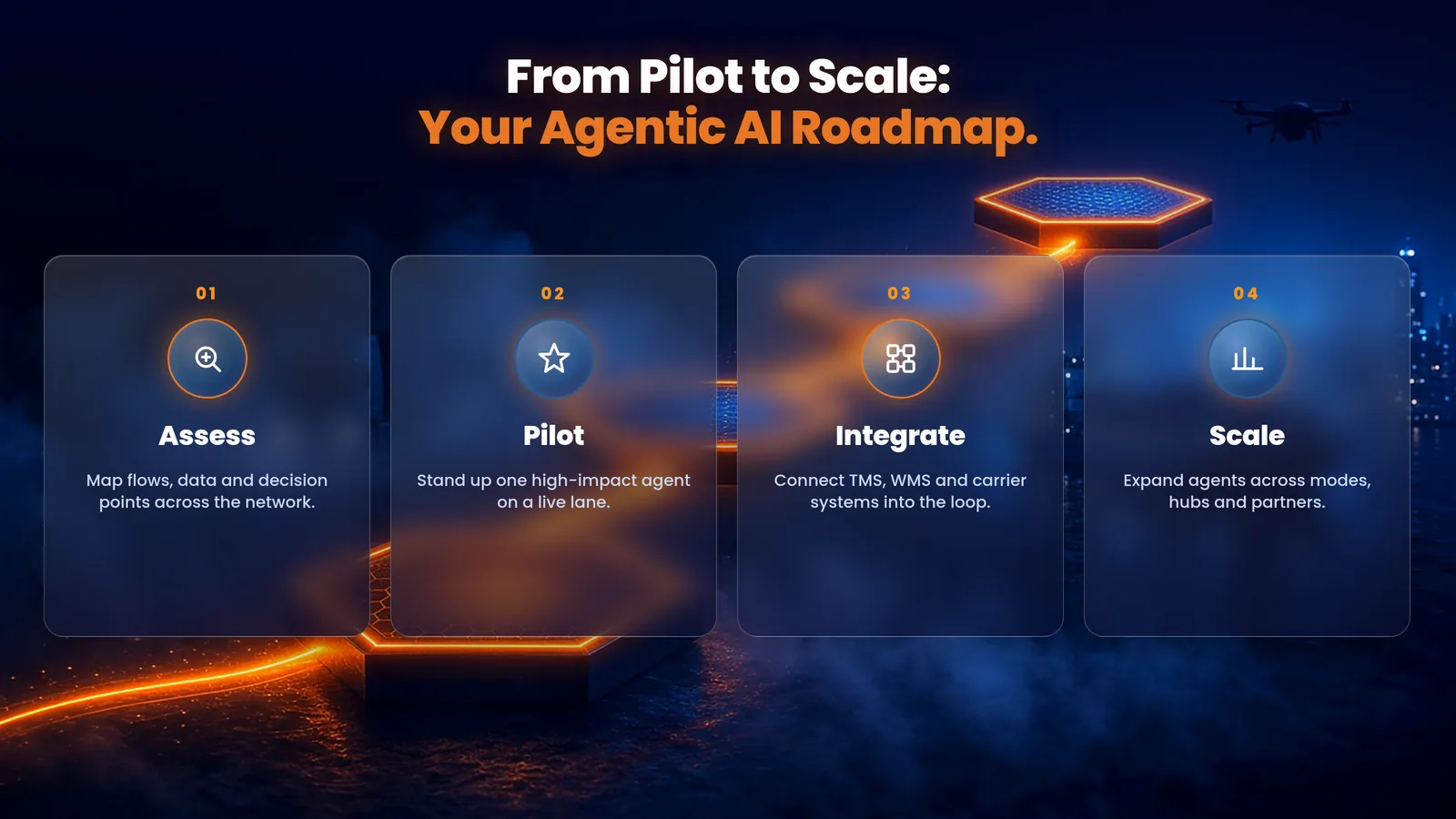
Adopt one workflow, prove accuracy, then expand. Trimble’s roadmap — data readiness, sandboxed pilots, governance, network connectivity and human capability — is a solid backbone. Here is a practical sequence for freight and warehouse teams.
- 1. Pick a painful, measurable workflow. Freight exceptions, ETA recovery or appointment scheduling beat vague “AI for logistics” programmes.
- 2. Baseline the metrics. Capture cycle time, error rate, backlog dollars and planner hours before any agent acts.
- 3. Define autonomy levels in writing. List every action and its approval rule with numeric thresholds.
- 4. Pilot in a sandbox with human approval default. Raise automation only after accuracy holds, as Worldwide Express did once accuracy passed 99 percent.
- 5. Instrument overrides. Every rejection should improve prompts, policies or knowledge bases.
- 6. Scale by role, not by hype. Add specialised agents (matching, pricing, accessorials) under an orchestrator instead of one mega-agent.
- 7. Train the floor. Managers must know what data the agent reads, where it fails and how to recover manually.
How does ideyaLabs help logistics and transportation teams?
ideyaLabs is an AI agent development company that builds custom multi-agent systems and ships a family of specialised agents under the AiLabs platform. For transportation and logistics organisations, the usual need is twofold: run safer agentic workflows on top of TMS, WMS and ERP, and ship the software that powers those networks faster.
For Agentic AI in Transportation & Logistics, we do not claim a single magic “logistics autopilot.” Instead, we combine governed custom agents for your operating processes with productised agents that accelerate platform engineering, analytics and support.
Build and orchestrate the logistics agent layer
The Head Engineer Agent acts as a technical orchestrator for multi-agent workflows. It helps govern handoffs, so quoting, exception and tracking agents share context instead of creating new silos. Custom agents can sit on your existing TMS and WMS APIs — the same integration-first pattern logistics teams prefer when rip-and-replace is off the table.
Ship TMS, rating and dispatch software faster
Logistics platforms change constantly with new carrier rules, pricing engines, EDI maps and portals. The DEV Agent accelerates full-stack delivery. The PR Agent reviews pull requests with codebase context, secret checks and low-noise fixes. The QA Agent turns requirements into cases, runs parallel suites and files defects. The DevOps Agent unifies CI/CD, policy gates, progressive rollouts, AI root-cause analysis and DORA metrics for 24/7 freight systems.
Keep docs, infra and prompts in sync
The DOC Agent regenerates business and technical docs as code changes — critical when rating logic and APIs evolve weekly. The Infra Agent helps turn infrastructure intent into resilient deployments. Auto Prompt Engine turns tickets and design context into ready coding prompts.
BI Agent for logistics analytics
The BI Agent converts natural-language questions into dashboards, anomaly alerts and executive reports. Transportation leaders can ask about on-time performance, exception backlog, lane cost or warehouse units per hour without waiting on a manual BI queue. It connects structured sources and supports a human approval step before dashboards go live.
CSX Agent for shipment support
The CSX Agent (customer support / CX intelligence on the AiLabs platform) handles omnichannel shipment and service questions across voice, email, chat and collaboration tools. It retrieves answers from product docs, portals and internal knowledge, drafts tone-consistent replies, and escalates low-confidence or high-risk cases to humans with context attached. That fits “where is my order?” volume that drains control-tower teams.
Across these agents, ideyaLabs emphasises shared context, auditability and human checkpoints before agents touch money, capacity or customer promises.
FAQ: Agentic AI in Transportation & Logistics
What is Agentic AI in Transportation & Logistics?
Agentic AI in Transportation & Logistics is a system of specialised AI agents that monitor shipments, capacity, inventory and documents, then plan and act toward goals such as lower cost, reliable ETAs and clean billing within human-defined guardrails.
How is agentic AI different from RPA in logistics?
RPA follows fixed scripts for stable steps. Agentic AI reasons over changing context, chooses tools and completes multi-step goals such as resolving a freight exception or recovering an ETA, while escalating when policy requires a person.
What are the best first use cases?
Strong first use cases include ETA monitoring and disruption recovery, freight bill exceptions, quoting and tendering, dock appointment scheduling, warehouse gap-time coaching and shipment status support.
Which companies use AI agents in logistics today?
Public examples include C.H. Robinson’s 30-plus freight agents, DHL Supply Chain’s voice and email agents with HappyRobot, Worldwide Express’s multi-agent exception automation on Amazon Bedrock, and CJ Logistics America’s warehouse agents across more than 40 sites.
Will agentic AI replace planners and dispatchers?
No. Agents absorb repetitive execution. Planners, dispatchers and FinOps teams set policy, approve high-risk actions and handle unusual cases. Roles shift toward orchestration and exception judgment.
What guardrails should we put in place first?
Define autonomy per action, require approval for spend and customer promises, keep full audit logs, name escalation owners, and rehearse a manual fallback before raising automation rates.
How can ideyaLabs help a transportation team start?
ideyaLabs builds custom governed agents for logistics workflows and provides productised agents for development, review, testing, DevOps, analytics and customer support so teams can launch safely on existing TMS, WMS and ERP systems.
Ready to put agents to work in your network?
Agentic AI in Transportation & Logistics rewards teams that start narrow, measure honestly and govern every action. If you want help designing the first agent for Agentic AI in Transportation & Logistics, wiring it to your stack and keeping humans in control, ideyaLabs can partner from pilot to scale.
