01
Always-on trip intelligence
AiLabs Agents · real-time monitoring
Continuous status monitoring detects ETA drift, delay anomalies, and route behavior patterns so teams can intervene before service impact expands.




ideyaLabs designed an AI agent strategy spanning trip operations, planning, billing, settings, and platform sync. Using AiLabs Agents, the team translated live workflow friction into a phased roadmap of autonomous, semi-autonomous, and always-on agents with explicit human confirmation paths where risk required it.
13
Operational agents designed from live backlog evidence
Agent opportunities were mapped directly to shipping and billing workflow behaviors that already existed in delivery tickets.
5
Domains orchestrated under one agent strategy
Trip operations, planning/cargo, billing, settings/rates, and platform orchestration were modeled as one connected system.
1,500+
Tickets analyzed to ground agent scope and rollout
Prioritization was based on concrete delivery artifacts, not speculative automation narratives.

Teams were already producing rich operational events, status transitions, and queue data, but many interventions still depended on manual review cycles and disconnected handlers. That gap created avoidable delay in recovery, escalation, synchronization, and financial follow-through.
The goal was to operationalize agent behavior where it was provable and safe: observe, decide, act, and confirm with policy-aware human oversight when business impact justified a checkpoint.
The team used AiLabs Agents to classify opportunities by autonomy level and rollout dependency. Instead of building a generic assistant, ideyaLabs scoped each agent to concrete workflow boundaries, explicit tool calls, and measurable operational outcomes.
Continuous status monitoring detects ETA drift, delay anomalies, and route behavior patterns so teams can intervene before service impact expands.
Agent flows chain retrieval, eligibility checks, ranked options, and action preparation while preserving explicit human confirmation for high-stakes decisions.
Stateful cargo watchdog behaviors track gate-cut windows, designation gaps, and elapsed follow-up intervals with targeted escalation logic.
Clear-match billing entries can be auto-resolved while ambiguous items are escalated with evidence, reducing queue load and preserving control.
A central transition coordinator executes downstream side effects in the correct sequence, improving consistency across sync, shipment writes, and notifications.
Scheduled report generation is coupled with pre-delivery data validation to prevent silent propagation of mismatched operational summaries.
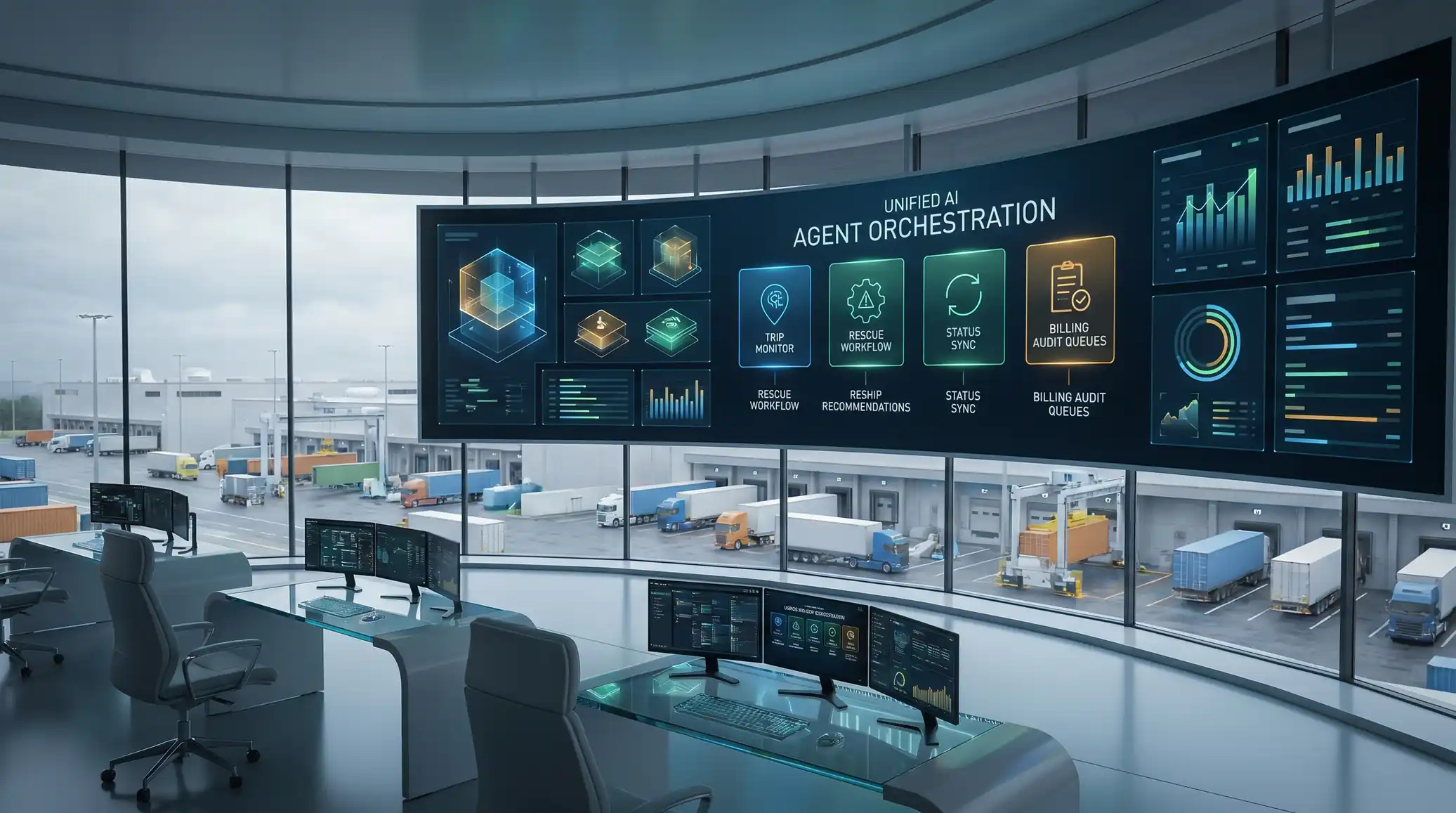

Success criteria focused on operational decision speed, exception quality, and cross-domain consistency between trip execution, billing controls, and recap reporting.
Tiered
Roadmap reduced delivery risk through dependency-aware sequencing
Agent rollout aligned to API readiness and upstream epic completion, preventing premature automation in unstable areas.
Queue focus
Human reviewers shifted toward exception handling
Routine decision patterns were candidates for autonomous or semi-autonomous handling, preserving expert attention for ambiguous cases.
End-to-end
Operational continuity improved across trip, billing, and reporting
A unified orchestration model reduced handoff gaps between status transitions, finance actions, and recap reporting.
Partner with ideyaLabs and AiLabs Agents to design transportation agents with clear autonomy boundaries, governance checkpoints, and measurable operational impact.
Talk to our team