

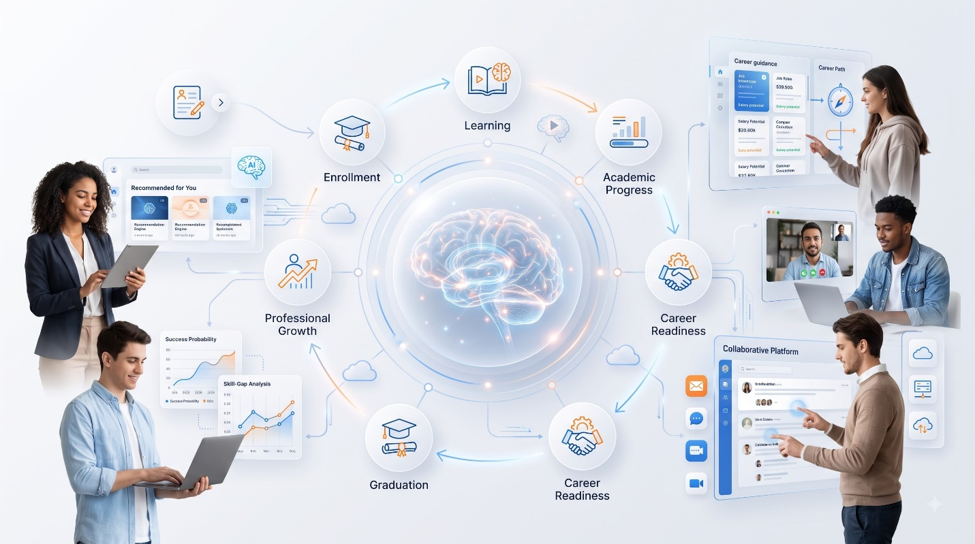
The education experience is evolving beyond traditional classrooms, learning management systems, and examinations. Today, a learner’s journey can begin with discovering an educational program and continue through application, enrollment, academic progress, career preparation, graduation, and professional development.
However, these stages are often supported by different systems, platforms, teams, and communication channels.
This creates a fragmented learner experience.
AI-powered e-learning software can help connect these experiences into one intelligent, personalized, and continuous learner journey.
Instead of treating admissions, academics, student support, career services, and post-graduation engagement as separate processes, organizations can use AI-powered orchestration to connect them into a unified ecosystem.
The Challenge of a Fragmented Learner Experience
Modern learners interact with numerous systems throughout their educational journey.
These can include:
- Admissions and application platforms
- Student information systems
- Learning platforms
- Academic planning tools
- Financial aid systems
- Communication platforms
- Student support services
- Career services
- Analytics and reporting systems
When these systems operate independently, learners may experience disconnected interfaces, inconsistent communication, limited personalization, and delays in receiving the right support.
The PPT identifies challenges such as confusing interfaces across platforms, poor learning materials, weak career preparation, technical failures, scheduling problems, administrative issues, and gaps in readiness.
The opportunity is to move from fragmented digital experiences toward a connected learner ecosystem.
What Is AI-Powered E-Learning Orchestration?
AI-powered orchestration brings different systems, data sources, workflows, and learner interactions together through an intelligent coordination layer.
The objective is not simply to add an AI chatbot to an existing learning platform.
Instead, AI can become part of the broader learner lifecycle.
It can help coordinate:
Application → Enrollment → Learning → Academic Progress → Career Preparation → Graduation → Professional Growth
This approach creates a more seamless experience while allowing institutions to deliver personalized guidance throughout the learner journey.
The PPT describes this model as an AI-powered orchestration hub supporting the learner from application through career, with personalized guidance, multi-channel experiences, AI-enabled intelligence, and 360-degree integration.
Connecting the Complete Learner Lifecycle
An effective e-learning ecosystem should support learners at every major stage.
1. Application and Lead Engagement
The journey begins before enrollment.
AI-enabled systems can support lead generation, lead qualification, initial communication, nurturing, application submission, and decision-making.
This creates an opportunity to provide relevant information based on the learner’s interests and stage in the journey.
2. Enrollment and Onboarding
After admission, learners need clear guidance about enrollment, financial aid, orientation, academic requirements, and institutional processes.
An integrated platform can bring these interactions together and provide timely alerts, reminders, and personalized guidance.
3. Academic Progress
Once learners begin their academic journey, the ecosystem can support course planning, learning materials, assignments, attendance, academic performance, and progress tracking.
AI can help identify patterns that may require additional support.
4. Personal and Academic Support
Learners may face academic, financial, personal, or other challenges during their education.
An intelligent ecosystem can help identify situations requiring intervention and route cases to the appropriate advisors or support teams.
5. Career Preparation
Career development should not be treated as an activity that begins only immediately before graduation.
The learner journey can incorporate career exploration, skill development, internships, resume building, interview preparation, job-search strategies, and professional planning.
6. Graduation and Career Transition
The ecosystem can continue supporting learners through graduation readiness and the transition from education to employment or further study.
7. Lifelong Professional Development
The journey can continue beyond graduation through certifications, specialization, advanced education, mentoring, leadership development, and continuous upskilling.
This creates a long-term learner relationship rather than a limited educational transaction.
Personalized Learning With AI
Every learner has different abilities, goals, learning patterns, and career aspirations.
A modern AI-powered e-learning platform can use learner data and interactions to provide more personalized experiences.
AI can support:
- Personalized learning pathways
- Recommended learning resources
- Adaptive content
- Practice questions
- Flashcards and quizzes
- Skill-gap identification
- Readiness assessments
- Personalized alerts
- Career recommendations
The PPT specifically identifies adaptive learning content generation, including flashcards and quizzes, as well as career persona recommendations and other AI-driven capabilities.
This allows learning experiences to become more responsive to individual learner needs.
Predictive Intelligence for Better Outcomes
AI can also help institutions move from reactive support toward proactive intervention.
Traditional systems often identify problems after a learner’s performance has already declined.
Predictive intelligence can analyze patterns and identify potential risks earlier.
The PPT includes predictive risk modeling for dropout and academic success, along with other intelligent capabilities.
For example, an intelligent system could identify patterns indicating that a learner may need additional academic support.
The appropriate advisor or support team can then intervene earlier.
This creates a more proactive approach to learner success.
Adaptive Learning Experiences
A traditional digital learning experience may provide the same content and pathway to every learner.
AI-powered e-learning can support a more adaptive model.
Based on learner progress and requirements, the platform can recommend appropriate resources, generate practice content, and adjust learning pathways.
This can help learners focus on areas where they need the most attention.
The objective is to make learning more personalized, responsive, and outcome-focused.
Connecting Learning With Career Readiness
One of the strongest concepts in the PPT is the connection between academic learning and career outcomes.
The learner lifecycle includes career exploration, goal setting, resume development, personal branding, job-search strategy, internship or co-op experience, interview preparation, offer evaluation, and transition into professional life.
AI-powered e-learning software can help connect these activities with the learner’s academic journey.
For example:
Academic Skills → Skill Gaps → Career Goals → Recommended Development → Career Readiness
This creates a more outcome-focused education experience.
Multi-Channel Learner Engagement
A connected learner ecosystem needs more than a single communication channel.
Learners may interact through web applications, mobile applications, email, SMS, push notifications, and other digital experiences.
The architecture described in the PPT includes a multi-channel nudging engine and intelligent case routing for advisors and counselors.
This can help organizations deliver:
- Academic reminders
- Important notifications
- Personalized recommendations
- Support messages
- Career opportunities
- Event information
- Case-management updates
The goal is simple:
Deliver the right information to the right learner at the right time.
Integrating Multiple Education Systems
AI cannot deliver a truly connected learner experience if it operates in isolation.
The underlying ecosystem needs to integrate with existing institutional technology.
The PPT architecture includes integrations across student information systems, financial aid, academic planning, CRM and case management, communication systems, data platforms, and AI services.
An API-first integration approach can help connect these systems while allowing organizations to continue using their existing technology investments.
This creates a unified digital ecosystem rather than forcing every function into a single application.
Data as the Foundation of Intelligent E-Learning
AI-powered personalization depends on reliable and connected data.
The architecture outlined in the PPT includes operational data stores, analytics platforms, data lakes or warehouses, and ETL/ELT pipelines.
The platform can bring together different categories of learner information to support intelligent decision-making.
This creates a continuous flow:
Data → Analysis → Intelligence → Recommendation → Action
With the right data foundation, AI can support use cases such as:
- Predictive risk analysis
- Academic performance insights
- Adaptive learning
- Readiness scoring
- Career recommendations
- Personalized interventions
AI and Decision Intelligence
The AI and decisioning layer can become the intelligence engine of the ecosystem.
The PPT identifies technologies and capabilities across machine learning, NLP models, cloud AI platforms, model training, inference services, and intelligent notifications.
This layer can transform raw learner information into actionable intelligence.
Instead of simply showing data on dashboards, the system can help answer questions such as:
What is happening?
Why is it happening?
What should happen next?
Who needs support?
What action can improve the outcome?
This is where AI-powered orchestration can create value beyond traditional reporting and analytics.
Security and Compliance
Education ecosystems handle sensitive learner information.
Therefore, security, privacy, access control, and compliance need to be incorporated into the architecture from the beginning.
The PPT references FERPA, HIPAA for clinical contexts, GDPR, role-based access control, end-to-end encryption, audit logging, and monitoring.
A modern e-learning ecosystem should therefore combine AI capabilities with strong security and responsible data-management practices.
Supporting Learners Beyond Graduation
A significant opportunity for e-learning software is extending the relationship beyond graduation.
The learner lifecycle presented in the PPT includes early-career development, specialization, certifications, advanced degrees, leadership opportunities, research, mentoring, and professional influence.
This creates the foundation for a lifelong learning ecosystem.
Organizations can continue supporting learners through:
- Continuous upskilling
- Professional certifications
- Career development
- Advanced learning
- Mentoring
- Leadership development
- Industry-aligned education
Education can therefore evolve from a fixed period of study into a continuous professional-development journey.
The Future of E-Learning Is Intelligent and Connected
The next generation of e-learning software will not be defined only by online courses or digital classrooms.
It will be defined by how effectively technology connects the complete learner experience.
AI-powered orchestration can bring together:
🎓 Learner Experience
🤖 Artificial Intelligence
📊 Data & Analytics
🔗 System Integration
📚 Personalized Learning
💼 Career Readiness
🔄 Lifelong Engagement
Together, these capabilities can create a more connected, intelligent, and outcome-focused education ecosystem.
How ideyaLabs Can Help
At ideyaLabs, we help organizations build and modernize digital solutions using technologies across software engineering, AI/ML, data, cloud, QA and automation, and digital transformation.
Our e-learning software development capabilities can support organizations looking to create intelligent learning platforms, connected learner experiences, AI-powered personalization, analytics-driven decision-making, and integrated education ecosystems.
The goal is not simply to digitize existing processes.
The goal is to create smarter digital experiences that improve how learners engage, learn, progress, and prepare for their future.
🌐 Explore ideyaLabs E-Learning Software Development Services:
https://www.ideyalabs.com/elearning-software-development-services/
Conclusion
The future of education is moving toward experiences that are connected, personalized, predictive, and lifelong.
AI-powered e-learning software can help organizations connect the learner journey from the first interaction through enrollment, academics, career preparation, graduation, and professional growth.
Instead of disconnected systems and isolated touchpoints, institutions can build an intelligent ecosystem where data, AI, learning, support, and career development work together.
The result is a shift from simply delivering education to creating a continuous learner journey focused on long-term success.
The future of e-learning isn’t just smarter learning.
It’s a smarter, connected journey for every learner.
