

US fleet leaders often start fleet management software development when tracking, duty logs and shop work live in separate tools. Dispatch sees one map. Meanwhile, safety reviews another portal. Then finance rebuilds IFTA numbers by hand. So the team needs one live vehicle and driver record, not another isolated app.
Fleet management software development is the work of designing and building that record. US carriers, private fleets and service operators can use this guide for features and US rules. It also covers build versus buy choices, AI agents, process and partner checks. It does not repeat our broader logistics build playbooks.
Quick answer
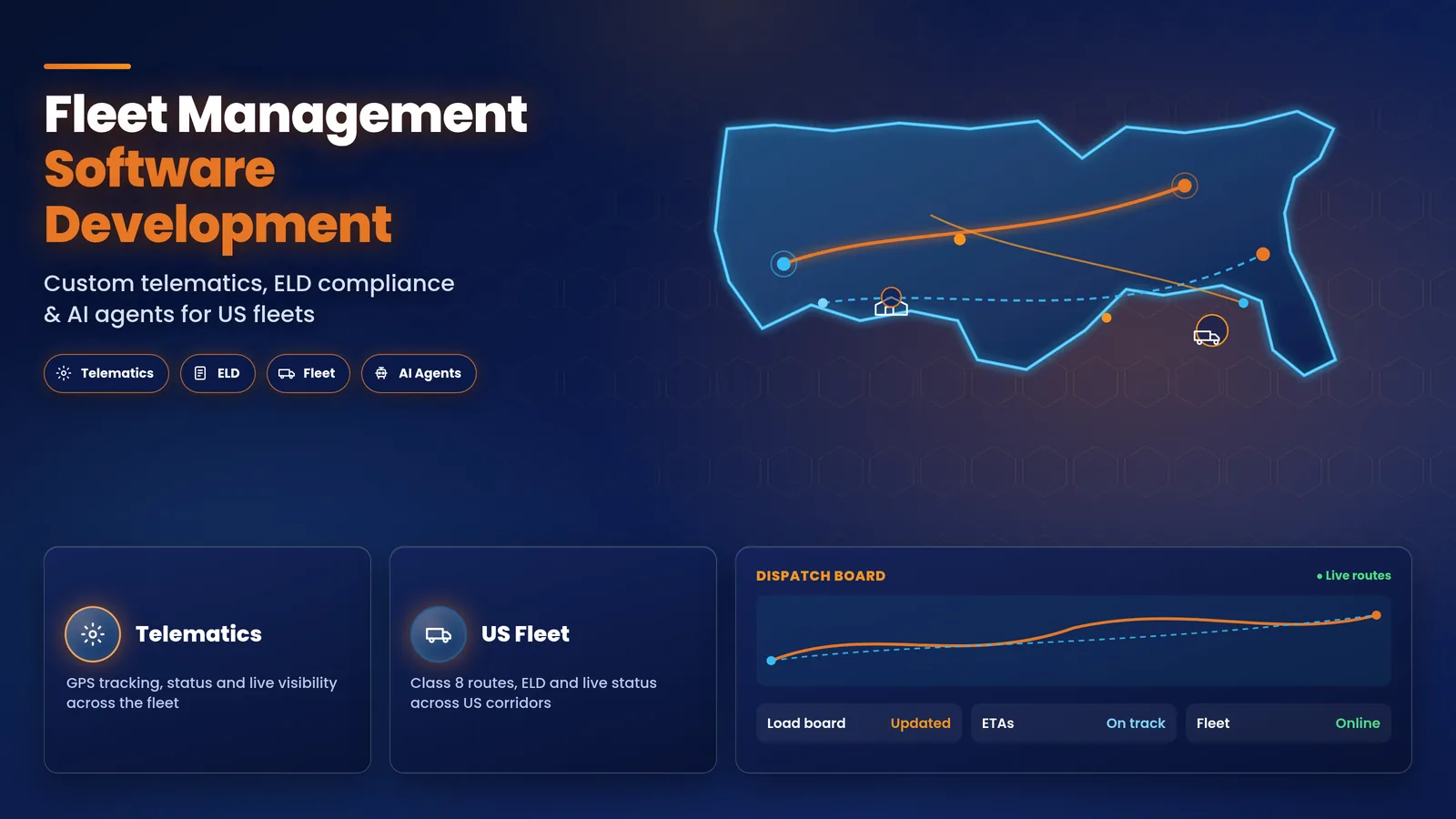
Fleet management software development is the process of designing, building and integrating custom software for US fleets. The work covers GPS and telematics, ELD and hours of service, maintenance, fuel, driver safety, dispatch and IFTA reporting. Then the platform keeps vehicles, drivers and records on one live view.
Last updated: November 2026
What should US buyers know before starting fleet management software development?
US buyers should treat fleet management software development as a rules and operations project, not a simple map app. Demand proof of ELD, hours of service and telematics work. Then start with one module and a written pilot plan.
Key takeaways
- Vehicles, drivers, duty status, maintenance and fuel should share one record.
- US plans should cover FMCSA hours of service, ELD rules, DVIR and IFTA reporting.
- Off-the-shelf platforms such as Samsara, Geotab or Motive can be enough for standard tracking.
- Custom work fits when dispatch rules, maintenance logic or partner links do not match a packaged product.
- Integrate telematics, ELD and fuel feeds early, because device and partner testing often take longer than screens.
- Pilot one terminal or vehicle group before a fleet-wide rollout.
What will US fleet teams learn in this guide?
US fleet teams can use this guide to compare features, US rules and build versus buy choices. It also covers AI agents, tech stack, delivery steps, case studies and a 10-question FAQ.
- What is fleet management software development?
- Which core features should fleet management software include?
- Should you build custom fleet software or buy an off-the-shelf platform?
- How can AI agents help fleet management?
- Which tech stack and integrations matter for US fleets?
- How does the development process work?
- How do you choose a fleet software development company in the USA?
- Which results do anonymized fleet case studies show?
- What questions do US buyers ask most?
What is fleet management software development?
Fleet management software development is the process of designing and building software for US fleets. The software helps teams track vehicles, manage drivers and run dispatch from one record. The finished system usually includes web dashboards, field apps, APIs and feeds from GPS, ELD and fuel sources.
Fleet software is not only a live map. In practice, it must survive weak signal, device outages and peak GPS load. The software must also show hours of service limits before a load is assigned. Then maintenance, fuel and safety events should land on the same vehicle ID.
Telematics hardware collects location, engine and duty data. Fleet software turns that data into workflows for dispatchers, safety leads, shop teams and finance. So a strong build joins those roles instead of adding another portal.
Pro tip: Scope the first release around one painful workflow, such as duty status, inspections or shop work orders. Then add more modules only after the first metrics improve.
In short: fleet management software development builds one shared record for vehicles, drivers and rules, not a stand-alone tracking screen.
Which core features should fleet management software include?
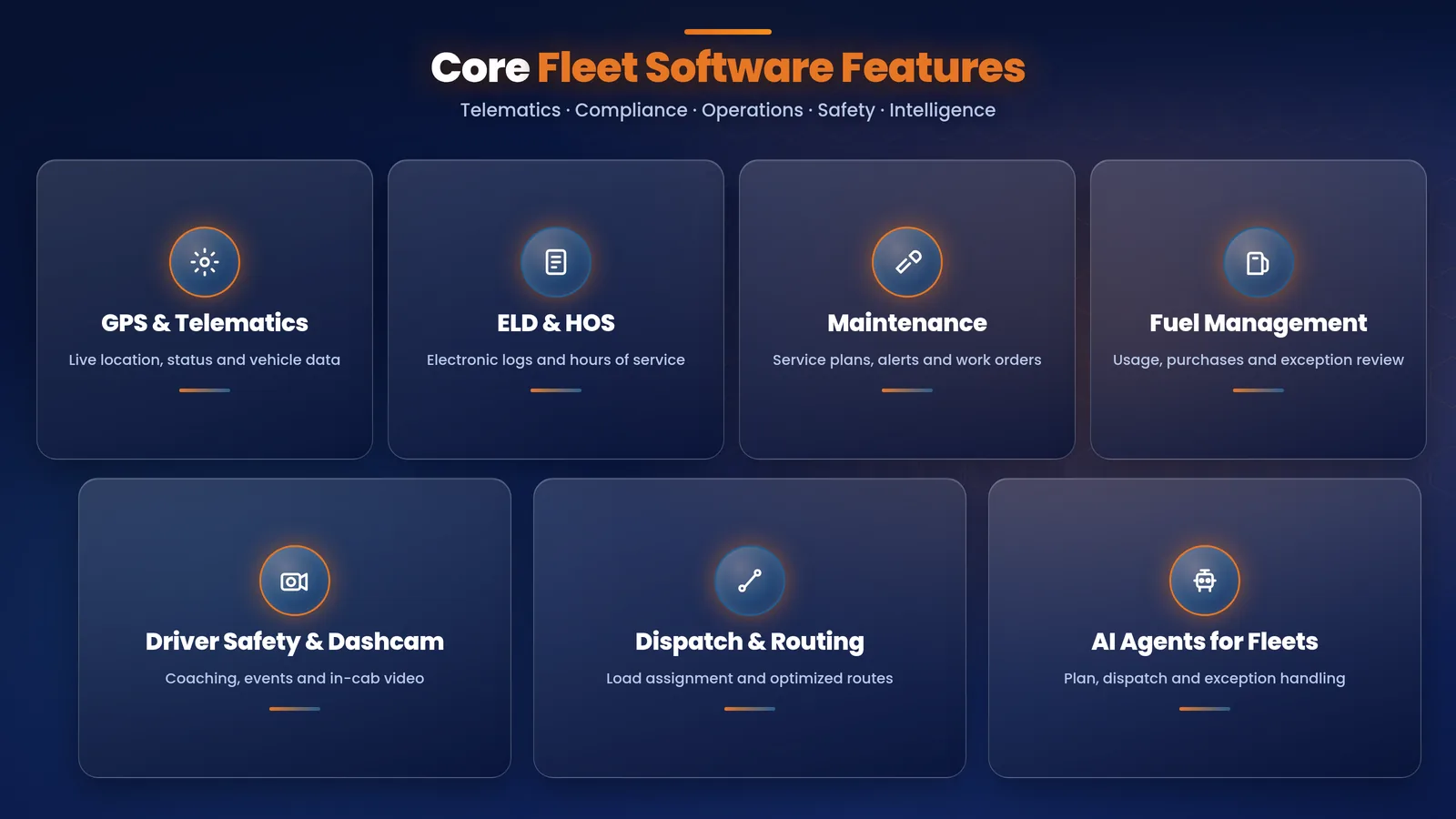
Fleet management software should include GPS and telematics, ELD and hours of service tools, plus maintenance and fuel tracking. It should also cover driver safety, dispatch, routing and IFTA reporting. US teams should still start with the module that closes the biggest safety, service or audit gap.
What do GPS and telematics features cover?
GPS and telematics features show live vehicle position, trips, idle time, geofences and engine events. Usually, devices or an existing telematics feed supply that data. Then dispatch and safety teams can act on the same picture.
A useful platform also stores trip history for coaching and incident review. In addition, it should flag offline units quickly, so a dark vehicle is not silent for hours.
How should ELD and hours of service work in the software?
ELD and hours of service tools should record duty status as the engine runs and keep dispatch inside legal limits. Under 49 CFR Part 395, an ELD syncs with the engine so driving time is captured more accurately. Therefore, assignment screens should show remaining drive time before a job is sent.
Digital DVIR flows also belong here. Drivers can complete pre-trip and post-trip inspections in the field app. Then defects can open a shop task without retyping.
What should maintenance features include?
Maintenance features should schedule service by miles, engine hours or date. Then work orders and parts should sit on the same vehicle record. Fault codes and inspection defects should feed that queue, so the shop is not waiting on email.
How does fuel tracking help a fleet platform?
Fuel tracking joins card transactions, tank or telematics readings and trip miles on one vehicle ID. As a result, teams can spot odd fill patterns, high idle and poor route efficiency. The same data later supports IFTA work.
What do driver safety and dashcam workflows include?
Driver safety workflows score events such as harsh braking, speeding and rapid acceleration. They can also attach dashcam clips to those events. Coaching should stay explainable, with a person reviewing serious incidents. Also, access to video and driver data should follow role limits and privacy rules.
What should dispatch and routing include?
Dispatch and routing should assign work based on location, remaining hours, vehicle type and maintenance status. Live ETAs and exception alerts then keep planners ahead of delays. For driver app patterns, see our logistics app development guide.
What is IFTA reporting in fleet software?
IFTA reporting helps fleets that travel across US and Canadian member states file fuel-tax reports from trip and fuel records. The International Fuel Tax Agreement site explains the program. Good software should group miles and fuel by jurisdiction, then keep an audit trail.
In short: core fleet features only work when location, duty status, shop work and fuel share one record.
Should you build custom fleet software or buy an off-the-shelf platform?
US fleets should buy an off-the-shelf platform when standard tracking, ELD and maintenance workflows already fit. Choose custom fleet management software development when your dispatch rules or shop logic do not match a packaged product.
Many US fleets already run platforms such as Samsara, Geotab or Motive for GPS, ELD and camera hardware. Those products can be a strong fit for standard operations. Custom software can also sit on top of their APIs when you only need extra workflows. A full custom platform fits when the vendor model cannot express how your fleet actually runs.
| Factor | Off-the-shelf platforms | Custom fleet software |
|---|---|---|
| Time to first use | Often days to weeks if devices and connectors already exist | Phased, with a focused first module and a later rollout |
| Workflow fit | Strong for standard tracking, ELD and common shop flows | Built around your dispatch, maintenance and reporting rules |
| Hardware and data | Usually tied to the vendor device and data model | You can design ownership, retention and mixed device feeds |
| Integrations | Pre-built connectors help when they cover your stack | Deeper ERP, TMS, fuel-card or private API work is easier to shape |
| Roadmap control | New features follow the vendor calendar | You set the sequence and keep the code |
| Best fit | Standard fleets that can adopt the product as designed | Fleets with unique rules, mixed assets or gaps the product cannot close |
A hybrid path is common. For example, keep a proven telematics or ELD feed in place. Then build the dispatch, shop or IFTA layer you actually need. However, write down who owns credentials, raw data and device setup before that work starts.
In short: buy when the packaged platform already fits. Build when your rules or data ownership need a system you control.
How can AI agents help fleet management?
AI agents can watch exceptions, flag maintenance risk and check hours of service conflicts. They can also extract inspection notes and draft status updates. The agents should work inside rules you set, and a person should still approve high-risk actions.
Good first jobs are high volume and easy to measure. For instance, an agent can group repeated fault codes or watch overdue inspections. It can also draft a dispatch alert when a driver nears an hours-of-service limit. Computer vision can also help with inspection photos, but those models need a clear review path.
For the broader model, read agentic AI in transportation and logistics. ideyaLabs also offers AI agent development for fleet teams. In every case, ask how agents are tested, logged and stopped if a recommendation is wrong.
In short: AI agents help fleet teams move faster on exceptions. People should still own safety, dispatch and compliance decisions.
Which tech stack and integrations matter for US fleets?
US fleets usually need a live web dashboard, a field app and a telematics ingest layer. They also need secure APIs into ERP, fuel cards, maps and ELD or camera systems. PostgreSQL with maps support, Redis and an event stream such as Kafka are common choices.
- Web: React or Next.js for dispatch, shop and safety consoles.
- Services: Node.js, .NET, Java, Python or Go for APIs and business rules.
- Data: PostgreSQL with PostGIS, Redis for live views and a time-series or event store for telemetry.
- Field apps: Flutter or React Native, with native modules when scanners or offline maps matter.
- Cloud: AWS, Azure or GCP, with MQTT or an IoT hub for device traffic.
- Integrations: Telematics and ELD APIs, fuel cards, maps, ERP or TMS, and camera or safety tools.
Start partner and device onboarding on day one. After all, firmware quirks and vendor test windows often take longer than UI work. Also plan role-based access, encryption and audit logs from the first sprint. Driver and location data is sensitive.
In short: pick a stack that can ingest live vehicle events and connect the systems you already run. Then prove those links early.
How does the fleet management software development process work?
Fleet management software development should follow a six-step process from discovery to a limited pilot. The team finds the bottleneck and locks one module. Then it designs for dispatch and drivers, connects devices early, tests real exceptions and only then scales.
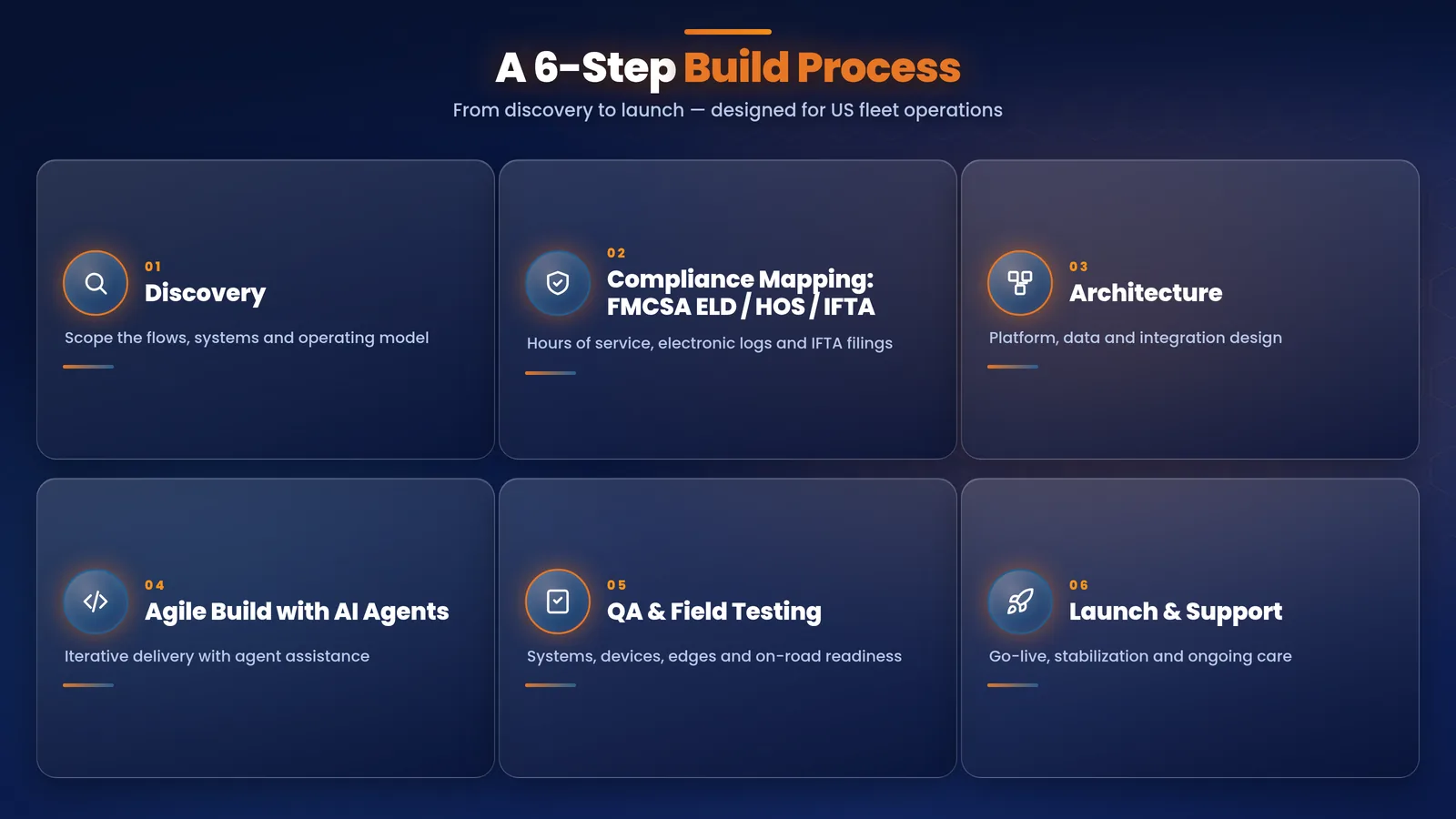
- Discover the bottleneck: Map vehicles, duty types, shop flows, systems and the first measurable pain.
- Prioritize one module: Choose tracking, ELD and HOS, maintenance or IFTA work that unlocks value first.
- Design for dispatch and the field: Build clear web flows for planners. Then add offline-ready screens for drivers and shop staff.
- Integrate early: Connect telematics, ELD, fuel, map and ERP feeds before UI polish.
- Test real exceptions: Validate offline sync, peak GPS load, duplicate events, failed inspections and hours-of-service conflicts.
- Pilot, then scale: Run a limited pilot on one terminal or vehicle group, then expand with proof.
Timelines vary with scope. A focused first module often takes about 3-5 months. Meanwhile, a multi-role platform with several device and back-office links commonly needs 5-9 months. Broader programs with ELD, shop, fuel, cameras and IFTA can run 9-18 months in phases. So treat those ranges as planning guides until discovery is done.
Pro tip: Field-test the driver or shop staff app in real cabs and shops before you lock the design. After all, sunlight, gloves and weak signal only show up on the road.
In short: the process should prove one fleet workflow in production before anyone asks for a network-wide rollout.
How do you choose a fleet software development company in the USA?
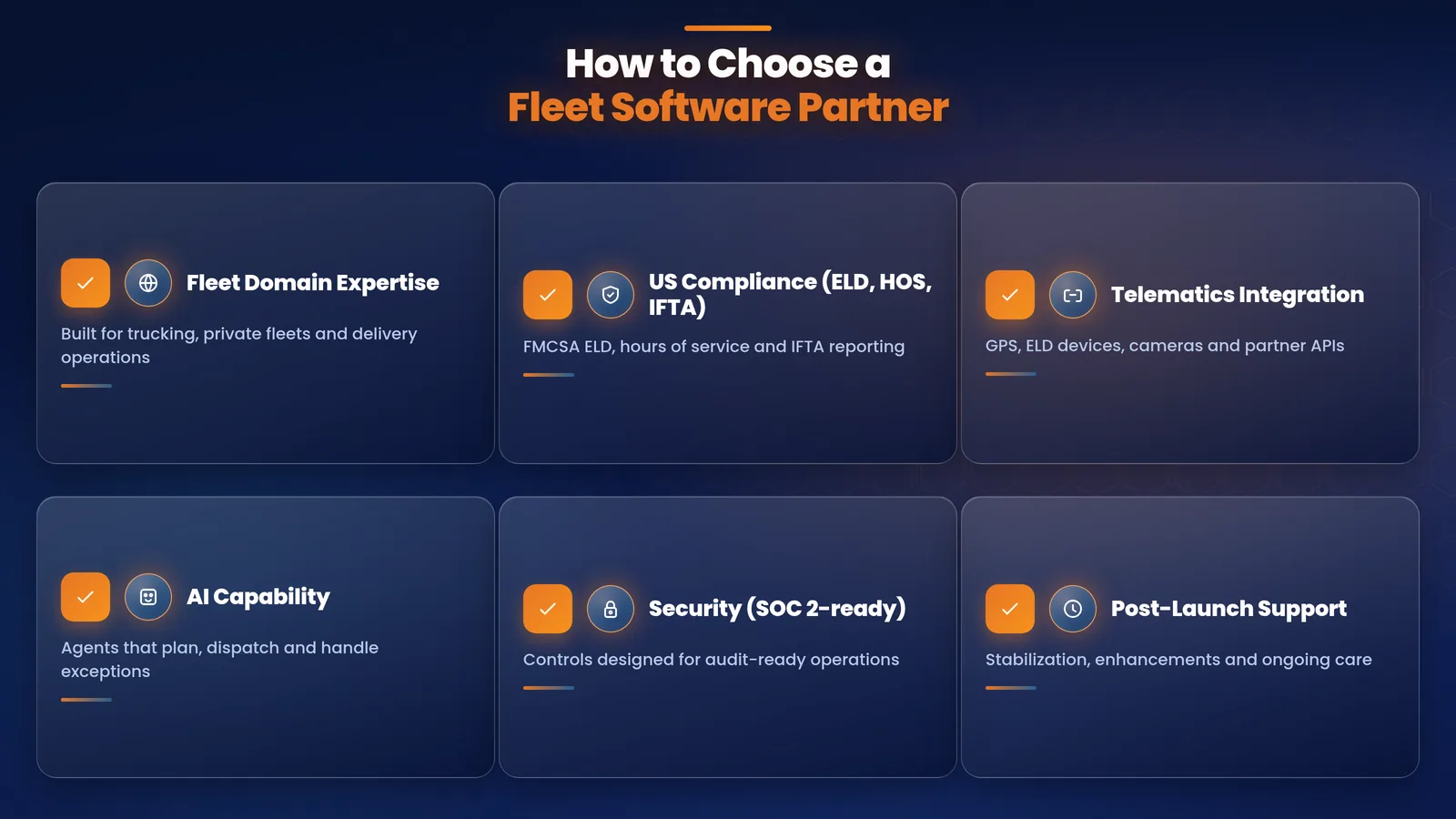
US buyers should choose a fleet software development company with live fleet platforms. The company should also show real ELD and telematics work. The company should also prove field delivery, testing and clear ownership of code, data and credentials.
What should be on your selection checklist?
- Have you shipped fleet, ELD or telematics work that stayed in production?
- Can you walk a US hours of service, DVIR or IFTA exception, not only a happy path?
- How do you test offline sync, duplicate GPS events and peak device load?
- Which fuel-card, camera, ERP or map links have you launched?
- Who owns code, data, credentials and device setup at the end?
- What is your plan for a limited pilot before a fleet-wide rollout?
- How do AI features stay inside rules, with a human on high-risk actions?
How should you run the selection steps in the USA?
US buyers should run six selection steps when they hire a partner in the USA. Write the brief first. Then demand proof, walk a rules exception, review tests, lock ownership and only then pilot.
- Write the brief: Record vehicles, duty types, success metrics and the systems you already run.
- Demand production proof: Ask for live fleet platforms and real ELD, hours of service or telematics work.
- Walk a US exception: Have the team demonstrate an hours-of-service conflict, failed DVIR or IFTA mismatch.
- Review the test plan: Check offline sync, peak GPS load, device failover and partner testing.
- Lock ownership: Confirm who owns code, data, credentials and device setup at the end.
- Pilot, then scale: Run a limited pilot on one terminal or vehicle group before a fleet-wide rollout.
Score each vendor against the same list. For example, ask for a redacted architecture, a test plan and a cutover outline. Also speak with the engineers who would join your account, not only the sales lead.
In short: pick the partner that can prove fleet delivery, US rules and clear ownership. Then hold every vendor to the same steps.
Which results do anonymized fleet case studies show?
Anonymized ideyaLabs case studies show gains when dispatch, field apps and back-office records share one shared ID. The write-ups withhold client names. Each example is labeled by company type only, because the source files do not record a region.
Case 1: Linehaul fleet with a unified driver app
Challenge: Linehaul, dispatch, dock, billing and quoting lived in separate tools.
Solution: So we built one core with map-based dispatch. Then a Flutter driver app shared IDs from quote to invoice.
Result: About 45% fewer manual handoffs and roughly 3x faster trip visibility. In addition, order-to-cash became traceable across eight modules.
Case 2: Multi-office fleet assignment operation
Challenge: Legacy tools struggled to assign contractors, drivers, trucks, trailers and loads across 50+ offices.
Solution: So we built a custom platform on managed Kubernetes. It also added automated CI/CD, serverless API hooks and real-time driver alerts.
Result: Event-driven releases replaced manual deploys. As a result, assignment alerts shortened the create-to-field loop.
Case 3: Multi-hub fleet network on one clock
Challenge: Publish clocks, field updates and invoice drafts disagreed across hubs.
Solution: Instead, hardened publish gates, live dispatch events, dock scans and billing triggers now run on the same IDs.
Result: About 60% fewer status bridges and about 2x faster publish-to-yard alignment. Also, billing rework loops fell by about 35%.
In short: one shared record is what turns fleet tools into real service and visibility gains.
What questions do US buyers ask most about fleet management software development?
US buyers ask ten questions most often about fleet management software development. The answers cover features, build versus buy, US rules, IFTA, timelines, links, AI agents and how ideyaLabs can help.
Basics and features
What is fleet management software development?
Fleet management software development is the process of designing, building and integrating custom software for vehicle fleets. The work usually covers GPS and telematics, ELD and hours of service, maintenance, fuel, safety, dispatch and IFTA reporting. The goal is one live record for vehicles, drivers and compliance.
What features should fleet management software include?
A US fleet platform should include GPS and telematics, ELD and hours of service tools, plus maintenance and fuel tracking. It should also cover driver safety, dispatch, routing and IFTA reporting. Start with the module that closes the biggest safety or audit gap, then expand with proof.
What is the difference between fleet management software and telematics?
Telematics collects vehicle data such as location, speed, engine events and duty status from devices in the field. Fleet management software uses that data to run workflows for dispatch, maintenance, safety, fuel and rules. Most US fleets need both, joined on one vehicle and driver record.
Should we build custom fleet software or buy a platform like Samsara, Geotab or Motive?
Buy an off-the-shelf platform when standard tracking, ELD and maintenance workflows already fit your fleet. Choose custom fleet management software development when dispatch rules or shop logic do not match the packaged product. A hybrid path can also keep a vendor feed and add the workflows you still need.
Rules, process and partners
Which US rules should fleet management software support?
US fleet software should support hours of service and ELD records under 49 CFR Part 395. It should also support digital DVIR flows where drivers complete inspections. IFTA reporting matters for fleets that travel across member jurisdictions. Privacy rules such as CCPA also apply when the system holds personal data of California residents.
What is IFTA reporting in fleet software?
IFTA reporting helps fleets file fuel-tax reports when they travel across member states in the agreement. The software should group miles and fuel by jurisdiction and keep an audit trail. IFTA publishes official program details. Finance should be able to trace each total back to trips and fuel records.
How long does fleet management software development take?
A focused first module often takes about 3-5 months. Meanwhile, multi-role platforms with several device and back-office links commonly need 5-9 months. Broader programs with ELD, shop, fuel, cameras and IFTA can run 9-18 months in phases. Lock the first module in discovery before you treat any range as a plan.
Which integrations matter most in a fleet platform?
Telematics and ELD feeds, fuel cards, maps, and any existing ERP or TMS usually matter first. Camera or safety tools and shop systems often follow. A strong partner starts device and vendor onboarding in the first phase. Those tests often take longer than screen work.
AI and delivery help
How do AI agents help fleet operations?
AI agents can monitor exceptions, flag maintenance risk and check hours of service conflicts. They can also extract inspection notes and draft status updates. However, people should still approve high-risk dispatch, safety and rule actions. Ask the partner how agents are tested, logged and stopped if a recommendation is wrong.
How can ideyaLabs help with fleet management software development?
ideyaLabs designs and builds custom fleet platforms across web, cloud and field surfaces. The team also links telematics, ELD, fuel and back-office stacks. In addition, QA, PR, DevOps and DOC agents speed up testing, review, release and docs, while humans stay in control.
What should US fleets do next?
US fleets starting fleet management software development should first lock one painful workflow. They should also lock the required US rules and a clear ownership model. Next, decide whether an off-the-shelf platform already fits. Then expand only after a limited pilot improves on-time, safety or audit metrics.
So keep vehicles, drivers and records on one live view. After that, add modules only when the first results hold.
Ready to scope a US fleet software pilot?
ideyaLabs can help you choose the first module, plan device links and deliver in governed phases. So explore our logistics software development services for a partner that ships with AI-assisted engineering and clear control gates.
