

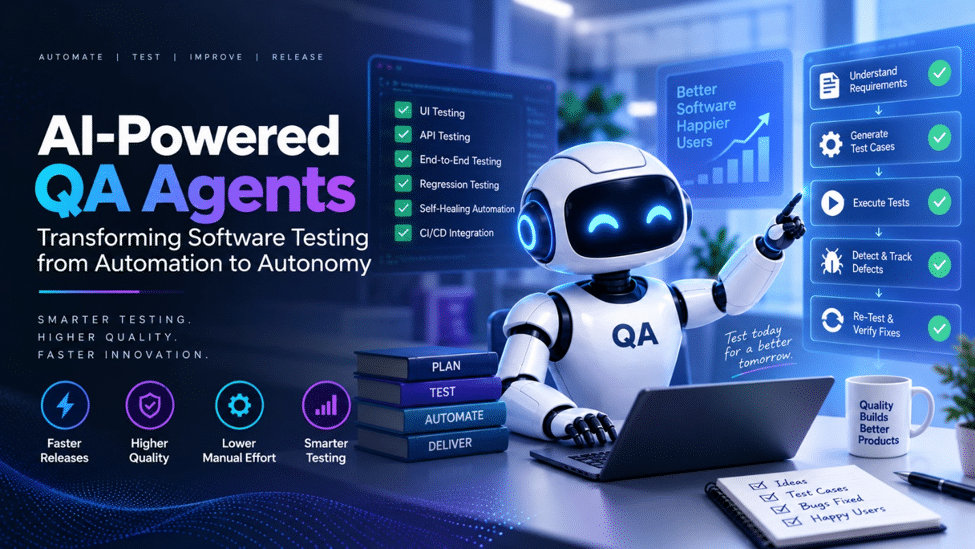
Software development is moving faster than ever. New features are released continuously, applications are becoming more complex, and customers expect flawless digital experiences across every device and platform.
But there is one challenge that continues to slow development teams down: software testing.
Traditional QA processes often depend on manually creating test cases, maintaining automation scripts, executing regression suites, analyzing failures, and tracking defects. As applications evolve, maintaining this process at scale can become increasingly difficult.
This is where AI-powered QA Agents are changing the game.
Instead of simply executing predefined test scripts, an autonomous QA Agent can understand requirements, generate test scenarios, execute tests, identify defects, validate fixes, and continuously support the software quality lifecycle.
From Test Automation to Autonomous Testing
Traditional test automation has already transformed software quality by replacing many repetitive manual tasks with automated scripts.
However, conventional automation has a fundamental limitation: it generally follows predefined instructions.
When an application’s UI changes, selectors move, workflows evolve, or requirements are updated, automation scripts can break. QA engineers then have to spend valuable time maintaining scripts rather than expanding test coverage.
AI-powered QA Agents take a different approach.
They combine artificial intelligence, generative AI, and agentic automation to understand the intent behind a requirement and determine what needs to be tested.
Instead of simply asking:
“What steps should this script execute?”
an intelligent QA Agent can approach testing from the perspective of:
“What could go wrong with this feature, and how should I validate it?”
That shift—from script execution to intelligent validation—is one of the most important developments in modern software quality engineering.
What Is an AI QA Agent?
An AI QA Agent is an autonomous software testing engine designed to assist with the complete QA lifecycle.
The QA Agent from ideyaLabs AiLabs is designed to analyze requirements, generate test cases, execute tests, track defects, perform regression testing, and integrate with development workflows.
The platform can translate business requirements and acceptance criteria into executable test scenarios, allowing QA teams to move from requirements to validation much faster.
The result is a more connected QA workflow:
Requirements → Test Planning → Test Generation → Test Execution → Defect Detection → Fix Verification → Release Confidence
Rather than treating these as isolated activities, an autonomous QA Agent brings them together into a continuous quality process.
How Does an AI QA Agent Work?
An intelligent QA workflow can be divided into several key stages.
1. Understand Requirements
The process begins with understanding what the software is supposed to do.
The QA Agent can analyze:
- Business requirements
- User stories
- Acceptance criteria
- Product specifications
- Natural-language prompts
- Relevant application context
This establishes the boundaries of what needs to be validated.
2. Generate Intelligent Test Cases
Once requirements are understood, the agent can generate structured test scenarios.
These can include:
- Positive or happy-path scenarios
- Negative test cases
- Boundary conditions
- Functional scenarios
- UI workflows
- API validation
- End-to-end journeys
- Regression scenarios
- Exploratory scenarios
This approach helps QA teams expand coverage without having to manually design every individual test case.
3. Execute Tests at Scale
The next step is execution.
Instead of running test suites sequentially, AI-powered testing can support parallel execution, allowing multiple test scenarios to run simultaneously across different application layers.
For modern engineering organizations, this can significantly improve feedback speed.
Developers don’t necessarily have to wait hours for a large regression suite to finish before discovering that a recent change introduced a defect.
4. Detect and Track Defects
When a test fails, the QA Agent can help capture the relevant execution information and route the issue into existing defect-management workflows.
The ideyaLabs QA Agent supports integrations with tools such as Jira and GitHub, helping connect automated testing with development and defect-tracking processes.
This creates a tighter feedback loop between:
Development → Testing → Defect → Fix → Verification
5. Re-Test and Verify Fixes
Finding a defect is only part of the process.
Once developers fix the issue, the system needs to verify that:
- The original problem has been resolved.
- The fix has not introduced another regression.
An autonomous QA workflow can trigger re-runs and fix verification, helping teams move toward a closed-loop quality process.
Why Self-Healing Test Automation Matters
One of the biggest challenges with traditional UI automation is script maintenance.
Imagine an application has a login button identified by a particular selector.
A small UI update changes that selector.
The application still works perfectly—but the automation script fails.
A QA engineer then has to investigate the failure, update the script, validate it, and maintain the automation framework.
Multiply this across hundreds or thousands of tests and script maintenance can become a significant operational burden.
Self-healing automation aims to reduce this problem.
Instead of rigidly depending on a fixed path, an AI-driven testing agent can use application context and intent to adapt when certain UI elements or workflows change.
This allows QA teams to spend less time repairing brittle automation and more time improving quality strategy and coverage.
One Agent, Multiple Testing Capabilities
Modern applications require more than simple functional testing.
An effective QA strategy needs to validate the entire digital experience.
An AI QA Agent can support multiple testing layers, including:
Functional Testing
Validate whether features behave according to business requirements and acceptance criteria.
UI Testing
Verify interfaces, user interactions, layouts, workflows, and critical user journeys.
API Testing
Validate endpoints, payloads, responses, integrations, and backend functionality.
End-to-End Testing
Test complete workflows across frontend and backend systems.
Regression Testing
Automatically re-run existing test suites whenever new builds or changes are introduced.
Exploratory Testing
Identify unexpected paths, unusual inputs, and boundary scenarios that may not be covered by conventional scripted tests.
The ideyaLabs QA Agent is designed to support these testing scenarios as part of a broader autonomous QA workflow.
AI QA Agents and CI/CD: Bringing Quality Closer to Development
Modern DevOps teams cannot afford to treat testing as a final stage before release.
Quality needs to become part of the development pipeline.
This is where CI/CD integration becomes critical.
An AI-powered QA Agent can participate in automated testing workflows triggered by builds, commits, or deployment processes.
A simplified workflow could look like:
Code Commit
↓
Build
↓
AI Test Planning
↓
Automated Test Generation/Execution
↓
Defect Detection
↓
Fix & Re-Test
↓
Release Decision
This makes testing a continuous activity rather than a final checkpoint.
The ideyaLabs QA Agent supports CI/CD integration and automated regression workflows, helping engineering teams incorporate quality into their delivery pipelines.
The Business Impact of Autonomous QA
The value of AI-powered QA is not limited to faster testing.
It can influence the entire software delivery lifecycle.
Faster Releases
Automated test generation and parallel execution can reduce the time required to validate releases.
Broader Test Coverage
AI can help generate scenarios across functional, negative, boundary, UI, API, and end-to-end workflows.
Lower Manual Effort
Automating repetitive activities allows QA professionals to focus more on strategy, risk analysis, exploratory testing, and quality improvement.
Faster Defect Resolution
Automated reporting, defect routing, re-testing, and verification can shorten the feedback cycle.
More Reliable Regression Testing
Regression suites can be executed more frequently without requiring the same level of manual intervention.
The ideyaLabs QA Agent is positioned around this objective: improving release speed while maintaining software quality and reducing manual QA setup effort.
AI Doesn’t Replace QA Engineers—It Amplifies Them
There is a common misconception that autonomous testing means eliminating QA professionals.
In reality, the most valuable model is human expertise + AI execution.
AI Agents are particularly effective at repetitive, high-volume, and systematic tasks.
QA engineers remain essential for:
- Quality strategy
- Risk assessment
- Business-context decisions
- Exploratory testing
- Release governance
- Complex failure analysis
- Defining quality standards
- Deciding what should ultimately ship
The AI handles the scale.
The QA professional provides the judgment.
This combination can create a much stronger quality engineering function.
The Future of Software Testing Is Agentic
Software quality is entering a new phase.
The evolution can be viewed as:
Manual Testing → Test Automation → Intelligent Automation → Autonomous QA
The first transition replaced repetitive manual execution.
The next transition is replacing rigid, script-centric workflows with systems that can understand context, reason about test coverage, adapt to changes, and participate in continuous quality processes.
That is the promise of agentic testing.
Instead of simply asking automation to execute a predefined list of instructions, organizations can increasingly give intelligent agents a quality objective and allow them to perform the repetitive work required to achieve it.
Why Businesses Should Consider an AI QA Agent Now
As applications become more sophisticated and release cycles become shorter, traditional QA approaches can struggle to keep pace.
Organizations dealing with:
- Frequent releases
- Large regression suites
- Complex UI applications
- API-heavy architectures
- Multiple development teams
- Continuous deployment
- High maintenance costs for test automation
- Increasing requirements for test coverage
can benefit from exploring AI-powered QA.
The objective isn’t simply to test more.
It is to test smarter, test continuously, and release with greater confidence.
QA Agent by ideyaLabs: Building a Smarter Quality Engineering Workflow
The QA Agent from ideyaLabs AiLabs brings together requirement analysis, AI-driven test generation, automated execution, parallel testing, defect tracking, regression testing, self-healing capabilities, and CI/CD integration within an autonomous testing approach.
By connecting these capabilities into a single workflow, organizations can move closer to continuous quality intelligence—where testing becomes an integrated part of software delivery rather than a bottleneck at the end of the development cycle.
The Bottom Line
The future of QA isn’t about choosing between humans and AI.
It is about giving QA teams intelligent systems that can handle repetitive testing at machine speed while allowing experienced professionals to focus on the decisions that require human judgment.
AI-powered QA Agents are turning software testing from a scripted activity into an intelligent, adaptive, and increasingly autonomous discipline.
And for organizations looking to release software faster without compromising quality, that shift could become a significant competitive advantage.
The future of software quality is autonomous.
With the right AI QA strategy, every release can move from “Did we test enough?” to “We have the intelligence and evidence to release with confidence.”
