

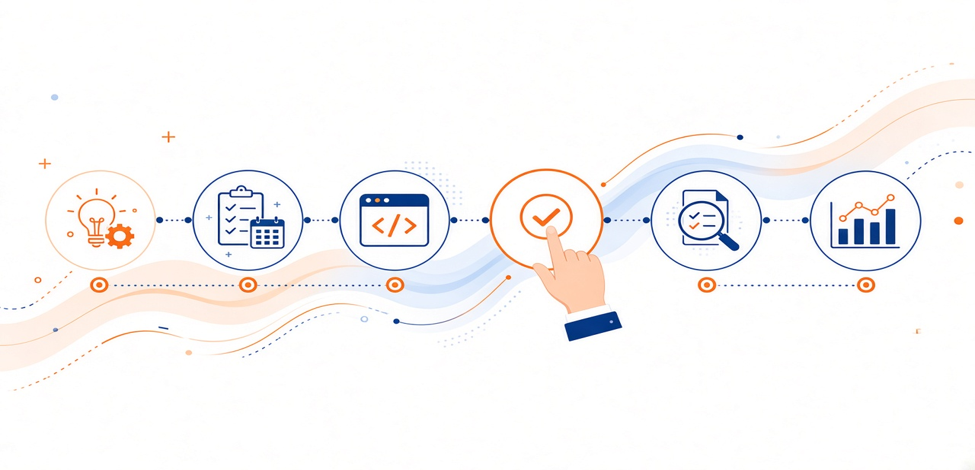
What the latest research says, and where AI agents fit in your product lifecycle.
Picture this. Your product manager has an idea on Monday. By Friday, you want a market view, a requirements document, a clean backlog, working code, tests, and a live dashboard. For most teams, that takes weeks, and half the time goes into hand-offs, meetings and waiting.
Now the big question every CTO and product leader is asking in 2026: can AI take over the busywork across the whole lifecycle, without taking humans out of the driver’s seat?
That idea has a name. It is called AI-PDLC. Let’s break it down in plain words.
So, what does “AI-PDLC” actually mean?
You will see the term used in two ways, and both are useful:
- AI-DLC (AI-Driven Development Lifecycle). This is a method published by Amazon Web Services in July 2025. AI makes a plan, asks questions, and does the work only after a human says yes. It runs in three phases: Inception (what to build), Construction (how to build it) and Operations (run it). AWS even swaps “sprints” for “bolts”, short cycles measured in hours or days.
- Agentic PDLC (AI-powered product development lifecycle). This is the wider view used by firms like McKinsey. AI agents help across the whole product journey: research, requirements, backlog, code, testing, release and reporting. Not just coding.
Same idea, different size. AI works in every stage, and people make the important decisions.
What’s new: the facts that matter
We checked every number below against its original source. Links are at the end.
1. Almost everyone is using AI to build software. A February 2026 Futurum Research survey found 76.6% of organizations are actively using AI in development, and another 20.4% are evaluating it. Only 3.1% are staying out. DORA’s 2025 report (nearly 5,000 professionals) found 90% use AI at work, and more than 80% say it made them more productive. But 30% report little or no trust in AI-generated code.
2. Using AI is not the same as getting results. McKinsey’s August 2026 article is based on 334 product and engineering leaders. Only 25% of senior respondents reported meaningful AI acceleration. And 30% said team productivity had actually fallen. The teams that redesigned their process before adding AI were more than twice as likely to report productivity gains above 20%. The lesson: tools alone don’t win. Redesigned workflows do.
3. The goal is the full lifecycle. An MIT Technology Review Insights survey of 300 executives (April 2026) found 51% of software teams use agentic AI today, mostly in a limited way, and 45% plan to start within 12 months. At 41% of organizations, teams aim to have agents manage the product and software lifecycle end to end for most or all products within 18 months. (This is sponsored custom research, not newsroom reporting.)
4. Humans stay in the loop, by design. Anthropic reports that developers use AI in roughly 60% of their work but can “fully delegate” only 0-20% of tasks. In the Stack Overflow 2026 survey, 48% said they trust AI when they can easily validate the answer. Stack Overflow calls human-in-the-loop “the dominant mode” of working with these tools.
5. Clear specs are the new superpower. Thoughtworks’ April 2026 Radar and a June 2026 Microsoft post both highlight spec-driven development: write down the intent clearly first, then let AI build against it. Microsoft’s summary: spec quality equals output quality.
6. The big platforms are moving in. GitHub announced Agent HQ in October 2025, a single place to run agents from several vendors. Atlassian brought its Rovo Dev agent into Jira in April 2026, so a work item can go to a merge-ready pull request, with the developer reviewing the plan and approving the changes.
The simple takeaway for leaders
Put the research together and a pattern appears:
- Redesign the flow, don’t just add tools. Speed without checks creates mistakes faster. DORA found AI still increases delivery instability.
- Make requirements clear. Vague input gives you confident-sounding wrong output.
- Build in review. Tests, code review and approvals are what make speed safe.
- Keep people in charge. Humans decide. Agents do the heavy lifting.
How ideyaLabs AI agents cover the lifecycle
At ideyaLabs, we build agentic AI that fits exactly this pattern. Each agent handles one stage, and your team reviews and approves the output. Below, “teams typically see” and “we target” describe our expected outcomes, not named customer results.
| Stage | ideyaLabs agent | What it does | What we target |
| Idea to plan | PO Agent → | Turns a raw idea into market research, BRD/PRD and a ready backlog | Research from 2-4 weeks down to 30-60 minutes |
| Context for builders | Auto Prompt Engine | Pulls context from Jira and builds a rich prompt for your AI coding tool | About 20 minutes of work down to about 10 seconds per prompt |
| Build and review | PR Agent → | Reviews every pull request like a senior engineer, designed so code stays in your infrastructure | Review in under 3 minutes, under 5% false positives |
| Test | QA Agent → | Creates test cases and automation scripts from your Jira tickets | 100-150 test cases in 5-10 minutes, versus about 6 hours by hand |
| Document | DOC Agent → | Writes and updates technical documentation straight from your code | Technical docs from 1-3 days down to 2-3 minutes |
| Release and run | DevOps Agent → | Handles CI/CD, root-cause analysis and DORA metrics | Teams typically see 70-90% faster recovery time (MTTR) |
| Learn and decide | BI Agent → | Builds dashboards and insights for leaders | Teams typically see 60-80% less reporting time |
Notice what’s common: every agent works on a clear input (a Jira ticket, a repo, an idea), produces something your team can check, and leaves the final call with a person. That is the same “AI proposes, humans approve” principle at the heart of AI-DLC, applied across the product lifecycle.
Meet the agents
Every agent has its own page with demos and details. Tap any link to explore.
- Head Engineer Agent: your AI tech lead for the engineering team. Explore →
- PO Agent: your AI product owner, from raw idea to ready backlog. Explore →
- Dev Agent: an autonomous AI developer that builds, tests and deploys. Explore →
- PR Agent: autonomous pull request review and code quality. Explore →
- QA Agent: test cases and test automation from your tickets. Explore →
- DevOps Agent: autonomous CI/CD and DevOps operations. Explore →
- BI Agent: business intelligence dashboards and insights. Explore →
- DOC Agent: automated software documentation from your code. Explore →
Where to start
You don’t need to transform everything at once. The research and our own approach agree on a simple path:
- Pick one painful stage. Slow test cycles? Review backlogs? Missing docs? Start there.
- Run a small pilot with one team and clear measures such as cycle time, defects and review time.
- Check outcomes, not usage. McKinsey found top performers track results like quality and speed, not just how many people log in.
- Connect the stages as you grow, so the output of one agent becomes the context for the next.
Ready to see AI-PDLC in action?
If you lead product or engineering and want to know which stage of your lifecycle to automate first, we’d love to talk. Book a conversation with our team, or explore the agents and our work.
