

Businesses are moving beyond traditional automation, chatbots, and standalone AI applications. The next generation of enterprise software is being built around autonomous AI agents that can understand goals, reason through complex tasks, execute workflows, collaborate with other agents, and continuously improve outcomes.
But building production-ready AI agents requires more than connecting an LLM to an application.
Enterprises need secure architecture, domain-specific intelligence, workflow orchestration, integrations, human-in-the-loop controls, observability, testing, governance, and continuous optimization.
This is where choosing the right AI Agent Development Company becomes critical.
At ideyaLabs, we build enterprise-grade AI agents through AiLabs, an Agentic AI platform designed to transform how organizations plan, build, test, deploy, monitor, and optimize software and business operations.
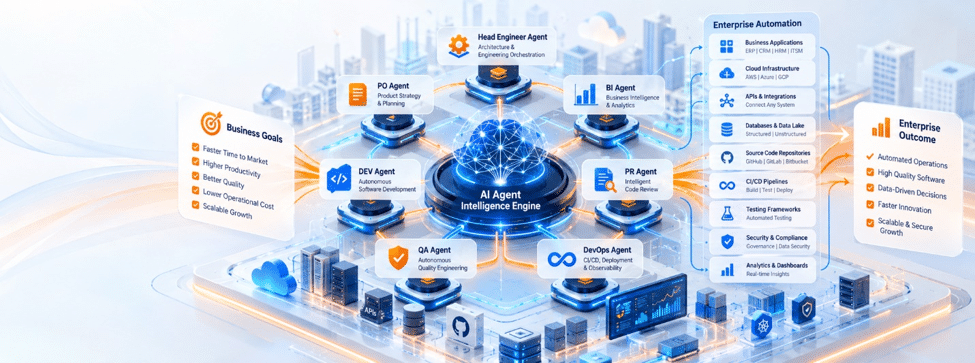
From product strategy and engineering governance to development, code review, testing, DevOps, and business intelligence, AiLabs brings specialized AI agents together into a connected intelligent ecosystem.
What Is an AI Agent?
An AI agent is an intelligent software system designed to understand objectives, reason about tasks, make decisions, use tools, execute actions, and collaborate with humans or other AI agents.
Unlike conventional automation, which generally follows predefined rules, AI agents can dynamically determine the next step based on context, available information, and the desired outcome.
An enterprise AI agent can:
- Understand natural-language requirements
- Analyze structured and unstructured data
- Break complex objectives into smaller tasks
- Plan and execute multi-step workflows
- Interact with enterprise applications and APIs
- Generate and analyze software code
- Create reports and business insights
- Perform automated testing
- Monitor systems and identify failures
- Collaborate with other specialized AI agents
- Escalate critical decisions to humans
- Learn from feedback and operational outcomes
This makes AI agent development fundamentally different from traditional chatbot development or simple workflow automation.
Why Enterprises Need AI Agent Development
Modern enterprises operate across hundreds of applications, data sources, development tools, cloud platforms, and business workflows.
Teams often work in disconnected silos:
Business → Product → Engineering → Development → Code Review → QA → DevOps → Production → Analytics
Information gets lost between these stages. Manual handoffs create delays. Repetitive tasks consume engineering capacity. Decision-making becomes dependent on fragmented data.
AI agents can connect these workflows through intelligent orchestration.
Instead of deploying one AI assistant for one task, enterprises can build a multi-agent ecosystem where specialized agents collaborate across an entire workflow.
That is the approach behind AiLabs.
AiLabs: An Enterprise AI Agent Development Platform
AiLabs by ideyaLabs brings specialized AI agents together on an intelligent agentic layer.
Each agent has a specific responsibility while remaining connected to the broader product and engineering workflow.
The result is an autonomous software and business operating model where agents can collaborate, exchange context, execute tasks, validate outcomes, and involve humans when required.
Meet the AiLabs AI Agent Ecosystem
| AI Agent | Primary Responsibility | Key Capability |
| Head Engineer Agent | Engineering orchestration | Architecture, technical governance, task delegation and workflow supervision |
| PO Agent | Product strategy and planning | Converts product vision into BRDs, PRDs, SRS, backlogs and release plans |
| BI Agent | Business intelligence | Converts business data into dashboards, insights, predictive analytics and anomaly detection |
| DEV Agent | Software development | Converts requirements, Jira stories and designs into production-ready software |
| PR Agent | Code review | Automates pull request analysis, security checks and code quality validation |
| QA Agent | Quality engineering | Generates test cases, executes tests, manages regression and supports self-healing automation |
| DevOps Agent | Software delivery | Automates CI/CD, deployment, observability, governance and failure remediation |
These agents are not isolated AI tools. They form a connected multi-agent system designed to support the complete software product lifecycle.
Head Engineer Agent: The Intelligent Engineering Orchestrator
Complex enterprise software requires technical governance across architecture, development, security, quality, and deployment.
The Head Engineer Agent acts as the master engineering orchestrator within AiLabs.
It translates business and technical requirements into scalable architecture, selects appropriate technologies, delegates work to specialized agents, monitors execution, and enforces engineering policies.
Its capabilities include:
- Intelligent task delegation
- System architecture design
- Technology and framework selection
- Engineering workflow orchestration
- Code quality governance
- Security and compliance checks
- Workflow monitoring
- Risk management
- Human approval and intervention
The Head Engineer Agent can supervise Dev, QA, DevOps, and PO workflows while maintaining awareness of system dependencies and execution status.
The result: an intelligent engineering control layer connecting multiple AI agents into one coordinated workflow.
PO Agent: From Product Vision to Execution
Turning an idea into an enterprise product requires research, requirements, prioritization, documentation, sprint planning, and release management.
The PO Agent automates these product management activities.
Its Prompt-to-Plan intelligence can transform natural-language product requirements into structured product artifacts such as:
- Business Requirements Documents
- Product Requirements Documents
- Functional Requirements Documents
- Software Requirements Specifications
- Product backlogs
- Sprint plans
- Release roadmaps
- Process diagrams
- Flowcharts and mind maps
The PO Agent can also support feature prioritization, risk assessment, strategic planning, and synchronization with platforms such as Jira and Confluence.
Instead of spending days converting business ideas into documentation, product teams can move from vision → strategy → requirements → backlog → execution through an intelligent AI-powered workflow.
BI Agent: Turning Enterprise Data into Intelligence
AI agent development is not limited to software engineering.
Enterprise decision-making also requires continuous access to accurate and actionable business intelligence.
The BI Agent transforms raw business data into decision-ready intelligence.
It can automate:
- Data preparation
- Dashboard creation
- Business analytics
- Predictive analytics
- Anomaly detection
- Performance monitoring
- Interactive data visualization
- Executive reporting
Its Prompt-to-BI intelligence enables users to express analytical requirements in natural language and transform them into dashboards and insights.
The BI Agent can work with data sources including Salesforce, MySQL, Google Sheets, structured data, and unstructured data.
This creates a direct connection between enterprise data → intelligence → decision-making.
DEV Agent: Autonomous AI Software Development
Software development remains one of the biggest opportunities for AI agent adoption.
The DEV Agent acts as an autonomous software engineering engine that can convert requirements, Jira stories, API contracts, and design specifications into production-ready code.
It supports:
- Frontend development
- Backend development
- API development
- Microservices
- Database connectivity
- Code generation
- Debugging
- Root-cause analysis
- Unit test generation
- Code quality validation
- Full-stack development
The DEV Agent’s Prompt-to-Code intelligence can convert Jira user stories and Figma designs into functional software while supporting technologies including TypeScript, Python, Java, Go, and Node.js.
This changes the role of AI from simply suggesting code to participating directly in the software engineering workflow.
PR Agent: Intelligent Code Review and Security
Writing code faster creates a new challenge: reviewing and validating that code at the same speed.
The PR Agent addresses this bottleneck by automating pull request analysis and code review.
It analyzes code changes, repository context, dependencies, security risks, and engineering standards.
Key capabilities include:
- Automated pull request analysis
- Semantic diff analysis
- AST-based code inspection
- Security vulnerability checks
- SQL injection detection
- XSS detection
- Secret exposure detection
- Automated test generation
- Coding standard enforcement
- Review comment generation
The current AiLabs PR Agent documentation reports comprehensive code audits in under three minutes and a verified 95.8% precision rate, with support for GitLab, Bitbucket, Azure DevOps, webhooks, CLI, and CI/CD workflows.
This allows engineering teams to move from manual code review queues to continuous intelligent code governance.
QA Agent: Autonomous Software Testing
Software cannot be released at machine speed if testing remains completely manual.
The QA Agent brings autonomous intelligence into the software testing lifecycle.
It can transform requirements into test plans and test cases, generate executable test scripts, execute tests in parallel, manage defects, trigger regression testing, and support self-healing automation.
The workflow can cover:
Requirements → Test Design → Test Generation → Test Execution → Defect Detection → Regression → Release Validation
The QA Agent integrates with tools including Jira, GitHub, Azure, AWS, and CI/CD pipelines. This enables organizations to move from traditional test automation toward AI-powered autonomous quality engineering.
DevOps Agent: From Code to Production
Building software is only one part of the lifecycle.
Enterprises also need reliable deployment, observability, governance, infrastructure automation, and rapid incident response.
The DevOps Agent provides an intelligent delivery layer across build, deploy, observe, and govern workflows.
It supports:
- CI/CD automation
- Deployment orchestration
- Release governance
- Infrastructure workflows
- AI-powered root-cause analysis
- Automated failure remediation
- DORA metrics
- Change risk scoring
- Observability
- Rollback guidance
- Production monitoring
The AiLabs DevOps Agent is designed to work across environments and tools including AWS, Azure, GCP, GitHub, GitLab, Bitbucket, Jenkins, and SonarQube.
According to the current AiLabs documentation, the DevOps Agent targets 60–80% faster release cycles and up to 90% reduction in manual DevOps effort.
How AI Agents Work Together
The real value of an enterprise AI Agent Development Company is not simply building individual agents.
The bigger opportunity is connecting them.
Consider a new product requirement.
Step 1: Product Vision
The PO Agent understands the product requirement and creates the necessary product documentation, backlog, and roadmap.
Step 2: Architecture
The Head Engineer Agent evaluates the requirements and establishes the architecture, technology decisions, engineering policies, and execution plan.
Step 3: Development
The DEV Agent converts approved requirements and designs into frontend, backend, API, and database components.
Step 4: Code Review
The PR Agent analyzes the generated code, identifies quality and security issues, and provides review feedback.
Step 5: Quality Engineering
The QA Agent generates and executes tests, validates functionality, identifies defects, and performs regression testing.
Step 6: Deployment
The DevOps Agent manages CI/CD workflows, deployment, observability, release governance, and production monitoring.
Step 7: Business Intelligence
The BI Agent analyzes operational and business data to provide dashboards, performance insights, predictive analytics, and anomaly detection.
Step 8: Continuous Optimization
Insights from production and business operations can feed back into product planning and engineering workflows.
This creates a continuous intelligent loop:
Idea → Product → Architecture → Development → Review → Testing → Deployment → Intelligence → Optimization
That is the power of a connected AI agent ecosystem.
AI Agent Development vs Traditional AI Development
Traditional AI applications typically focus on a specific use case.
For example:
Customer question → AI response
An AI agent can go much further:
Business objective → Reasoning → Planning → Tool selection → Execution → Validation → Collaboration → Outcome
A multi-agent architecture expands this model further:
Business Objective → Specialized Agents → Agent Collaboration → Human Governance → Automated Execution → Continuous Feedback
This is why enterprises are increasingly exploring AI agent development services instead of building isolated AI applications.
What Makes Enterprise AI Agent Development Different?
Building an AI agent prototype is relatively straightforward.
Building an enterprise-ready AI agent is much more complex.
A production AI agent may require:
1. Agent Architecture
The system must define how agents reason, plan, communicate, execute, and recover from failures.
2. LLM Orchestration
Different tasks may require different models, prompts, tools, context windows, and reasoning strategies.
3. Enterprise Integrations
AI agents need secure connections with platforms such as:
- Jira
- GitHub
- GitLab
- Azure DevOps
- AWS
- Azure
- GCP
- Confluence
- CRM systems
- Databases
- APIs
- CI/CD platforms
4. Security and Governance
Enterprise AI agents require:
- Access controls
- Authentication
- Authorization
- Auditability
- Data protection
- Policy enforcement
- Human approval workflows
5. Observability
Organizations need visibility into:
- Agent decisions
- Tool calls
- Workflow execution
- Errors
- Token consumption
- Latency
- Cost
- Business outcomes
6. Human-in-the-Loop
Autonomy does not mean removing humans from critical decisions. Enterprise AI systems should allow humans to review, approve, modify, or override agent actions when required.
Why Choose ideyaLabs as Your AI Agent Development Company?
At ideyaLabs, AI agent development goes beyond building conversational interfaces.
We focus on enterprise AI agents capable of reasoning, orchestration, execution, collaboration, and continuous workflow automation.
With AiLabs, organizations can explore AI agent solutions across:
- Product management
- Software engineering
- Business intelligence
- Code review
- Quality engineering
- DevOps
- Enterprise automation
- Data-driven decision-making
Our agentic approach connects specialized intelligence into a unified software and business ecosystem.
Build Specialized AI Agents for Your Business
Every enterprise has unique workflows.
A banking organization may need an AI agent for compliance and risk operations.
A healthcare organization may need agents for clinical workflows, documentation, analytics, or administrative automation.
A logistics company may need agents for fleet operations, dispatch, billing, and supply-chain intelligence.
A software company may need autonomous agents across product management, engineering, QA, and DevOps.
The opportunity is to design AI agents around the actual business process, rather than forcing the business process into a generic AI application.
That is where an experienced AI Agent Development Company can create measurable enterprise value.
From AI Assistants to Autonomous AI Agents
The evolution of enterprise AI is moving through several stages:
Traditional Software → Automation → AI Assistants → Generative AI → AI Agents → Multi-Agent Systems → Autonomous Enterprise Workflows
AI assistants primarily help humans perform tasks.
AI agents can perform defined tasks themselves.
Multi-agent systems allow multiple specialized agents to collaborate.
Enterprise agentic systems connect those agents to business processes, enterprise applications, data, and governance frameworks.
This creates the foundation for increasingly autonomous organizations.
The Future of AI Agent Development
The future of enterprise software will not be defined by a single AI model.
It will be defined by intelligent systems that can combine:
LLMs + AI Agents + Tools + Enterprise Data + APIs + Workflows + Governance + Human Intelligence
AI agents will increasingly become digital workers embedded inside product, engineering, operations, analytics, customer service, finance, and other enterprise workflows.
The organizations that successfully adopt this model will not simply use AI to generate content.
They will use AI to reason, coordinate, execute, validate, and continuously optimize business processes.
Build the Next Generation of Enterprise AI Agents with ideyaLabs
AI agent development is becoming a strategic capability for modern enterprises.
The opportunity is no longer limited to building an AI chatbot or adding an LLM to an existing application.
Enterprises can build specialized autonomous agents that understand their processes, connect with their systems, collaborate with other agents, and execute complex workflows.
With AiLabs, ideyaLabs brings together the Head Engineer Agent, PO Agent, BI Agent, DEV Agent, PR Agent, QA Agent, and DevOps Agent to create an interconnected agentic ecosystem for modern product engineering and enterprise automation.
From idea to architecture, architecture to code, code to quality, quality to deployment, and deployment to intelligence, AI agents can transform the way software and business operations are executed.
The next generation of enterprise software is not simply AI-powered. It is agent-powered.
Ready to build your enterprise AI agent? Partner with an AI Agent Development Company that understands AI, software engineering, automation, data, cloud, and enterprise workflows.
Talk to ideyaLabs about building your AI agent solution with AiLabs.
