

Software quality is no longer just about finding bugs before release. In today’s fast-moving engineering environment, QA teams are expected to deliver higher test coverage, faster validation, stable automation, actionable defect insights, and continuous quality assurance—without slowing down development.
Yet many organizations still operate with fragmented QA workflows.
Requirements live in Jira. Test scenarios are created manually. Automation scripts require continuous maintenance. UI changes break locators. Test failures need investigation. Defects are logged separately. And connecting a production issue back to the original requirement can become a time-consuming exercise.
This is where AI-powered QA Agents are changing the game.
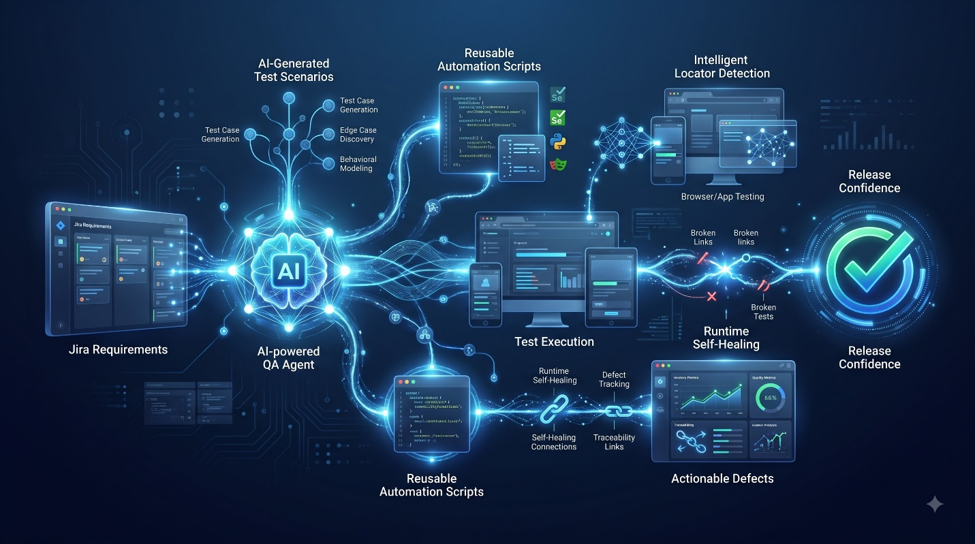
Instead of treating testing as a collection of disconnected activities, a QA Agent can create an intelligent, connected quality engineering workflow—from requirement to test scenario, automation, execution, self-healing, defect management, and release decision-making.
The Traditional QA Challenge
A typical enterprise testing lifecycle involves multiple handoffs:
Requirement → Test Case → Automation Script → Execution → Failure Analysis → Defect → Retest → Release
Each stage can introduce delays and manual effort.
A requirement may be interpreted differently by different team members. Test scenarios may not provide sufficient coverage. Automation scripts can become unstable when applications change. Locator failures can cause otherwise valid tests to fail. QA engineers then spend valuable time diagnosing whether the failure is caused by the application, test script, environment, or locator.
The result?
More maintenance. More manual effort. Slower feedback.
The real opportunity is not simply to automate individual testing tasks—it is to connect the entire QA lifecycle with intelligence.
Enter the QA Agent
The QA Agent brings AI-driven intelligence into the end-to-end software testing lifecycle.
It can transform Jira requirements into test scenarios, generate stable and reusable automation scripts, execute those scripts, handle runtime changes through self-healing, and create actionable Jira defects with complete traceability.
The result is a more autonomous approach to quality engineering.
Jira Requirements → Intelligent Test Scenarios
The journey begins with the requirement.
Instead of relying entirely on manual interpretation, the QA Agent analyzes Jira requirements and transforms them into actionable test scenarios.
This helps QA teams systematically move from:
What needs to be built?
to:
What needs to be validated?
By connecting requirements directly to testing, teams can improve coverage and reduce the risk of important acceptance criteria being overlooked.
Test Scenarios → Stable, Reusable Automation
Creating an automated test is only part of the challenge.
Maintaining it is where many QA teams spend significant time.
Applications evolve. UI structures change. Elements move. Attributes are modified. Locators become invalid.
The QA Agent generates stable, reusable automation scripts using intelligent locator strategies designed to improve script reliability and maintainability.
Instead of treating automation as static code, the agent approaches test automation as an adaptive engineering asset.
This can significantly reduce the repetitive effort involved in building and maintaining automation suites.
Runtime Self-Healing: Making Automation More Resilient
One of the biggest challenges with UI automation is brittleness.
A small application change can cause a locator to fail—even when the underlying business functionality is working correctly.
This creates unnecessary noise in the QA process.
A QA Agent with runtime self-healing capabilities can identify changes during execution and adapt to them, helping tests continue to validate the intended functionality rather than simply failing because an element changed.
The objective is simple:
Make automated testing more resilient to application change.
This shifts QA automation from rigid, maintenance-heavy scripts toward more adaptive testing.
From Test Failure to Actionable Jira Defect
A failed test should not simply produce a red status.
It should produce context.
The QA Agent can analyze execution results and generate actionable Jira defects, connecting the failure back to the relevant requirement and test scenario.
This creates an integrated chain of traceability:
Jira Requirement → Test Scenario → Automation Script → Execution Result → Defect
For engineering and QA leaders, this visibility is critical.
Instead of asking:
“Where did this failure come from?”
teams can trace the failure through the quality lifecycle and quickly understand its context.
100% Traceability Across the QA Lifecycle
Traceability is one of the most important aspects of enterprise software quality.
When requirements, tests, executions, and defects exist in disconnected systems, establishing coverage and impact becomes difficult.
The QA Agent brings these elements together.
With 100% traceability, teams can establish a clear relationship between business requirements and quality validation.
This enables teams to answer critical questions:
- Has every requirement been tested?
- Which test scenarios validate a particular requirement?
- Which scripts were executed?
- What failed?
- Which Jira defects were created?
- Has the defect been resolved and retested?
- What is the current quality status of the release?
This level of visibility helps transform QA from a downstream validation function into an integral part of engineering decision-making.
More Test Coverage. Faster Release Decisions.
The ultimate goal of intelligent QA is not simply to execute more tests.
It is to help organizations release with greater confidence and speed.
By automating multiple stages of the QA lifecycle, reducing script maintenance, enabling runtime self-healing, and improving requirement-to-defect traceability, the QA Agent helps teams increase test coverage while reducing repetitive QA effort.
The business impact can be significant:
40% Faster Release Decisions
When quality signals are generated faster and connected across the lifecycle, engineering leaders can make release decisions with greater confidence.
Instead of waiting for lengthy manual validation cycles, teams can get actionable quality insights earlier in the development process.
QA Agents Are Moving Testing from Automation to Autonomy
Traditional test automation answers:
“Can we automate this test?”
AI-powered QA asks a much bigger question:
“How much of the quality lifecycle can we make intelligent and autonomous?”
That distinction matters.
Automation executes predefined instructions.
An intelligent QA Agent can reason across requirements, testing, execution results, application changes, and defects to support the broader quality engineering lifecycle.
This represents a shift from:
Test Automation → Intelligent Test Engineering → Autonomous Quality Engineering
The Future of Enterprise QA
As software delivery cycles continue to accelerate, traditional QA processes will struggle to keep pace with increasingly complex applications and frequent releases.
The future of quality engineering will be defined by systems that can:
Understand requirements.
Generate tests.
Create resilient automation.
Execute continuously.
Heal runtime failures.
Identify defects.
Maintain traceability.
Accelerate release decisions.
That is the promise of AI-powered QA Agents.
The objective isn’t to replace QA engineers. It is to augment their expertise, eliminate repetitive work, improve coverage, and give them more time to focus on the areas where human judgment matters most.
From Jira to Quality. From Testing to Intelligence.
The modern QA lifecycle should not be a series of disconnected tools and manual handoffs.
It should be an intelligent quality pipeline.
Jira Requirements → Test Scenarios → Stable Automation → Execution → Runtime Self-Healing → Actionable Jira Defects → 100% Traceability → Faster Release Decisions
With the QA Agent, organizations can move toward a more intelligent, resilient, and autonomous approach to software quality.
👉 Explore the QA Agent: https://www.ideyalabs.com/agent/qa-agent/
