

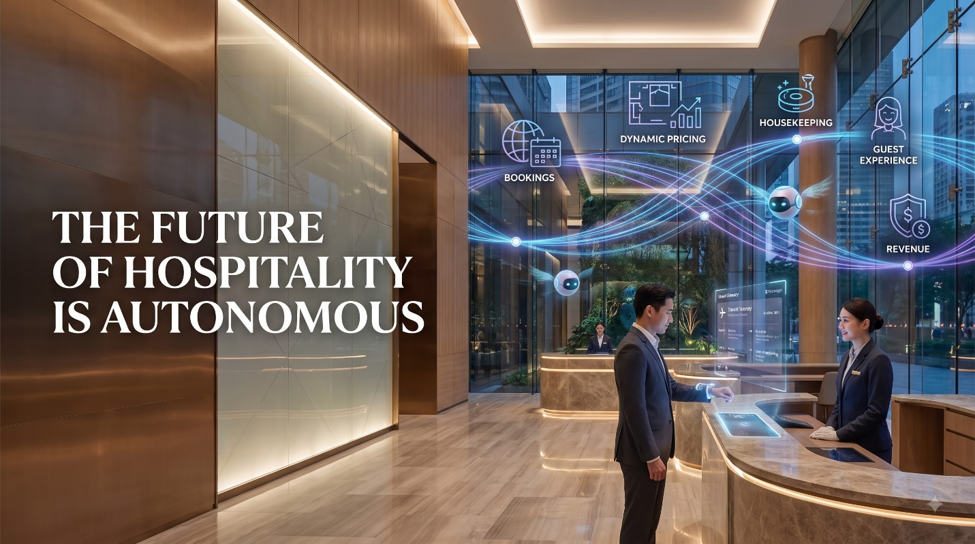
The travel and hospitality industry is entering a new era of intelligent operations. Hotels, resorts, OTAs, travel brands, and hospitality platforms are managing increasingly complex booking journeys, growing guest expectations, multiple distribution channels, and highly interconnected operational systems. Traditional automation can streamline individual tasks, but the next generation of hospitality technology is going further.
Autonomous AI agents can observe, reason, decide, act, and confirm outcomes across connected hospitality workflows.
From reservations and revenue management to guest experience, housekeeping, loyalty, and service recovery, Agentic AI is creating new possibilities for organizations looking to operate smarter while delivering more personalized guest experiences.
From Traditional Automation to Autonomous Hospitality
Traditional automation typically follows predefined rules:
If X happens → perform Y.
Agentic AI introduces a more intelligent approach:
Observe → Understand → Decide → Act → Confirm
An AI agent can evaluate information from multiple systems, understand the business context, determine an appropriate action, interact with authorized enterprise tools, and verify whether the action produced the intended result.
For example, instead of simply notifying a revenue manager that demand is increasing, an AI agent could analyze occupancy, booking pace, rate information, market signals, and property rules; recommend an appropriate pricing action; execute an approved change through the relevant system; and verify that the updated rate was successfully published.
This represents a fundamental shift from task automation to intelligent workflow execution.
How Autonomous AI Agents Can Transform Hospitality
1. Intelligent Property & Reservation Management 🏨
Reservations sit at the center of every hospitality operation. Managing availability, restrictions, inventory, cancellations, group bookings, and overbooking scenarios can require constant coordination between teams and systems.
Autonomous AI agents can continuously monitor reservation information across PMS, CRS, and channel management platforms.
They can help organizations:
- Monitor real-time availability and restrictions
- Identify potential overbooking situations
- Triage waitlists and reservation exceptions
- Coordinate group and event room blocks
- Detect inventory inconsistencies across channels
- Assist with allocation decisions
- Escalate high-risk reservation issues
The result is a more intelligent reservation workflow where teams can focus on exceptions and high-value decisions instead of repetitive monitoring.
2. AI-Powered Guest Experience & Concierge 🤖
Guest expectations are changing rapidly. Travelers want immediate, personalized, and context-aware assistance before, during, and after their stay.
AI agents can support guest journeys by understanding relevant guest and property information and interacting with approved hospitality systems.
For example, a guest might request a late checkout while also asking for a restaurant recommendation.
An AI agent can evaluate hotel policies, availability, guest context, and relevant recommendations before providing an appropriate response or initiating an authorized workflow.
Potential applications include:
- Pre-arrival communication
- In-stay digital concierge
- Guest request management
- Personalized recommendations
- Front-desk agent assistance
- Service recovery workflows
- Post-stay engagement
The objective isn’t simply faster communication.
It is more relevant, personalized, and context-aware guest service.
3. Smarter Revenue Management & Pricing 📈
Revenue management requires continuous analysis of multiple business signals.
Occupancy, booking pace, demand patterns, room availability, competitor pricing, seasonality, events, cancellation trends, and distribution channels can all influence pricing decisions.
Agentic AI can help revenue teams analyze these signals and support:
- Demand forecasting
- Rate recommendations
- Length-of-stay analysis
- Occupancy-based pricing insights
- Channel parity monitoring
- Pricing anomaly detection
- Revenue opportunity identification
- Explainable pricing recommendations
Instead of simply asking, “What happened?”, revenue teams can move toward answering:
“What should we do next?”
With appropriate policies and approvals, AI agents can also execute authorized actions while maintaining human oversight for higher-risk decisions.
4. Autonomous Housekeeping & Property Operations 🧹
Housekeeping and property operations depend on accurate, timely coordination.
Room status, guest checkout information, maintenance requests, VIP arrivals, early check-ins, and room-readiness requirements can all affect operational priorities.
AI agents can help coordinate these signals to:
- Prioritize room cleaning
- Optimize housekeeping assignments
- Identify rooms requiring urgent attention
- Route maintenance requests
- Monitor service-level agreements
- Identify operational bottlenecks
- Coordinate room readiness with front-desk teams
Instead of departments working from disconnected information, agentic workflows can create a shared operational view of the property.
5. Loyalty, Marketing & Channel Management 🎯
Personalization has become a major differentiator in travel and hospitality.
AI agents can work with approved guest profiles, stay history, loyalty information, booking behavior, and campaign data to support more relevant customer engagement.
Potential applications include:
- Personalized loyalty offers
- Guest segmentation
- Campaign recommendations
- Cross-sell and upsell opportunities
- OTA fallout detection
- Channel performance monitoring
- Loyalty benefit recommendations
For organizations managing multiple distribution channels, AI agents can also help identify inconsistencies and exceptions before they become customer-facing problems.
The Technology Behind Agentic Hospitality
Building autonomous AI agents for enterprise hospitality requires more than simply connecting an LLM to a chatbot.
Production-grade solutions need AI orchestration, enterprise data, secure tool access, contextual retrieval, governance, observability, and reliable integrations.
Multi-LLM Orchestration
Different hospitality workflows can require different AI capabilities.
Multi-LLM orchestration allows organizations to route requests based on factors such as:
- Business intent
- Complexity
- Cost
- Latency
- Risk
- Reasoning requirements
This creates more flexible and resilient AI architectures.
MCP Integration
Model Context Protocol (MCP) can enable AI agents to interact with enterprise tools through structured interfaces.
In hospitality environments, this can connect agents with:
- PMS
- CRS
- CRM
- Channel managers
- Payment platforms
- Ticketing systems
- Operational applications
With appropriate permissions, validation, and monitoring, agents can interact with enterprise systems while maintaining controlled access and traceability.
RAG & Vector Search
Hospitality organizations possess large amounts of operational knowledge, including:
- Property policies
- SOPs
- Brand standards
- Cancellation rules
- Guest service guidelines
- Operational documentation
- Product information
Retrieval-Augmented Generation (RAG) allows agents to retrieve relevant information before responding or taking action.
This helps ground AI outputs in organization-specific knowledge and current operational context.
Knowledge Graphs
Hospitality data is highly interconnected.
A guest may have loyalty status, previous stays, preferences, service requests, and relationships with multiple properties.
Knowledge graphs can help represent these relationships and provide AI agents with richer business context.
Together, RAG, vector search, and knowledge graph reasoning can help agents produce more grounded and explainable decisions.
Enterprise Guardrails: Autonomy with Accountability
Autonomous does not mean uncontrolled.
Hospitality workflows can involve financial, operational, privacy, and customer-experience risks.
For example:
- Changing room rates
- Offering compensation
- Modifying reservations
- Moving guests between properties
- Accessing guest information
- Processing refunds
These actions require appropriate policies and controls.
A robust agentic architecture can follow a workflow such as:
Input Guardrails → Policy Validation → Agent Reasoning → Tool Authorization → Action → Verification → Audit Trail
Human-in-the-loop controls can be introduced for sensitive or high-impact actions.
This creates the right balance between automation, autonomy, and accountability.
From Fragmented Systems to Connected Hospitality Operations
One of the biggest technology challenges in hospitality is not necessarily the absence of software.
It is the presence of multiple disconnected systems.
PMS, CRS, CRM, channel managers, revenue platforms, payment systems, housekeeping applications, loyalty platforms, and customer service tools often operate independently.
Agentic AI can help orchestrate workflows across these systems.
Instead of employees manually moving information between applications, AI agents can coordinate authorized workflows across the technology ecosystem.
This creates a connected operational journey:
Booking → Reservation → Guest Experience → Operations → Revenue → Service Recovery → Loyalty Every stage can become part of an intelligent workflow.
The Future of Hospitality Is Human + AI
The purpose of Agentic AI is not to remove the human element from hospitality.
Hospitality is fundamentally about people.
AI agents can handle repetitive monitoring, information retrieval, coordination, and routine actions—allowing employees to focus on interactions that require empathy, judgment, creativity, and human connection.
The future of hospitality can move from:
Employees + disconnected systems
to:
Employees + AI agents + connected enterprise systems
That is where autonomous operations can become a genuine competitive advantage.
Building the Next Generation of Travel & Hospitality Technology
At ideyaLabs, we help organizations explore and build AI-powered solutions across the travel and hospitality ecosystem.
Our capabilities span:
- Property & Reservation Management
- Guest Experience & AI Concierge
- Revenue Management & Pricing
- Housekeeping & Operations
- Loyalty & Marketing
- Channel Management
- Travel Marketplaces & Integrations
- Custom Autonomous AI Agent Development
We combine AI agents, multi-LLM orchestration, MCP integration, RAG, vector search, knowledge graphs, enterprise guardrails, and modern cloud architecture to build intelligent solutions around real hospitality workflows.
The objective is simple:
Automate More. Serve Better. Grow Smarter.
The Next Chapter of Hospitality Has Already Begun
Travel and hospitality are moving beyond chatbots and rule-based automation.
The next generation of hospitality platforms will be defined by AI agents capable of understanding context, making decisions, executing actions, and coordinating workflows across enterprise systems.
From the moment a guest makes a booking to the moment they check out—and even through service recovery and loyalty engagement—autonomous AI agents can become part of every stage of the guest journey.
The opportunity isn’t simply to add AI to hospitality. It is to reimagine how hospitality operates with AI at the center. 🚀
👉 Explore Travel & Hospitality Software Development with ideyaLabs:
https://www.ideyalabs.com/travel-and-hospitality/
