

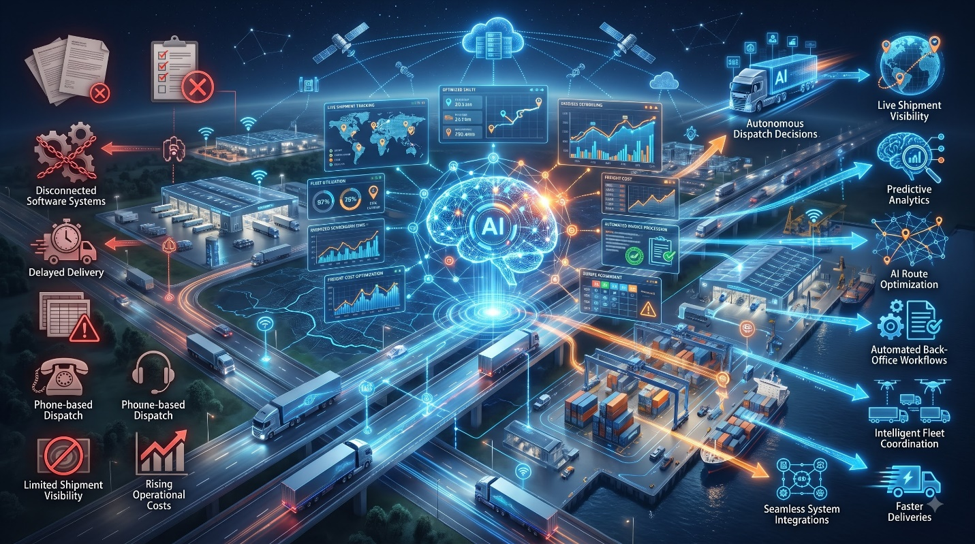
The transportation and logistics sector is always under pressure to increase delivery speed, cut costs, and offer customers 100% real-time visibility. With the growing complexity of supply chains and rising customer expectations, logistics companies need more intelligent solutions to manage their operations, speed, accuracy, and profitability.
In many transportation companies, despite huge investments in digital transformation, a lot of processes are still manual, systems are not integrated, and decisions are made in reaction to events. Such challenges can result in inefficiency, increased expenses, delivery delays, and inconsistent customer experiences.
While traditional logistics software can automate certain tasks, it is not always capable of making intelligent decisions throughout the logistics ecosystem. In today’s transportation industry, businesses require solutions that can process data, learn from patterns of their operations, and provide real-time informed decisions.
This is where AI Agents are making a difference in the industry.
At ideyaLabs, we assist transportation and logistics companies with intelligent AI Agents to streamline and modernize their operations, automate intricate workflows, optimize logistics planning, and facilitate autonomous decision-making across the supply chain. With our AI-driven offerings, companies can streamline their operations, cut expenses, and provide outstanding customer experiences while paving the way for the future of intelligent logistics.
The significance of AI in the Transportation & Logistics Sector.
Before a shipment gets to its destination, hundreds of decisions are made that are critical to the shipment. From pricing and carrier selection to route planning, dispatch coordination, invoice processing, and customer communication, each step plays a vital role in ensuring efficient logistics operations.
But there are still a lot of transportation companies that rely on manual methods to handle these processes. These traditional processes slow down decision-making, add cost, and cause operational bottlenecks as shipment volumes continue to rise.
Some of the most common challenges include:
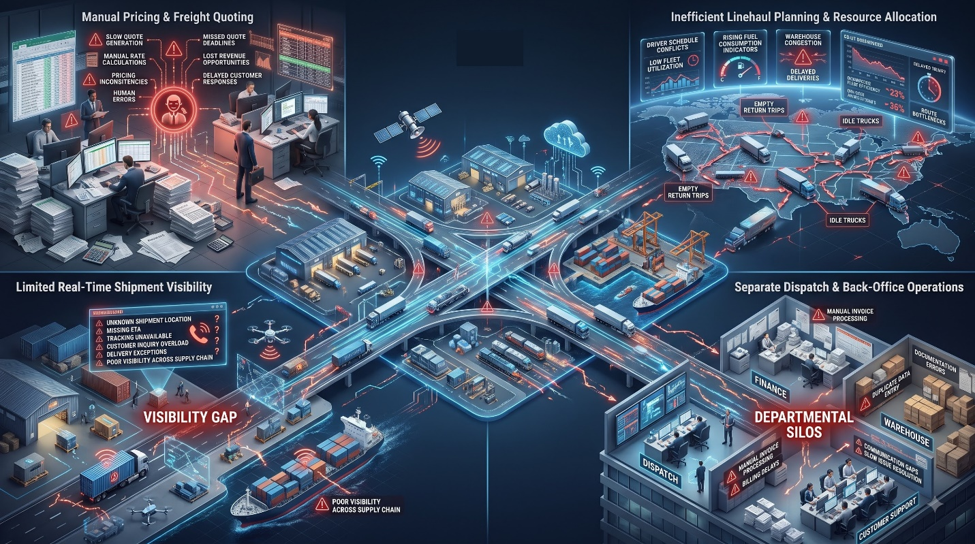
Manual Pricing
The price of freight is constantly fluctuating with changes in fuel prices, market demand, carrier availability, seasonal variations and transportation capacity. To stay profitable and competitive, it’s crucial to react promptly to these changes.
When it comes to quoting freight, many logistics providers are still manually searching through spreadsheets, past contracts, and various carrier rate sheets. This can be time-consuming and leads to the potential of inaccurate prices and human error.
Consequently, organizations can have:
• Failure to respond to customers with follow-up calls after they submit a quote request
• Failure to provide accurate quotes or estimates of costs and benefits for the same service to different customers or in different areas
• Calculating the rates manually by humans
• Missed out on business opportunities because of late quotations
• Loss of profit because of bad pricing
Salespeople waste hours on quoting freight and figuring out rates, rather than working on new customers and business relationship building.
Linehaul Planning and Resource Allocation is Not Efficient
One of the most challenging activities in transportation and logistics is linehaul planning. Logistics planners face a number of different variables each day to ensure goods flow smoothly in the logistics system.
Some of the main reasons are:
• Vehicle availability
• Driver schedules
• Freight volumes
• Route optimization
• Delivery priorities
• Warehouse capacities
These variables are usually managed manually, resulting in less-than-optimal planning and resource use.
Organizations often find themselves facing:
Empty return trips that are costly to run
• Fleets with a higher number of vehicles but lower productivity
• Increased fuel usage from sub-optimal routing
Delayed deliveries and longer transit times.
• Increased operational expenses
Even minor transportation planning inefficiencies can make a substantial difference in the overall cost of transportation. If not intelligently optimized, fleets are not being fully used and are therefore limiting profitability and operational performance.
Limited Real-time Shipment Visibility
Customers want to be able to see the entire transportation process today. Whether it is a business shipment or a customer delivery, they want to know exactly where their shipment is and when it will arrive.
Unfortunately, numerous logistics enterprises have yet to achieve complete system connectivity, and as a result, they are still not able to provide accurate and timely shipment updates.
Some of the common visibility issues are:
• Lack of shipment tracking updates in time
• Several separate tracking systems
• Missing delivery milestones
Limited or inaccurate ETAs based on predictions.
• Inadequate exception handling on the way
These restrictions cause operations personnel to spend countless hours answering customer queries like ‘Where is my shipment?’, rather than working on strategic initiatives that can improve the performance of overall logistics.
No real-time visibility means businesses can’t move fast to meet disruptions, can’t proactively communicate with customers, and can’t make informed business decisions.
Separate dispatch and back office operations
Seamless coordination within dispatch teams, finance departments, warehouse operations, customer support teams, and back-office staff is essential for efficient logistics operations. Unfortunately, many transportation companies still run these departments on a standalone basis, and they don’t communicate effectively with each other.
This lack of integration causes inefficiency in operations, which impacts the entire supply chain.
Some of the most frequent challenges are:
- Poor data quality and analysis
- Manual invoice generation
- Billing delays
- Documentation errors
- Departmental silos are also a problem, as they create communication gaps.
- Slow issue resolution
Organizations that have critical business functions existing in isolation lose time, incur unnecessary administration costs and decrease productivity. Departments don’t work seamlessly together in a connected ecosystem; they waste time fixing mistakes, manually transferring data, and solving unnecessary operational problems.
With the ongoing growth of logistics networks, the problem of isolated operations grows increasingly challenging, and intelligent automation is the answer to sustainable growth.
AI Agents are transforming logistics. AI Agents are reshaping logistics.
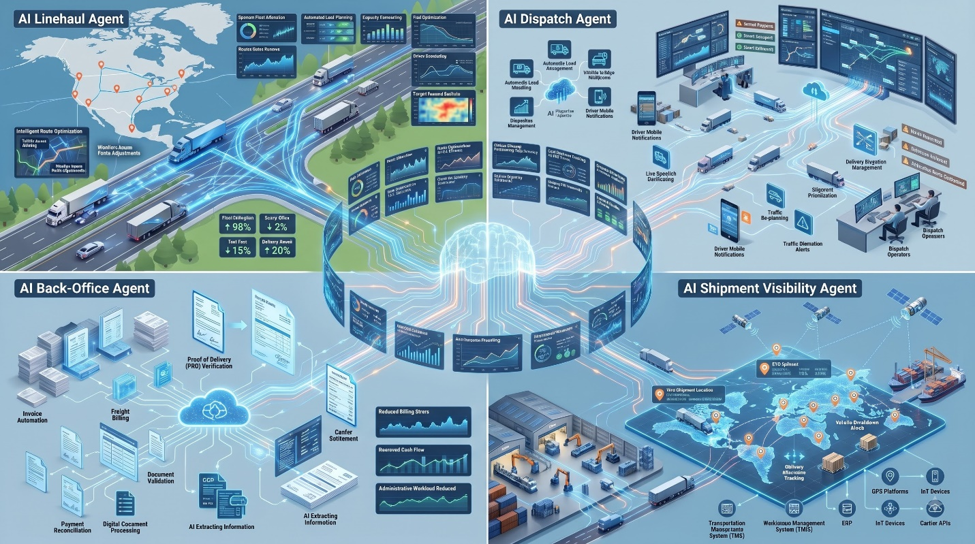
Traditional automation has helped logistics companies to minimize manual effort by automating repetitive tasks. But the transportation network of today requires more than just rule-based automation. In today’s business landscape, there is an increasing need for systems to analyze complex situations, adapt to changing conditions, and make intelligent decisions in real time.
That’s where AI Agents are transforming the logistics landscape.
AI Agents can comprehend business context, process data from various enterprise systems, detect trends, provide suggestions, and independently perform actions with minimal human intervention – unlike traditional automation solutions. These smart agents work together among various departments, thereby handling the entire logistics process, thus forming a connected and very efficient operation system.
Our AI-powered Agents learn from the operational data of transportation and logistics businesses, continually evolving to meet new challenges and opportunities and helping improve decision-making throughout the supply chain at ideyaLabs. This leads to higher speeds, better resource utilization, and more dynamic logistics network.
AI Agent for Linehaul Management.
Planning linehaul is among the most difficult parts of transportation management. On a daily basis, logistics teams will need to weigh thousands of variables to ensure the right freight is transported in a timely and cost-efficient manner without compromising the quality of service.
The AI-powered Linehaul Agent constantly analyzes important operational data such as:
- Freight demand
- Vehicle capacity
- Driver availability
- Traffic conditions
- Delivery priorities
- Historical shipment patterns
- Fuel costs
This data is processed in real-time, allowing the AI Agent to automatically generate optimized routes and schedules that minimize empty miles, maximize fleet utilization, and streamline shipments through the network as much as possible.
In contrast to traditional planning approaches, the AI Agent is continuously adjusting to fluctuating factors like traffic jams, weather conditions, vehicle availability, and sudden alterations in shipments. This allows logistics teams to act swiftly without having to manually redo schedules.
Key Capabilities
• Intelligent route optimization
• Automated load planning
• Dynamic fleet allocation
• Capacity forecasting
• Predictive delivery scheduling
• Real-time route adjustments
Business Benefits
• Higher fleet utilization
• Reduced transportation costs
• Lower fuel consumption
• Faster deliveries
• Refined driver productivity
• Improved resource allocation and planning for operations
The AI Linehaul Agent enables logistics companies to streamline complex planning tasks, ensuring efficient operations and delivering timely, reliable service throughout their transportation network.
AI Agent for Dispatch Operations
Dispatch teams are responsible for coordinating hundreds—or even thousands—of shipment requests every day. It can be time-consuming to process these requests manually, and hard to meet the increasing demands of the operations quickly.
By automating and streamlining the dispatch process, the AI Dispatch Agent enables organizations to make quicker and more accurate dispatch decisions, while simultaneously minimizing manual effort.
The AI Agent can:
Assign loads to vehicles automatically based on the availability of vehicles.
• Match the capacity of the most appropriate vehicles with shipment requirements
• Inform drivers immediately of deliveries made
Proactively manage delivery exceptions
• Track orders in real time
• Suggest alternative ways to travel when there are disruptions
- This saves dispatch teams hours of manual shipping coordination, allowing them to focus on overseeing shipping, handling high-priority exceptions, and enhancing service quality.
The AI Agent regularly checks operational information, allowing it to rapidly alert you to any potential problems and suggests corrective measures, preventing service disruptions or delays in delivery commitments.
Business Benefits
- Faster dispatch decisions
- Reduced manual workload
- Upgraded shipment coordination
- Better asset utilization
- Greater reliability with both deliveries and collections
- Increased operational efficiency
Intelligent automation not only optimizes dispatch processes but also enhances responsiveness, minimizes delays, and ensures a more dependable customer experience for logistics companies.
Incorporate AI Agent for Back-Office Automation.
Even though back-office operations are an important part of the transportation and logistics industry, many companies are still stuck with manual back-office processes. These tedious tasks waste time, add unnecessary expenses, and add unnecessary mistakes in everyday tasks.
- Some of the common back-office processes are:
- Invoice generation
- Proof of Delivery (POD) verification
- Freight billing
- Document validation
- Carrier settlement
- Payment reconciliation
Manually doing these tasks can slow down financial processes, postpone client invoicing and lead to inconsistencies throughout business systems.
These processes can be automated using an AI-powered Back-Office Agent, which can extract information from documents, validate data, match records across systems, and trigger the necessary business processes, with minimal manual effort.
This frees up time for staff to dedicate to more valuable tasks like customer service, financial planning, and optimizing operations.
Business Benefits
- Faster invoice processing
- Reduced billing errors
- Enhanced cash flow
- Lower administrative costs
- Higher operational efficiency
- Increased efficiency in financial and operational activities
Beyond productivity gains, AI Back-Office Agent enhances logistics operations by guaranteeing consistency, compliance, and transparency.
Real-Time Shipment Visibility with AI.
Real-time shipment visibility is no longer a nice-to-have feature; it’s a customer expectation. Customers monitor one shipment or thousands of shipments in various regions; they want information that is timely and accurate at each point in the transportation journey.
But it’s hard for many logistics organizations to achieve this level of visibility because key shipment information resides in many different systems. Consequently, operations teams are unable to have a single view of their transportation network and do not know the issues until they affect deliveries.
- By seamlessly integrating with existing logistics systems, AI Agents address these challenges, such as:
- Transportation Management Systems (TMS)
- Warehouse Management Systems (WMS)
- GPS tracking platforms
- Enterprise Resource Planning (ERP) systems
- IoT devices and sensors
- Carrier APIs
This integration enables AI Agents to give a unified and up-to-the-minute perspective of all goods navigating the supply chain.
Operations teams are instantaneously notified when they need to pay attention to critical events such as:
- Delivery delays
- Route deviations
- Vehicle breakdowns
- Traffic disruptions
- Weather-related impacts
AI Agents can also leverage predictive analytics to anticipate possible disruptions beyond just tracking shipments. This gives logistics teams the opportunity to manage and act quickly and proactively to the customer to mitigate the effects of the unforeseen.
Full visibility into transportation operations can boost customer satisfaction, minimize service disruptions, and facilitate decisions more quickly.
Optimizing the Supply Chain Decision-Making Process.
Dashboards and historical reports have become too limited in modern logistics. Companies require smart systems that can process real-time data from operations and make the most appropriate decision based on the circumstances.
By continually watching logistics operations, pinpointing trends, finding anomalies, and creating actionable suggestions, AI Agents can aid organizations in enhancing efficiency and cost reduction.
Examples include:
• Choosing the cheapest carrier for each shipment
• Suggesting alternative routes in traffic or weather disruptions
• Planning to prevent capacity shortage before it impacts operations
• Estimating the demand for the shipment based on the historical and real-time data
• Finding opportunities to lower transportation costs
• Focusing on high-value or time-sensitive deliveries
Logistics teams can now get real-time intelligence rather than having to manually analyze and report on information.
AI Agents continually improve their accuracy over time, leveraging data from operational systems, allowing organizations to enhance planning, optimize resource utilization, and adapt rapidly to shifting business conditions.
No-code Enterprise System Integration.
One of the most difficult problems transportation and logistics organizations have is the lack of integration between business-critical systems. Data is frequently stored on various platforms, leading to data silos and hindering operational efficiency and visibility.
AI Agents from ideyaLabs is designed to easily integrate with existing enterprise applications, ensuring seamless connection of the technology ecosystem while avoiding the need to replace current infrastructure.
Our AI-powered solutions work with:
• Transportation Management Systems (TMS)
• Business Intelligence (BI) tools and applications
• Control of Inventories (CI)
• Call centre software systems
• Product development and design
• Fleet management software
• Third-party carrier networks
• Logistics and transportation applications that have already been developed
AI Agents bring these systems together to provide a seamless operational environment, enabling information to flow effortlessly between departments.
This end-to-end network not only helps to avoid redundancies in data entry but also significantly cuts down on manual efforts, enhances the collaboration between different logistics stakeholders, and facilitates intelligent automation across the entire organization.
All departments have access to real-time, accurate information, resulting in quicker decision-making, more efficient operations, and increased customer satisfaction.
Experience Business Outcomes with ideyaLabs AI Agents
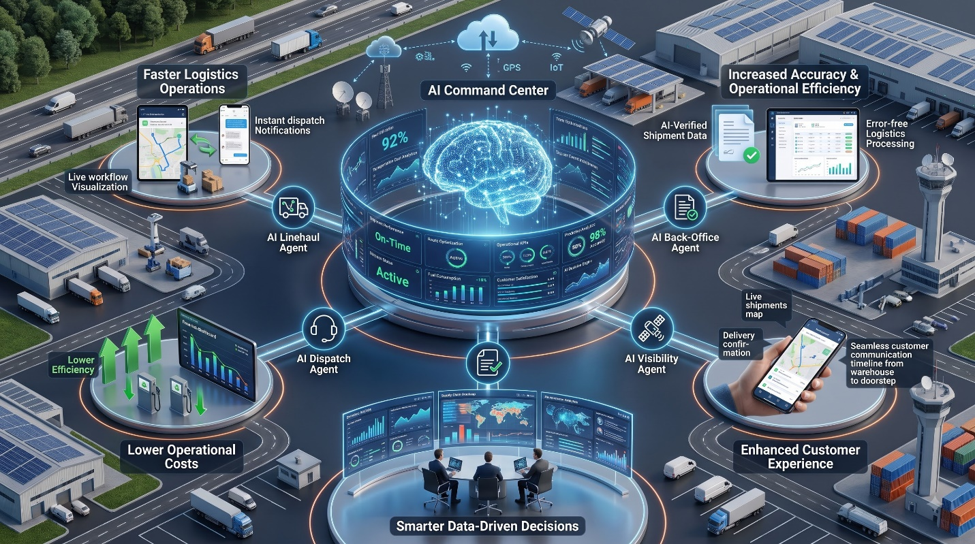
Companies implementing AI in logistics see tangible benefits throughout the transportation process. Intelligent automation paired with real-time decision-making can enhance efficiency, cut costs, and boost overall supply chain performance.
Faster Logistics Operations
AI Agents handle tedious, time-consuming tasks like shipment planning, dispatch coordination, invoice processing, and customer communication. This can significantly improve processing times and enable logistics teams to be more responsive to shifting demands in the business.
Lower Operational Costs
Fuel consumption and labour costs are reduced while fleet utilization is improved, along with administrative and operational costs, through intelligent route optimisation, automated workflows and predictive planning to minimise unnecessary operational overhead.
Increased accuracy and efficiency.
AI Agents can also cut down on human mistakes in the logistics process, from pricing to dispatching, billing, documentation, and reporting, enhancing consistency.
Enhanced Customer Experience
Real-time shipment visibility, predictive delivery timelines, proactive notifications, and quicker problem resolution help organizations deliver a better customer experience and foster long-term customer relationships.
Smarter Data-Driven Decisions
AI Agents continuously process operational data to provide real-time insights, enabling logistics leaders to make quicker and more informed decisions. Whether it’s capacity planning or cost optimization, organizations can benefit from the intelligence to optimize performance throughout the supply chain.
These capabilities, when combined, have more than just an operational impact. Organizations are able to be more agile, resilient, and adaptable to market, customer and business demands.
AI Agents from ideyaLabs offer a way for transportation and logistics businesses to transcend conventional automation and usher in an era of intelligent operations that yield tangible benefits now and hold the promise for the future of autonomous logistics.
Given that logistics is a fundamental part of the business, the Future of Logistics is Autonomous.
Today’s transportation and logistics sector is on the verge of a new age in which intelligence, automation, and data-driven decisions are crucial components for sustained success. With an increasingly complex supply chain and ever-rising customer expectations, companies can no longer afford to rely on manual processes or outdated automation strategies to stay competitive.
AI Agents have been transforming logistics, collaborating with human teams to handle more complex operations. These intelligent agents are not meant to replace humans, but to augment and empower logistics professionals by freeing up time from repetitive tasks, offering real-time insights into operations, and facilitating quicker and more informed decision-making.
AI Agents can assist companies with tasks like planning and dispatching shipments, and managing financial activity, among others, by optimising workflows and minimising manual tasks and interdepartmental collaboration. This frees staff to concentrate on strategic actions, client interactions, and ongoing operations enhancement.
The inability to meet customer expectations, manage operational costs, and quickly adapt to market conditions is becoming a major challenge for organizations that are still stuck with disparate systems and manual processes. Businesses that adopt AI-driven logistics, on the other hand, will be better equipped to optimize their supply chains, improve customer service, and gain a competitive edge that helps them operate more efficiently and effectively.
At ideyaLabs, we don’t just stop at traditional automation – we empower organizations in the transportation and logistics sectors to leverage intelligent AI Agents in Linehaul Management, Dispatch Operations, Back-Office Automation, and Real-Time Supply Chain Visibility. Our AI-based solutions can be seamlessly integrated with the currently present enterprise systems, thus enabling organizations to set up connected, intelligent, and autonomous logistics.
Logistics companies that adopt intelligent automation today will have a massive edge over their competitors tomorrow, as AI continues to develop. The future lies with the companies that can integrate human intelligence with AI capabilities to provide quicker, smarter, and more efficient logistics services.
Conclusion
Organizations that can leverage intelligent automation and AI-driven decision-making will be the ones leading the transportation and logistics industry into the future. With the growing dynamism of supply chains, companies are looking for more than software; they are turning to intelligent systems that can process data, adjust to shifts, and fine-tune operations in real time.
AI Agents are changing the way logistics functions at every stage, from planning to dispatch, to visibility, financial operations, and supply chain optimization. Organizations can create outstanding client experiences, improve precision, boost effectiveness, and lower operating expenses by automating repetitive tasks and helping to make data-driven decisions.
With a wealth of industry experience and cutting-edge artificial intelligence (AI) technology, ideyaLabs is poised to empower transportation and logistics businesses to create more intelligent, efficient, and connected operations. Our AI Agents work seamlessly with existing systems, automate important business processes, and offer real-time insights to help organizations make smarter, agiler, and more confident decisions.
From optimizing linehaul planning to automating dispatch operations, streamlining back-office processes, enhancing shipment visibility, and making better supply chain decisions, ideyaLabs offers you a suite of AI-powered solutions that can help you take a step towards digital transformation.
The logistics sector is undergoing rapid transformation, and businesses that adopt AI technologies now will be well-positioned to navigate future challenges and opportunities. Intelligent automation can help businesses develop resilient supply chains, streamline operations and achieve long-term growth.
Are you looking to change your Transportation & Logistics?
Collaborate with ideyaLabs to maximize the capabilities of AI Agents and create a smart logistics environment that enhances efficiency, lowers expenses, provides better visibility, and offers top-tier customer experiences. Let’s work together to help you get there faster to operate your transportation systems independently and be ready for the future in supply chains.
