

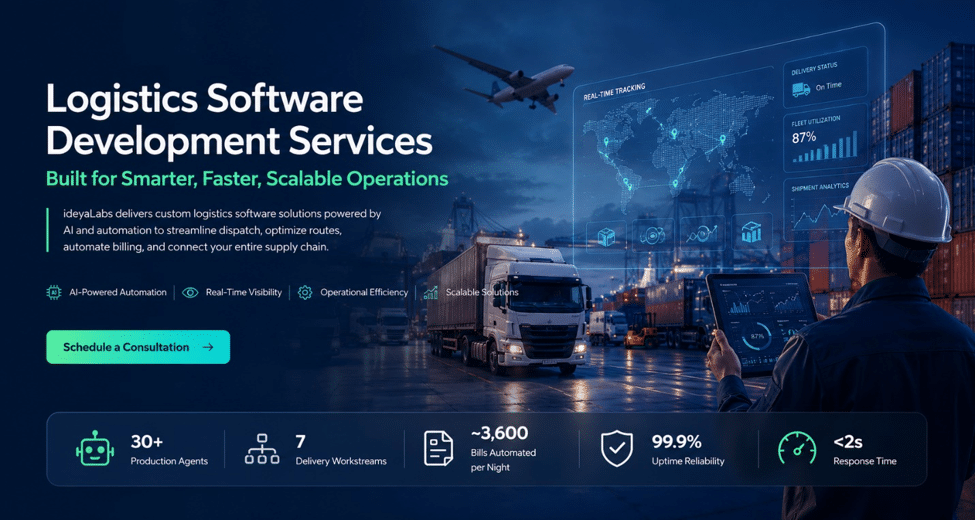
Modern transportation companies face constant pressure to move freight faster, reduce operating costs, improve visibility, and deliver exceptional customer experiences. Manual processes, disconnected systems, and legacy transportation software often create delays that affect profitability and customer satisfaction.
Logistics Software Development Services help transportation providers replace fragmented operations with intelligent, connected, and scalable digital solutions. From dispatch management and route planning to automated billing and customer portals, custom logistics software enables organizations to streamline operations while preparing for future growth.
Today, the combination of cloud computing, artificial intelligence, machine learning, IoT, and automation is redefining how logistics businesses operate. Organizations are investing in intelligent logistics platforms that analyze operational data, automate repetitive tasks, and support better decision-making across the entire supply chain.
Why Businesses Need Logistics Software Development Services
The transportation and logistics industry generates enormous volumes of operational data every day. Dispatch teams monitor shipments, warehouse teams coordinate inventory, drivers update delivery statuses, finance departments process invoices, and customer service representatives respond to shipment inquiries.
Without an integrated software platform, these activities become disconnected, increasing manual effort and reducing operational efficiency.
Professional Logistics Software Development Services create centralized platforms that connect every department, providing real-time visibility and automation across transportation workflows.
Benefits include:
- Faster shipment planning
- Real-time fleet visibility
- Automated dispatch operations
- Intelligent route optimization
- Digital document management
- Reduced operational costs
- Improved customer communication
- Accurate billing and invoicing
- Better compliance management
- Higher productivity across operations
Key Features of Modern Logistics Software
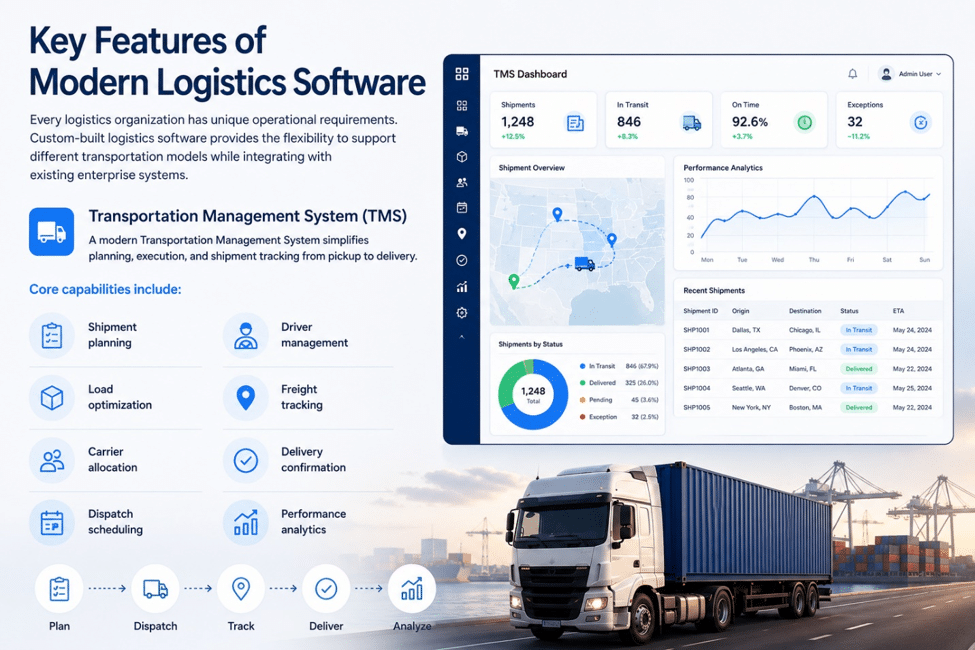
Every logistics organization has unique operational requirements. Custom-built logistics software provides the flexibility to support different transportation models while integrating with existing enterprise systems.
Transportation Management System (TMS)
A modern Transportation Management System simplifies planning, execution, and shipment tracking from pickup to delivery.
Core capabilities include:
- Shipment planning
- Load optimization
- Carrier allocation
- Dispatch scheduling
- Driver management
- Freight tracking
- Delivery confirmation
- Performance analytics
AI-Powered Dispatch Automation
Dispatch teams manage hundreds or even thousands of shipments every day. Intelligent automation reduces manual intervention by monitoring transportation events continuously.
AI-powered dispatch solutions can:
- Detect delivery delays
- Monitor ETA deviations
- Recommend alternate routes
- Trigger rescue operations
- Identify stranded vehicles
- Support carrier reassignment
- Prioritize urgent shipments
- Notify customers automatically
This significantly improves response times while allowing dispatchers to focus on complex operational decisions.
Intelligent Route Optimization
Fuel expenses remain one of the largest operational costs for logistics companies.
Custom logistics software analyzes multiple factors simultaneously, including:
- Traffic conditions
- Weather forecasts
- Delivery priorities
- Vehicle capacity
- Driver availability
- Fuel consumption
- Road restrictions
The software recommends optimized routes that reduce travel time while improving fleet utilization.
Automated Billing and Invoice Processing
Billing delays directly impact cash flow.
Modern Logistics Software Development Services automate invoice generation by validating transportation rates, shipment details, accessorial charges, and contractual pricing.
Automation supports:
- Freight bill generation
- Rate validation
- Invoice auditing
- Digital approvals
- Payment tracking
- Exception handling
- Financial reporting
Organizations reduce manual errors while accelerating billing cycles.
Customer and Carrier Self-Service Portals
Customers expect real-time shipment visibility without contacting support teams.
Custom portals allow customers to:
- Track shipments
- Download invoices
- View delivery history
- Raise support requests
- Monitor freight status
- Access reports
Carrier portals improve collaboration by enabling transport partners to manage loads, upload delivery documents, receive assignments, and communicate with dispatch teams.
Warehouse and Inventory Integration
Warehouse operations become more efficient when logistics software integrates directly with inventory management systems.
Integrated platforms enable:
- Stock visibility
- Dock scheduling
- Shipment preparation
- Barcode scanning
- Inventory synchronization
- Receiving automation
- Order fulfillment
This minimizes inventory discrepancies while improving warehouse productivity.
AI Agents for Logistics Operations
Artificial intelligence is rapidly transforming transportation management.
Instead of relying entirely on manual monitoring, intelligent AI agents continuously analyze operational events and assist logistics teams throughout the shipment lifecycle.
Examples include:
- Dispatch assistants
- Billing assistants
- Compliance monitoring agents
- Shipment tracking agents
- Customer support assistants
- Load planning assistants
- Reporting automation agents
- Exception management agents
These intelligent systems monitor business events, identify operational risks, recommend actions, and automate repetitive workflows while maintaining complete operational visibility.
Real-Time Analytics and Business Intelligence
Transportation leaders require accurate operational insights.
Custom dashboards provide visibility into:
- Fleet utilization
- Delivery performance
- On-time percentages
- Revenue trends
- Carrier performance
- Fuel costs
- Driver productivity
- Shipment exceptions
- Billing accuracy
- Customer satisfaction
These insights support faster and more informed business decisions.
Integration with Enterprise Systems
Modern logistics platforms rarely operate independently.
Professional Logistics Software Development Services integrate with:
- ERP platforms
- CRM systems
- Transportation Management Systems
- Warehouse Management Systems
- GPS tracking providers
- Accounting software
- Payment gateways
- Customer support platforms
- IoT devices
- Third-party carrier APIs
This creates a unified digital ecosystem where information flows automatically across departments.
Security and Compliance
Transportation companies manage sensitive operational and financial information.
Enterprise logistics software includes:
- Role-based access control
- Multi-factor authentication
- Data encryption
- Audit logs
- Activity monitoring
- Secure API integrations
- Compliance reporting
- Backup and disaster recovery
Strong security ensures operational reliability while protecting business-critical data.
Industries That Benefit from Logistics Software
Custom logistics solutions support organizations across multiple industries, including:
- Freight transportation
- Third-party logistics (3PL)
- Manufacturing
- Retail
- E-commerce
- Distribution
- Cold chain logistics
- Healthcare logistics
- Automotive supply chains
- Food and beverage transportation
Each solution can be customized to meet industry-specific operational requirements.
Future Trends in Logistics Software Development
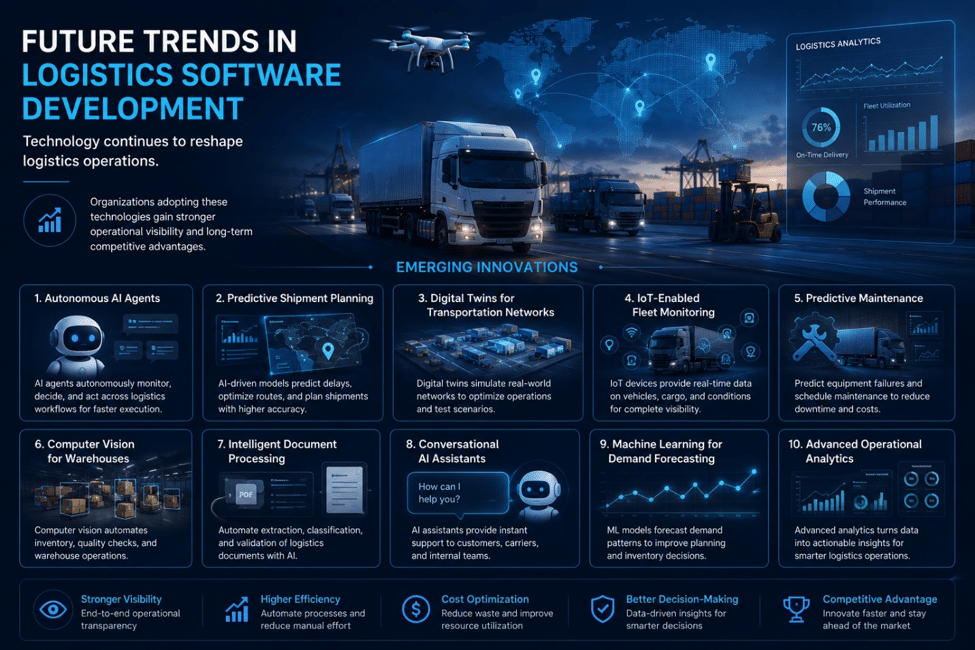
Technology continues to reshape logistics operations.
Emerging innovations include:
- Autonomous AI agents
- Predictive shipment planning
- Digital twins for transportation networks
- IoT-enabled fleet monitoring
- Predictive maintenance
- Computer vision for warehouses
- Intelligent document processing
- Conversational AI assistants
- Machine learning for demand forecasting
- Advanced operational analytics
Organizations adopting these technologies gain stronger operational visibility and long-term competitive advantages.
Conclusion
The logistics industry continues to evolve as customer expectations increase and transportation networks become more complex. Investing in Logistics Software Development Services enables businesses to automate operations, improve shipment visibility, optimize dispatch, streamline billing, and make faster data-driven decisions.
Custom logistics software combined with AI-powered automation creates a connected operational environment where transportation planning, dispatch management, warehouse operations, billing, compliance, and customer engagement work together seamlessly. Organizations that modernize today position themselves to improve efficiency, reduce operating costs, and scale confidently in an increasingly competitive logistics landscape.
