

Software development has entered an AI-driven era. Developers can analyze requirements, generate code, debug issues, and accelerate releases with AI-assisted development tools. Yet one critical part of the software lifecycle often remains heavily dependent on manual effort: quality assurance.
QA teams still spend significant time understanding requirements, designing test scenarios, preparing test cases and data, managing test cycles, executing tests, writing defects, and creating automation scripts. As development cycles become faster, this traditional approach can become a bottleneck.
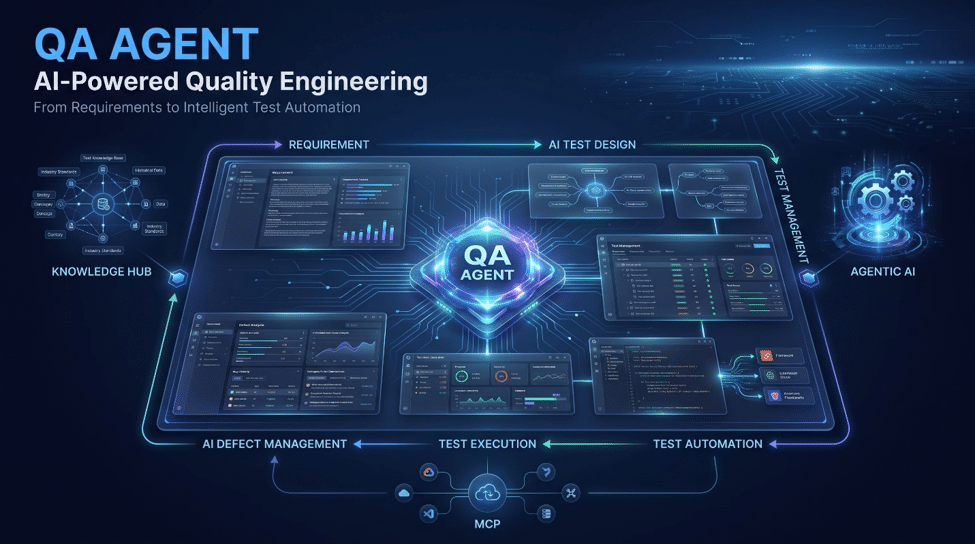
QA Agent by ideyaLabs is designed to close that gap by bringing AI into the quality engineering lifecycle—from requirements and test design to automation, execution, and defect management. The platform combines AI-driven testing capabilities, Knowledge Hub, Agentic AI, and MCP into a unified quality engineering environment.
Why Traditional QA Needs to Evolve
Modern engineering teams are shipping software faster, but faster development creates greater pressure on testing teams.
Traditional QA often requires teams to manually:
- Review requirements and Jira tickets
- Design test scenarios
- Create detailed test cases
- Prepare test data
- Build mindmaps and flowcharts
- Organize test suites and cycles
- Execute tests
- Document defects
- Create automation scripts
When these activities are performed across multiple tools and processes, testing can become fragmented. The result is additional manual effort, longer testing cycles, and increased pressure to maintain sufficient coverage. QA Agent approaches the problem differently by connecting these activities into a unified, AI-powered workflow.
From a Requirement to a Complete Test Strategy
One of QA Agent’s core capabilities is AI-driven test design.
Instead of starting with a blank document or test management screen, QA teams can provide requirements or user stories and use AI to transform them into structured testing assets.
QA Agent supports:
- AI-driven requirement analysis
- Automatically generated mindmaps and flowcharts
- Intelligent test scenario generation
- Detailed test cases
- Test data
- Test steps
- Expected results
This creates a connected path from business requirement to actionable testing artifacts.
The benefit is not simply generating more test cases. It is reducing the manual effort involved in test design while improving consistency and coverage.
One Platform for Test Management
Once test assets are generated, QA Agent continues into the management and execution stages.
Teams can create test suites and test cycles, execute test cases within the platform, generate execution reports and metrics, and connect testing to release-based workflows.
This creates a more centralized approach to functional testing instead of requiring QA teams to manage every stage through disconnected processes.
QA Agent also supports AI-assisted Jira defect creation for failed tests, helping connect test execution with defect management.
Turning Test Cases into Automation
Automation is another major part of the QA Agent platform.
The platform can convert functional test cases into automation scripts, helping teams move from manually designed tests to executable automation more quickly.
Its automation capabilities include:
- Automation script generation
- Script management and editing
- Cross-browser test execution
- Parallel test execution
- Test scheduling
- Continuous testing
- Execution videos and screenshots
- Automated Jira defect logging
- Self-healing test automation
Parallel execution can also transform the way regression suites are handled. The QA Agent presentation illustrates a scenario where 150 tests can move from approximately four hours of execution to about 35 minutes through parallel execution. The goal is not simply to automate individual tests. It is to create a scalable automation workflow that supports faster and more consistent testing across releases.
When a Test Fails, QA Agent Goes Beyond “Failed”
A failed test is only the beginning of a defect investigation.
Traditional workflows often require a QA engineer to manually examine the failure, compare expected and actual behavior, understand the problem, determine severity and priority, and then prepare a Jira defect.
QA Agent introduces AI-assisted defect analysis into this process.
When a test fails, the platform can analyze the failure using actual versus expected results and generate important defect information, including:
- Defect title
- Defect summary
- Steps to reproduce
- Severity
- Priority
QA teams can then review, edit, and create the defect in Jira. This helps reduce repetitive reporting work while improving the consistency and quality of defect information.
The Intelligence Behind QA Agent
The most interesting part of QA Agent is not just test generation. It is the intelligence layer supporting the testing lifecycle.
Knowledge Hub
QA Agent’s Knowledge Hub brings together application and domain information from sources such as code repositories, databases, external sources, content libraries, web domains, and internal documentation.
The platform also supports integrations with Confluence, Notion, and SharePoint.
This knowledge provides context to AI so that generated test artifacts can be more aligned with application workflows, dependencies, business context, and testing intent.
Agentic AI
The Agentic AI layer is designed as an intelligence engine that can generate, execute, and optimize tests end-to-end.
This moves QA beyond simple content generation toward an AI-driven testing lifecycle.
MCP
QA Agent also incorporates MCP as a universal connector.
Its capabilities include live discovery, resilient execution, scalable runtime, and a unified protocol for interacting with applications without relying on framework-specific logic.
MCP enables dynamic discovery of UI elements and application structures while supporting adaptive interaction and scalable execution.
A More Connected Quality Engineering Lifecycle
The real value of QA Agent comes from connecting these capabilities.
Instead of:
Requirement → Manual Design → Manual Testing → Manual Defect → Separate Automation
QA Agent creates a connected lifecycle:
Requirement → AI Analysis → Test Design → Test Management → Automation → Execution → AI Defect Management
That workflow brings testing closer to the speed of modern software development.
It also provides QA teams with a single environment spanning functional testing and automation rather than treating each activity as an isolated process.
Measurable Impact
The QA Agent presentation highlights four key value metrics:
80% Less Test Design Effort
10X Faster Test Case Generation
5X Faster Test Automation Creation
70% Better Test Coverage
The platform also demonstrates significant differences between manual QA and AI-assisted generation. For example, the presentation compares hours of manual effort for mindmaps, flowcharts, scenarios, and test cases with generation times ranging from under three minutes to several minutes through QA Agent.
These capabilities position QA Agent not merely as another test management tool, but as an AI-powered Quality Engineering platform designed to reduce repetitive work and accelerate the testing lifecycle.
Built for Modern Enterprise Engineering
QA Agent combines a modern application architecture with an AI and agent layer.
Its technology stack includes React, Tailwind CSS, Redux, Python, FastAPI, Rust, Node.js, MongoDB, and multiple AI providers including OpenAI, Anthropic, Groq, Gemini, Cohere, and Voyage. Its DevOps environment includes Grafana, GitLab, Jenkins, and S3.
The architecture also incorporates components such as RAG, LangGraph, knowledge graphs, semantic and hybrid search, MCP, MongoDB, Pinecone, Neo4j, Redis, and AWS S3, alongside integrations including Jira, TestRail, Notion, Confluence, and SharePoint.
This architecture supports the platform’s broader objective: bringing AI, application context, test intelligence, automation, and execution together within a scalable Quality Engineering environment.
The Future of QA Is Intelligent, Connected, and Automated
The next generation of Quality Engineering will not be defined simply by how many test cases a team can execute.
It will be defined by how intelligently those tests can be designed, contextualized, automated, executed, analyzed, and continuously improved.
QA Agent brings these capabilities together through AI-driven test design, centralized test management, automation generation, intelligent defect handling, Knowledge Hub, Agentic AI, and MCP.
For organizations looking to accelerate software delivery without allowing quality engineering to become the bottleneck, this shift represents a fundamental change in how testing can work.
QA Agent helps move QA from manual execution toward intelligent Quality Engineering—where AI supports the journey from requirement to reliable release.
