

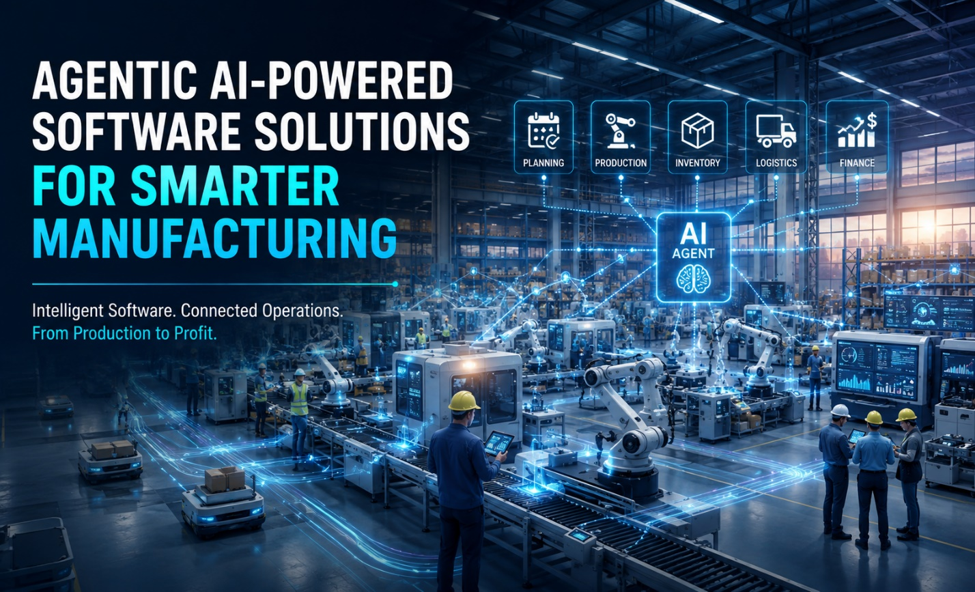
The manufacturing industry is entering a new era where software, automation, data, and Agentic AI are becoming essential to operational excellence. From procurement and production planning to inventory, logistics, and financial operations, manufacturers are looking for intelligent technology that can reduce manual effort, improve visibility, and enable faster decision-making.
This is where Software Development Services in the Manufacturing Industry can create significant value.
Modern manufacturing software is no longer limited to basic enterprise applications. Intelligent solutions can connect ERP, MES, WMS, TMS, PLM, analytics platforms, and AI agents to create a connected digital ecosystem that helps organizations move efficiently from production to profit.
Why Manufacturing Needs Intelligent Software Solutions
Manufacturing operations involve thousands of interconnected activities. A delay in procurement can affect production. Production changes can impact inventory. Inventory issues can affect logistics, customer deliveries, and ultimately revenue.
Traditional systems often operate in silos, requiring employees to manually move information between applications and teams.
Modern Software Development Services in the Manufacturing Industry focus on connecting these systems, automating repetitive workflows, and introducing intelligence into critical business processes.
The objective is not simply to add another software application. It is to create an intelligent technology ecosystem that helps manufacturers:
- Improve operational visibility
- Reduce repetitive manual processes
- Accelerate decision-making
- Improve inventory accuracy
- Strengthen supply chain coordination
- Identify operational bottlenecks
- Improve financial and operational reporting
- Create scalable and auditable workflows
- Enable intelligent automation with appropriate human oversight
Agentic AI: The Next Evolution of Manufacturing Software
Manufacturing is moving beyond traditional automation toward Agentic AI.
Traditional automation generally follows predefined rules:
IF X happens → THEN perform Y.
Agentic AI introduces a more adaptive operating model in which AI agents can observe, reason, plan, collaborate, and take authorized actions based on changing business conditions.
Imagine a supplier delay that could impact a production schedule.
Instead of waiting for multiple teams to manually identify and investigate the issue, an AI agent could:
🔍 Detect — Identify the supply or production exception.
🧠 Reason — Analyze inventory, purchase orders, supplier information, production schedules, and demand.
💡 Recommend — Identify potential corrective actions.
🤝 Collaborate — Coordinate with the appropriate people, systems, or specialized AI agents.
⚙️ Act — Execute authorized workflow actions or initiate an approval process.
📋 Report — Maintain an auditable record of the event, decision, and action.
This creates a fundamental shift from software that waits for instructions to intelligent systems that proactively support operations.
How Agentic AI Can Transform Manufacturing
Agentic AI can support multiple functions across the manufacturing value chain.
🏭 Production Planning Agents
Production planning requires balancing demand, capacity, inventory, materials, resources, and delivery commitments.
AI agents can analyze these variables, identify potential bottlenecks, highlight scheduling risks, and provide planners with actionable recommendations.
Instead of reacting after a production problem occurs, manufacturers can move toward proactive planning and intelligent exception management.
📦 Procurement Agents
Procurement teams manage suppliers, purchase orders, contracts, pricing, compliance documents, and approvals.
Agentic workflows can help monitor procurement activities, identify exceptions, validate information, and route issues to the right stakeholders.
This allows procurement teams to spend less time on repetitive administrative tasks and more time on strategic supplier management.
🔄 Inventory Agents
Inventory visibility is critical to manufacturing performance.
Inventory-focused AI agents can analyze stock levels, movements, demand signals, production requirements, and discrepancies to identify potential shortages or excess inventory.
This can help organizations make faster, data-driven inventory decisions while improving traceability.
🚚 Supply Chain & Logistics Agents
Manufacturing does not end when a product leaves the production line.
Transportation, carrier coordination, warehouse operations, shipment updates, and delivery schedules all influence operational performance.
Agentic AI can help coordinate information across WMS, TMS, ERP, warehouse operations, and logistics workflows, allowing teams to identify and respond to exceptions faster.
💰 Finance & Invoice Reconciliation Agents
Manufacturing organizations process large volumes of purchase orders, receipts, invoices, contracts, freight charges, taxes, and pricing information.
AI agents can support invoice reconciliation, three-way matching, discrepancy identification, and approval workflows.
Instead of manually reviewing every transaction, finance teams can focus their attention on exceptions and higher-value decisions.
📊 Operations Intelligence Agents
Manufacturing leaders need timely visibility into production performance, costs, inventory, procurement, supply chain activity, and profitability.
AI agents can bring information together from multiple enterprise systems and help answer questions such as:
What changed?
Why did it change?
What could happen next?
What action should we take?
This transforms reporting from a passive information source into an intelligent decision-support capability.
Connecting ERP, MES, WMS and TMS
One of the biggest challenges in manufacturing technology is interoperability.
Manufacturers commonly depend on multiple systems, including:
ERP → MES → WMS → TMS → PLM → Analytics
When these systems remain disconnected, employees may spend significant time transferring information, reconciling data, and manually coordinating workflows.
Modern Software Development Services in Manufacturing Industry can address this challenge through APIs, integration platforms, data pipelines, event-driven architectures, and intelligent orchestration.
Once enterprise systems are connected, AI agents can operate across approved data sources and workflows while following business rules, permissions, and enterprise guardrails.
The result is a more connected manufacturing environment where information can move efficiently between systems and teams.
From Automation to Agentic Manufacturing
Traditional automation has delivered significant value to manufacturers by eliminating repetitive, rule-based tasks.
Agentic AI takes this concept further.
Instead of automating only individual steps, organizations can create intelligent workflows where agents can understand context and coordinate multiple activities.
The emerging model can be represented as:
Observe → Understand → Reason → Plan → Act → Learn/Improve
For example, an agent could identify a potential inventory shortage, investigate the relevant production requirements, review available procurement information, recommend a solution, request approval when necessary, and initiate an approved workflow.
This is the foundation of Agentic Manufacturing.
The goal is not to remove humans from the manufacturing process.
The goal is to give employees intelligent digital capabilities that help them identify problems earlier, make better decisions, and execute workflows faster.
Why Enterprise Guardrails Matter for Agentic AI
Agentic AI should not mean unrestricted autonomy.
Manufacturing environments involve production continuity, financial transactions, supplier relationships, sensitive operational data, and business-critical decisions.
Therefore, AI agents need clearly defined:
- Access permissions
- Approval thresholds
- Business rules
- Security controls
- Human-in-the-loop workflows
- Activity logging
- Monitoring and observability
- Audit trails
- Exception escalation
A mature agentic manufacturing platform should allow organizations to determine what an AI agent can see, what it can decide, and what it can actually do.
For example, an agent may be permitted to analyze purchase orders and recommend an action, while the actual purchase order approval may still require human authorization.
This creates a practical balance between AI autonomy and human accountability.
Key Benefits of Software Development Services in Manufacturing Industry
A well-designed manufacturing software ecosystem can deliver benefits across operational and business functions.
⚡ Faster Decision-Making
Connected data and AI-powered insights help teams access relevant information faster and respond to operational changes.
🤖 Intelligent Automation
AI agents can support repetitive and complex workflows, allowing employees to focus on higher-value activities.
🔗 Better System Connectivity
Integration across ERP, MES, WMS, TMS, and other systems reduces information silos.
📈 Improved Operational Visibility
Real-time or near-real-time information can help leaders understand production, inventory, procurement, logistics, and financial performance.
🎯 Proactive Exception Management
AI-powered systems can identify potential problems before they become major operational disruptions.
💰 Greater Operational Efficiency
Automating manual processes and reducing repetitive reconciliation can help organizations improve resource utilization.
🛡️ Better Governance & Traceability
Controlled permissions, approvals, logging, and audit trails help organizations deploy AI responsibly.
🚀 Scalable Digital Transformation
A modular software and AI architecture allows manufacturers to introduce new capabilities progressively instead of attempting a complete transformation at once.
A Practical Approach to Manufacturing Software Development
Successful manufacturing technology transformation starts with understanding the existing operational environment.
A structured approach can include five stages.
01. Discovery & Manufacturing-System Assessment
Map existing processes across production, procurement, inventory, supply chain, logistics, finance, and reporting.
Identify manual processes, bottlenecks, data silos, integration challenges, and high-value automation opportunities.
02. Solution Blueprint & Architecture
Define the required applications, integrations, APIs, AI capabilities, data flows, security controls, and governance framework.
Determine where conventional automation is appropriate and where Agentic AI can provide additional value.
03. Agile Development & Integration
Develop and integrate the solution incrementally.
Connect relevant enterprise systems and validate workflows against real operational requirements.
04. Validation, Deployment & Enablement
Test workflows, validate AI outputs, establish appropriate human approval points, deploy the solution, and enable employees to use the new capabilities effectively.
05. Continuous Monitoring & Optimization
Track system performance, exceptions, human overrides, automation rates, and business outcomes.
Use these insights to continuously improve workflows and expand AI capabilities where appropriate.
The Role of Multi-Agent AI in Manufacturing
The future of manufacturing may involve not just one AI agent, but a network of specialized AI agents.
For example:
Procurement Agent → monitors suppliers and purchase orders.
Production Agent → analyzes schedules and capacity.
Inventory Agent → monitors stock and demand.
Logistics Agent → tracks shipments and transportation exceptions.
Finance Agent → supports reconciliation and financial workflows.
Operations Agent → coordinates information and provides leadership-level insights.
These agents can work independently within defined boundaries while collaborating when a business process crosses multiple functions.
This creates an intelligent digital workforce that can work alongside manufacturing employees and existing enterprise applications.
AI + Manufacturing Software: Building the Intelligent Factory
The intelligent factory is not simply a factory filled with connected machines.
It is an ecosystem where people, machines, software, data, enterprise systems, and AI agents work together.
A modern architecture can connect:
Machines & Sensors
↓
Operational Systems
↓
ERP / MES / WMS / TMS
↓
Enterprise Data & Knowledge
↓
AI & Agentic Layer
↓
Intelligent Decisions & Controlled Actions
↓
Measurable Business Outcomes
This architecture can help manufacturers move from isolated automation initiatives toward a connected and intelligent operating model.
Why Choose ideyaLabs for Manufacturing Software Development?
ideyaLabs combines software engineering, AI engineering, enterprise integration, and digital transformation capabilities to help manufacturers modernize complex operations.
Its manufacturing-focused approach addresses key business areas including:
Procurement & Vendor Management | Production Planning & Scheduling | Inventory & Warehouse Operations | Supply Chain & Logistics | Invoice Reconciliation | Financial & Operational Reporting
The approach can incorporate modern AI technologies such as multi-LLM orchestration, MCP-based tool integration, Retrieval-Augmented Generation (RAG), knowledge-graph reasoning, enterprise guardrails, and integrations across ERP, MES, WMS, and TMS environments.
The objective is to help manufacturers connect fragmented workflows, improve operational intelligence, reduce unnecessary manual effort, and create a scalable foundation for Agentic AI adoption.
The Future of Manufacturing Is Agentic
Manufacturing is moving from manual processes → automation → connected systems → intelligent operations → Agentic AI.
The organizations that successfully navigate this transition will not simply adopt AI as another standalone technology.
They will integrate AI into the operational fabric of their business.
With the right Software Development Services in Manufacturing Industry, manufacturers can build intelligent solutions that connect enterprise applications, orchestrate workflows, support employees, identify exceptions, and enable faster decisions.
The future manufacturing environment will increasingly combine:
🏭 Connected Operations
🤖 Agentic AI
🔗 Enterprise Integration
📊 Intelligent Data
👥 Human Expertise
⚙️ Controlled Automation
The destination is not simply a smarter factory.
It is a smarter manufacturing enterprise—where AI agents and people work together to move from production to profit with greater speed, intelligence, and control. 🚀🏭🤖
