ideyaLabs LogoideyaLabs LogoideyaLabs Logo
Operations and finance leaders reviewing service and billing alignment
Case study

When service promises and invoices read the same trip

This initiative connected TTSL transit-time logic, P&R pricing, CS customer operations, and BIL billing to the same movement evidence produced by LH, DIS, and IB/OB execution. AiLabs Agents from ideyaLabs accelerated requirements, integration tests, and rollout so finance and operations stopped reconciling three versions of the same shipment.

38%

Fewer billing exception tickets

BIL queues saw less duplicate-identifier and missing-attribute churn when TTSL, P&R, and movement events shared lineage.

2×

Faster promise vs. proof checks

Planners and finance reconciled service matrices and actual movement in one workspace instead of end-of-week merges.

28%

Less CS-to-finance rework

Customer operations quotes and activity stayed tied to the same rate and PRO context billing relied on.


Promises were written in one system; proof and revenue lived in others

Visual contrast between service planning and billing exception pressure

Transportation networks sell time and certainty. When TTSL rules, P&R rates, and CS commitments are not continuously aligned with what LH publishes, what DIS executes, and what IB/OB scans prove, BIL becomes the reconciliation layer—and that is expensive, slow, and fragile at scale.

The organisation needed a single order-to-cash spine: the same identifiers, effective-dating, and accessorial intent from quote through movement through invoice—without naming a different “source of truth” in every meeting.

What was breaking trust

  • TTSL matrices lived apart from live execution: Junction rules, service holidays, and alternate load point logic were defended in spreadsheets while dispatch and dock teams executed against a different snapshot of reality.
  • P&R rates and CS quotes diverged from what BIL billed: Quick Quote and full rating paths did not always propagate the same accessorial intent and account rules into invoice preparation.
  • Movement evidence arrived without settlement context: Linehaul and dispatch events proved motion, but billing still needed manual stitching to explain which service window and rate version applied.
  • Exception handling peaked after freight had already moved: Finance discovered gaps late—after commitments were made to shippers—forcing expedited corrections instead of prevention at publish time.

Six modules, one settlement story

ideyaLabs paired revenue and operations SMEs with AiLabs Agents to harden the path from customer-facing commitment to billable fact. Each increment tightened how TTSL, P&R, CS, LH, DIS, IB/OB, and BIL referenced the same shipment lifecycle instead of stitching it at month-end.

01

TTSL — Service levels that follow the trip

AiLabs Agents · matrices & holidays

Junction matrices, bulk maintenance paths, service holidays, end-of-line centres, and alternate load point recalcs were wired so the same trip planners and dispatchers see is what TTSL evaluates—not a parallel workbook.

02

P&R — One rating spine for quote and invoice

AiLabs Agents · rate intelligence

Quick Quote, full rate quote, global versus account rates, fuel, and accessorial engines fed both customer-facing flows and bill generation so AiLabs Agents could help keep deltas visible before invoices leave the queue.

03

BIL — Settlement readiness by design

AiLabs Agents · revenue integrity

Bill triggers, biller queues, partner and cross-border fields, duplicate or weak-image paths, and audit trails were checked against upstream identifiers so exceptions surfaced while context was still fresh.

04

CS — Customer operations on the same IDs

AiLabs Agents · order-to-cash entry

Order entry, pickup creation, pickup review, shipment activity, and claims read views shared keys with DIS and BIL—reducing shadow spreadsheets between customer care and finance.

05

LH + DIS — Evidence without narrative drift

AiLabs Agents · event continuity

Publish discipline, trip changes, seal and check-in signals, and field-side stop edits became structured inputs to TTSL and BIL instead of free-text bridges.

06

IB + OB — Dock proof for accessorial truth

AiLabs Agents · scan & manifest lineage

Strip manifests, scan-unload-load milestones, and close-out events reinforced what moved, when, and under which lane context—supporting defensible settlement.

One integrity dashboard for planners and finance

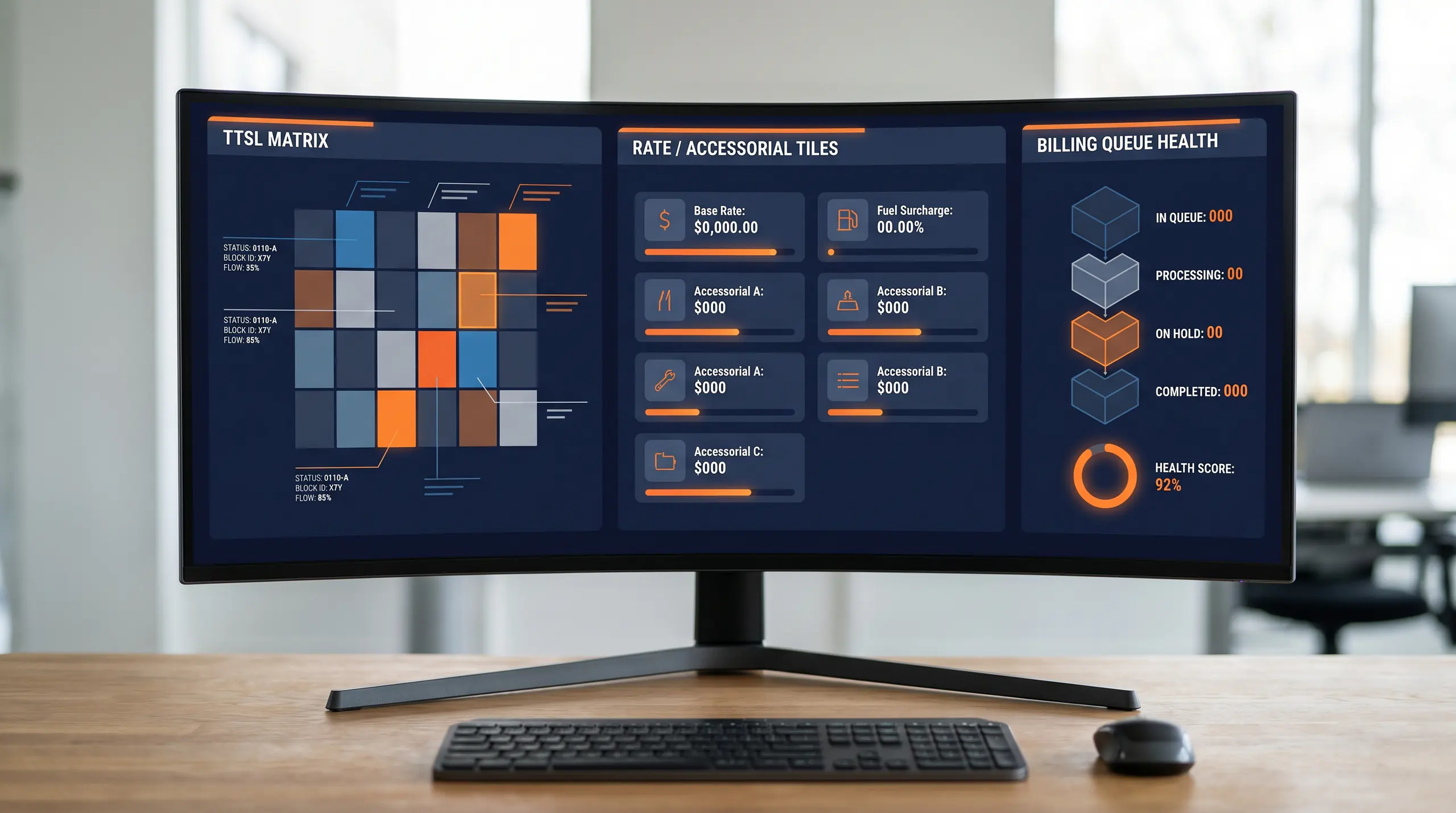
Unified dashboard for service matrices, rates, and billing readiness

Leadership gained a shared lens: which trips were published with incomplete data, which service windows were at risk, which rate versions applied, and which bills were blocked for evidence—not opinion. AiLabs Agents helped encode guardrails and synthetic fixtures so regressions in TTSL or P&R propagation surfaced before payroll and peak volumes collided.

Metrics that matter

Finance and operations reviewing settlement and service metrics together

Success was measured where revenue integrity shows up: fewer reopened bills, faster alignment between promised service and executed movement, and less cross-team rework between customer operations and finance.

38%

Billing exception reduction

Invoice preparation pulled fewer duplicate-PRO and missing-field cases once rating and service rules referenced the same movement keys.

2×

Promise-to-proof cycle time

Service matrices and execution timelines were reviewed together, shrinking the lag between commitment checks and operational sign-off.

28%

Less CS–finance back-and-forth

Quotes, pickups, and billing disputes referenced one lineage from customer entry through settlement.

Ready to align service, rating, and billing on one spine?

Engage ideyaLabs with AiLabs Agents to modernise TTSL, P&R, CS, and BIL alongside operational systems—without losing the nuance your network runs on.

Talk to our team