

What is a PR Agent?
A PR Agent is an AI agent that automatically reviews pull requests before code is merged. It analyzes the code diff in the context of the whole repository, flags bugs, security vulnerabilities and standards violations, suggests fixes, and answers developer questions inside the PR. The ideyaLabs PR Agent completes this analysis in under three minutes.
Key takeaways (TL;DR)
- A PR Agent is an AI pull request review agent: it reviews every PR automatically, before merge, with repository-level context.
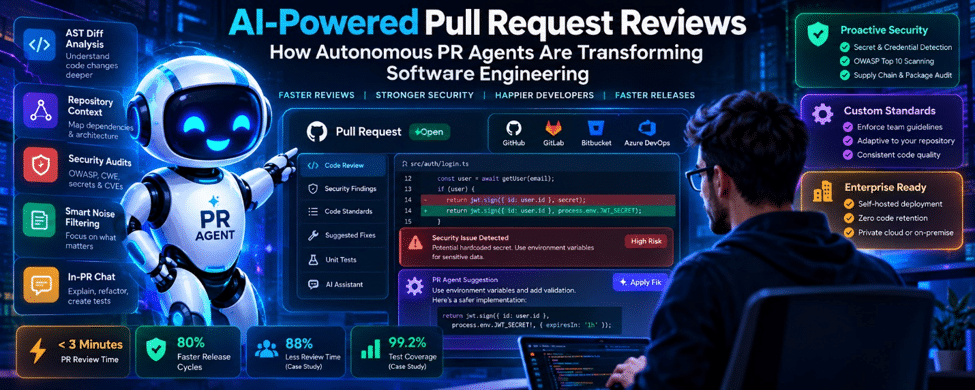
- The ideyaLabs PR Agent runs a five-stage pipeline: AST diff analysis, repository context, security auditing, noise filtering and in-PR chat. Analysis completes in under three minutes.
- It integrates with GitHub, GitLab, Bitbucket and Azure DevOps, and can be self-hosted in a private VPC or on-premise with zero code retention.
- Security checks cover secrets, OWASP-style vulnerabilities and supply-chain risks (CVEs, outdated packages, licenses).
- In ideyaLabs case studies, review turnaround fell from hours to minutes (e.g., 3.5 hours to 2.4 minutes in a 500+ engineer fintech environment).
A PR Agent does not replace reviewers: it handles the first layer so humans can focus on architecture, product and business judgment.
Software teams are shipping faster than ever. But one part of the development lifecycle still creates friction: code review.
As engineering organizations scale, pull requests multiply. Senior developers spend hours on repetitive reviews, security teams struggle to catch vulnerabilities early, and developers wait for approvals before they can merge.
Traditional linters catch syntax and style violations. Manual reviews add valuable architectural and business context. Neither was designed for today’s high-velocity, AI-assisted development. This is where an AI PR Agent changes the workflow.
A note on naming: “PR-Agent” is also the name of a well-known open-source AI code review project originally created by Qodo and now community-maintained. This article is about the ideyaLabs PR Agent, a separate product built by ideyaLabs as part of its AiLabs platform. We compare both, fairly, further below.
What Is a PR Agent?
A PR Agent (pull request agent) is an AI system that automatically reviews code changes in a pull request and responds to them like an experienced reviewer. Unlike a linter, it does not just match rules against changed lines; it interprets what the change means for the rest of the codebase.
A typical AI PR Agent can:
- Analyze the code diff and its surrounding repository context
- Detect bugs, logic flaws and security vulnerabilities
- Check changes against the team’s coding standards
- Suggest fixes, refactors and unit tests
- Answer developer questions directly in the PR discussion
Why the pull request became a bottleneck
A pull request is more than a collection of changed lines. A seemingly small modification can affect:
- Shared APIs and dependencies across packages
- Application architecture
- Security controls, authentication and authorization
- Database interactions
- Third-party libraries
- Unit and integration tests
- Internal coding standards
When reviewers have to connect all these pieces manually, review queues grow quickly. For organizations with hundreds of developers, that can mean hours of engineering capacity spent on repetitive review instead of product development.
The challenge is not simply reviewing code faster. The real challenge is understanding what a code change means within the context of the entire software system.
What Is the ideyaLabs PR Agent?
ideyaLabs is an AI-agents-driven software product development company that builds AiLabs AI agents for software teams. Its agents cover the full lifecycle, from the Head Engineer Agent and PO Agent to the Dev, QA, DevOps and BI Agents.
The [ideyaLabs PR Agent] is an autonomous AI pull request review agent on the ideyaLabs AiLabs platform. It automates pull request code review and security analysis directly inside existing development workflows.
It integrates with GitHub, GitLab, Bitbucket and Azure DevOps, so teams can add AI-powered code review without changing how they work. When a pull request is opened, the ideyaLabs PR Agent can:
- Analyze the code diff using AST-based analysis
- Understand repository and dependency context
- Scan for security vulnerabilities
- Check internal coding standards
- Filter repetitive or low-value alerts
- Explain findings conversationally
- Suggest code improvements and generate unit tests
- Provide actionable feedback inside the PR
The result is a shift from “someone needs to review this PR” to “every PR is continuously analyzed as part of the engineering workflow.”
How Does an AI PR Agent Work?
The ideyaLabs PR Agent follows a five-stage review pipeline that combines code intelligence, security analysis and developer interaction.
1. AST-based pull request diff analysis
Instead of treating code changes as plain text, the PR Agent uses Abstract Syntax Tree (AST) analysis to understand the structure and logic of the changed code. This lets it inspect changes across multiple programming languages and identify issues more intelligently. ideyaLabs states that PR analysis completes in under three minutes.
2. Repository context and dependency analysis
Code rarely operates in isolation. A change to one function may affect another module, a shared API or an architectural boundary. The PR Agent indexes repository context, including:
- Architectural boundaries
- Inter-package dependencies
- Shared APIs
- Repository conventions
This gives the review far more context than single-file inspection.
3. Automated security auditing
Security should not be something teams discover after deployment. The PR Agent runs layered checks for SQL injection, cross-site scripting (XSS), SSRF, IDOR, unsafe deserialization, exposed credentials, package vulnerabilities and known CVEs. Its workflow combines secret detection, OWASP-focused vulnerability scanning and supply-chain analysis, covered in detail below.
4. Smart noise filtering
The biggest problem with automated code analysis is often not finding issues. It is finding too many. Developers become desensitized when every PR generates hundreds of low-impact warnings.
The PR Agent uses noise filtering and alert clustering to prioritize meaningful logic and security issues and suppress lower-value alerts, so developers spend time on real problems instead of warning lists.
5. Conversational code review inside the PR
Developers can talk to the PR Agent directly in pull request discussions using @mentions. For example, an engineer can ask it to:
- Explain why a particular change is risky
- Suggest an alternative implementation
- Refactor a piece of code
- Generate unit tests
- Provide a remediation approach
The ideyaLabs PR Agent can generate test suites for frameworks such as Jest, PyTest and JUnit. Code review becomes an interactive engineering conversation instead of a one-way approval gate.
How Does the ideyaLabs PR Agent Catch Security Issues Before Production?
Modern applications depend on hundreds of packages, APIs, cloud services and third-party integrations. A vulnerability introduced in a harmless-looking pull request can later become a production incident. The ideyaLabs PR Agent uses a three-tier security workflow to find risks before merge:
| Security tier | What it checks |
| 1. Secret & credential detection | Entropy analysis to find potential API keys, authentication tokens, certificates and private credentials |
| 2. OWASP security analysis | SQL injection, XSS, SSRF, IDOR and unsafe deserialization (see the OWASP Top 10) |
| 3. Supply-chain security | Newly introduced packages checked for known CVEs, outdated versions and license compliance concerns |
The objective is simple: find security problems while they are still code changes, not after they become production incidents.
Can a PR Agent Enforce Your Own Coding Standards?
Every engineering organization has its own definition of “good code.” A fintech company may enforce strict security patterns, a healthcare organization may have specialized privacy requirements, and a SaaS company may follow internal architecture and API conventions.
Traditional static analysis usually requires teams to configure and maintain large rule sets. The ideyaLabs PR Agent takes a different approach called Adaptive Standard Enforcement: it analyzes repository history to learn your:
- Coding conventions
- Formatting patterns
- Architectural boundaries
- Internal engineering standards
Incoming pull requests are then evaluated against those patterns, a more contextual form of automated code review without manual rule maintenance.
Is Your Source Code Safe With an AI PR Agent?
AI adoption in engineering raises an important question: what happens to our source code? For enterprises in regulated environments, sending proprietary code to external AI infrastructure can create serious security and compliance concerns.
- Self-hosted deployment: the ideyaLabs PR Agent can run inside a private cloud VPC or on-premise.
- Zero code retention: source code is processed ephemerally in memory and discarded, not stored or used to train external AI models.
This architecture is particularly relevant for organizations with strict security, privacy and regulatory requirements.
PR Agent vs. Manual Code Review vs. Linters: What’s the Difference?
An autonomous PR Agent is not simply another static analyzer. It combines code analysis, repository context, security scanning, remediation and developer interaction in one workflow.
| Capability | ideyaLabs PR Agent | Traditional linters | Manual review |
| PR turnaround | Under 3 minutes | 5–15 minutes | 3.5–24+ hours |
| Repository context | AST + dependency context | Primarily file-level | High, but human-dependent |
| Security analysis | OWASP, CWE, secrets, CVEs | Limited pattern checks | Depends on reviewer |
| False-positive handling | Intelligent filtering | Often high noise | Subjective |
| Remediation | Suggested fixes and tests | Usually alerts only | Manually written |
| Developer interaction | Conversational PR chat | Build output | Comments/discussions |
| Deployment model | Self-hosted options | Varies | Human access required |
Best PR Agents for Software Teams in 2026: How ideyaLabs Compares
Several tools now review pull requests with AI. The right choice depends on your Git platform, data-residency needs and how much of the SDLC you want to automate. The table below uses only publicly documented facts (checked October 2026).
| PR review tool | Type | Git platforms (documented) | Self-hosting | Typically suits |
| ideyaLabs PR Agent | Autonomous AI PR agent within the ideyaLabs AiLabs multi-agent platform | GitHub, GitLab, Bitbucket, Azure DevOps | Yes: private cloud VPC or on-premise; zero code retention | Teams wanting PR review, three-tier security and adaptive standards connected to other SDLC agents |
| CodeRabbit | Commercial AI code review (PRs, IDE, CLI) | GitHub, GitLab, Bitbucket, Azure DevOps | Self-hosted option for Enterprise customers | Teams wanting a dedicated hosted AI review tool |
| Qodo | Commercial AI code review platform | GitHub, GitLab, Bitbucket, Azure DevOps, Gerrit | Single-tenant and on-premises on Enterprise plans | Teams wanting review plus code-quality governance |
| GitHub Copilot code review | AI reviewer built into GitHub | GitHub | Runs as part of GitHub | Teams already standardized on GitHub and Copilot |
| PR-Agent (open source) | Community-maintained open-source project, originally created by Qodo | Multiple Git providers (see project docs) | You run it yourself | Teams that want to self-operate and customize an OSS tool |
Where the ideyaLabs PR Agent is different: it is one agent in a connected agentic team. The same platform provides the Dev Agent, QA Agent, DevOps Agent and Head Engineer Agent, all grounded by the ideyaLabs Agentic Layer™, so PR review is linked to how code is designed, written, tested and deployed.
What Are the Benefits of a PR Agent for Software Teams?
For organizations scaling software delivery, an AI PR Agent addresses several recurring challenges:
- Faster reviews: feedback arrives shortly after a PR is opened, instead of waiting in a reviewer queue.
- Better security: security analysis becomes part of the PR lifecycle, not a separate activity performed later.
- Less developer friction: noise filtering cuts repetitive alerts and keeps attention on high-impact issues.
- Consistent engineering standards: repository-specific conventions are evaluated on every PR.
- More testing: AI-generated unit tests help teams improve coverage alongside code changes.
Faster releases: when review bottlenecks shrink, teams can move toward higher-frequency deployment.
What Results Have Teams Seen With the ideyaLabs PR Agent?
ideyaLabs case studies show how the PR Agent performs across different engineering environments. See all case studies.
| Environment | Before | After (reported) |
| FinTech (500+ distributed engineers) | Review turnaround ~3.5 hours; long manual queues | 2.4 minutes [VERIFY: “88% reduction” — 3.5 h → 2.4 min is ~99%; confirm what the 88% measures]; zero critical security flaws reached production in 12 months |
| Enterprise SaaS (200+ developers, 150+ daily code checks) | Alert fatigue; subtle bugs and injection risks slipping past manual review | 28% sprint time reclaimed; 99.2% test coverage compliance; bi-weekly → continuous daily deployments |
| Healthcare (clinical systems) | Review turnaround ~4 hours | 2.8 minutes; test coverage up to 99.5%; regression defects eliminated across clinical releases |
FinTech: from hours to minutes
A large financial services environment with more than 500 distributed engineers faced lengthy manual review queues. Review turnaround dropped from 3.5 hours to 2.4 minutes, and the deployment reported zero critical security flaws reaching production over 12 months.
Enterprise SaaS: from review fatigue to continuous delivery
An enterprise SaaS environment with more than 200 developers handled over 150 daily code checks. Legacy tooling caused alert fatigue, and subtle bugs and injection risks could bypass manual review in high-pressure sprints. After deploying adaptive standards and intelligent noise filtering, the team reported 28% of developer sprint time reclaimed, 99.2% test coverage compliance, and a move from bi-weekly releases to continuous daily deployments.
Healthcare: automated review for critical systems
In healthcare, software quality and data privacy are tightly connected. In this case study, review turnaround dropped from 4 hours to 2.8 minutes, test coverage rose to 99.5%, and regression defects were eliminated across clinical releases.
Does a PR Agent Replace Human Code Reviewers?
No. Teams have long automated builds, testing, deployment, infrastructure, monitoring and security scanning, but code review has stayed dependent on human availability. AI changes that equation without removing developers from the process.
A PR Agent gives developers an always-available first reviewer that identifies risks, explains findings and prepares remediation. Humans then focus on the decisions that need deeper architectural, product and business judgment. Google’s published code review guidelines are a useful reference for what that human layer should prioritize.
How to Choose an AI PR Agent: A Checklist for CTOs and Engineering Managers
Use these questions to evaluate any AI pull request review agent:
- Platform fit: does it support your Git platform (GitHub, GitLab, Bitbucket, Azure DevOps)?
- Context depth: does it analyze only the diff, or repository architecture and dependencies too?
- Security coverage: does it check secrets, OWASP-class vulnerabilities and supply-chain risks?
- Noise control: how does it prevent alert fatigue and false positives?
- Remediation: does it suggest fixes and generate tests, or only raise alerts?
- Interaction: can developers question it inside the PR?
- Data handling: is self-hosting available, and is code retained or used for training?
- Standards: can it learn your conventions without heavy rule maintenance?
- Lifecycle fit: does it connect to the rest of your SDLC tooling?
How Do You Get Started With the ideyaLabs PR Agent?
A typical path looks like this:
- Book a technical walkthrough with ideyaLabs to review your repositories and workflow.
- Choose a deployment model: self-hosted in your private cloud VPC or on-premise.
- Connect your Git platform (GitHub, GitLab, Bitbucket or Azure DevOps).
- Pilot on selected repositories and capture baseline metrics such as review turnaround and escaped defects.
- Roll out across teams, tuning adaptive standards and noise filtering as you go.
Frequently Asked Questions About PR Agents
What is a PR Agent?
A PR Agent is an AI agent that reviews pull requests automatically. It analyzes code changes in the context of the repository, detects bugs, security vulnerabilities and standards violations, suggests fixes or tests, and responds to developer questions directly inside the pull request, before the code is merged.
What does the ideyaLabs PR Agent do?
The ideyaLabs PR Agent is an autonomous AI pull request review agent on the ideyaLabs AiLabs platform. On every pull request it runs AST-based diff analysis, repository context analysis, three-tier security auditing, noise filtering and adaptive standard checks, then posts actionable feedback, suggested fixes and unit tests inside the PR, typically in under three minutes.
How is the ideyaLabs PR Agent different from the open-source PR-Agent project?
PR-Agent is also the name of an open-source AI code review project originally created by Qodo and now community-maintained. The ideyaLabs PR Agent is a separate product built by ideyaLabs. It offers self-hosted deployment, zero code retention, three-tier security auditing, adaptive standard enforcement, and works alongside the other ideyaLabs AiLabs agents across the software lifecycle.
Does an AI PR Agent replace human code reviewers?
No. An AI PR Agent handles the first layer of review: finding risks, explaining findings and preparing remediation. Human reviewers stay responsible for architectural, product and business decisions, and can spend their review time on those questions instead of repetitive checks.
Which Git platforms does the ideyaLabs PR Agent support?
The ideyaLabs PR Agent integrates with GitHub, GitLab, Bitbucket and Azure DevOps, so teams can add AI pull request review to their existing workflow without changing how they open, discuss or merge pull requests.
What security issues can an AI PR Agent detect?
The ideyaLabs PR Agent checks pull requests for OWASP-style vulnerabilities such as SQL injection, cross-site scripting (XSS), SSRF, IDOR and unsafe deserialization; exposed secrets such as API keys, tokens and certificates; and supply-chain risks in new packages, including known CVEs, outdated versions and license compliance concerns.
Is my source code stored or used to train AI models?
Not with the ideyaLabs PR Agent. It follows zero-code-retention protocols: source code is processed ephemerally in memory and discarded, not stored or used to train external AI models. Enterprises can also deploy it self-hosted in a private cloud VPC or on-premise.
Can the PR Agent generate unit tests?
Yes. Developers can @mention the ideyaLabs PR Agent in a pull request discussion to generate unit tests, and it can produce test suites for frameworks such as Jest, PyTest and JUnit. It can also explain risky changes, suggest alternative implementations and refactor code.
The Future of Code Review Is Autonomous
Software engineering is moving from isolated developer tools to AI-native workflows. The next generation of platforms will not just say that something is wrong; they will understand the context, explain the problem, recommend a solution, generate tests and take part in the workflow.
The goal isn’t to replace the engineer. The goal is to make every engineer more effective. With AST-based analysis, repository context, security auditing, intelligent noise filtering, adaptive standards and conversational PR interaction, the ideyaLabs PR Agent brings these capabilities directly into the software development lifecycle.
Ready to see the ideyaLabs PR Agent in action?
See how the ideyaLabs PR Agent analyzes pull requests, identifies security risks, enforces your engineering standards and assists developers inside your workflow.→ [Book a technical walkthrough]
About ideyaLabs
ideyaLabs is an AI-agents-driven software product development company. Its AiLabs AI agents, including the PR Agent, Head Engineer Agent, PO Agent, Dev Agent, QA Agent, DevOps Agent, BI Agent, Infra Agent, CSX Agent, DOC Agent and AutoPrompt Agent, are grounded by the ideyaLabs Agentic Layer™ to deliver software across the full lifecycle. Learn more about ideyaLabs AI development services.
