

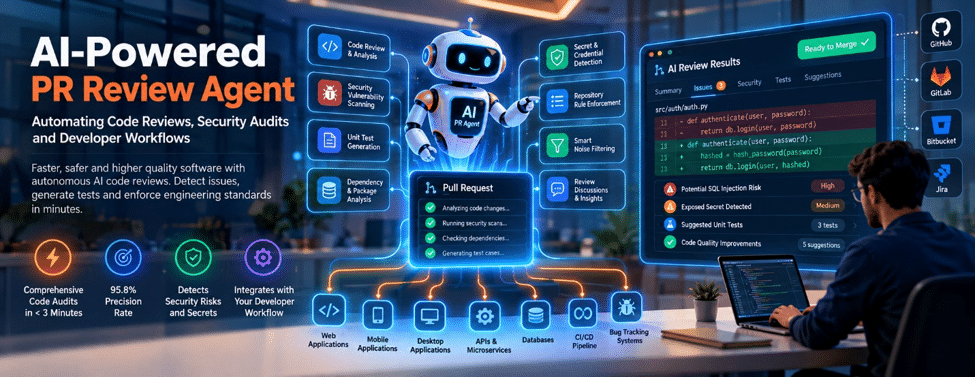
Pull request reviews are a critical part of modern software engineering. They help teams identify bugs, enforce coding standards, detect security vulnerabilities, and maintain code quality before changes reach production.
But as engineering teams scale, manual pull request reviews can become a serious bottleneck.
Large repositories may generate hundreds of pull requests every day. Senior developers spend valuable hours reviewing repetitive changes, security issues can slip through during sprint pressure, and noisy linting alerts can make it difficult to identify the problems that actually matter.
An AI-powered PR Review Agent can automate much of this process.
The PR Agent from AiLabs by ideyaLabs is designed as an autonomous code review and security automation engine that analyzes pull requests, performs semantic code checks, generates tests, identifies security vulnerabilities, and enforces repository-specific engineering standards.
According to the provided product specifications, the system can complete comprehensive code audits in under three minutes with a reported 95.8% precision rate, while supporting private-network deployment for organizations that require stronger data sovereignty.
What Is an AI-Powered PR Review Agent?
An AI-powered PR Review Agent is an intelligent software engineering system that automatically examines code changes submitted through a pull request.
Instead of relying entirely on developers to manually inspect every changed line, the agent analyzes the code, repository context, dependencies, security patterns, and engineering standards.
It can perform tasks such as:
- Semantic diff analysis
- Automated code review
- Security vulnerability scanning
- Secret and credential detection
- Unit test generation
- Repository rule enforcement
- Dependency and package analysis
- Linter-noise reduction
- Branch and pull request insights
- Interactive review discussions
The goal is not simply to identify syntax errors. A modern AI code review system analyzes the context and intent of code changes so engineering teams can focus their human review effort on higher-value decisions.
Why Automated Pull Request Reviews Matter
Traditional code review becomes increasingly difficult as engineering organizations grow.
A small development team may be able to manually review every pull request. At enterprise scale, however, review queues can grow quickly.
Common challenges include:
1. Growing Review Backlogs
Developers may wait hours for a pull request to receive a comprehensive review. This can slow down releases and interrupt development workflows.
2. Repetitive Manual Checks
Senior developers often spend time identifying issues that could be automatically detected, including coding-standard violations, exposed credentials, dependency risks, and common security patterns.
3. Security Risks
A pull request may introduce SQL injection vulnerabilities, cross-site scripting risks, exposed secrets, insecure dependencies, or other weaknesses.
4. Alert Fatigue
Large engineering repositories can generate significant numbers of linting and static-analysis alerts. Excessive low-value notifications can make critical issues harder to identify.
5. Increasing Engineering Costs
When experienced developers spend substantial time performing repetitive reviews, less time remains for architecture, innovation, debugging complex problems, and product development.
An autonomous PR review system addresses these challenges by introducing automated analysis directly into the developer workflow.
How an AI PR Review Agent Works
The PR Agent workflow consists of multiple stages that analyze a pull request before merge approval.
Step 1: Instant PR Analysis
The system analyzes code changes and performs automated review checks.
The specifications provided state that comprehensive code audits can be completed in less than three minutes, compared with substantially longer manual review cycles.
Step 2: Repository Context Analysis
Code cannot always be evaluated correctly by examining an isolated diff.
The system scans repository information to understand:
- Internal coding rules
- Dependencies
- Shared packages
- Repository standards
- Existing project context
This repository-level context helps the AI reviewer evaluate changes against the broader software environment.
Step 3: Layered Security Scanning
The PR Agent applies a three-tier security workflow covering credentials, application vulnerabilities, and software supply-chain risks.
The documented security workflow includes secret detection, OWASP Top 10 vulnerability scanning, and third-party package auditing.
Step 4: Smart Noise Filtering
Automated development tools can sometimes produce large numbers of repetitive alerts.
Smart noise filtering is designed to reduce repetitive linting notifications and prioritize higher-impact findings, helping developers concentrate on actionable issues.
Step 5: Interactive Review
Developers can discuss findings directly within the pull request workflow rather than moving between multiple systems.
This creates a more connected review experience where automated analysis and human engineering judgment work together.
Three-Tier Security Scanning for Pull Requests
Security is one of the most important capabilities of an automated PR review system.
The documented PR Agent architecture uses three security layers.
1. Secret and Credential Detection
The system uses entropy analysis to identify potentially exposed:
- API keys
- Access tokens
- Certificates
- Private credentials
Detecting these issues before they enter Git history can help prevent accidental credential exposure.
2. OWASP Top 10 Vulnerability Scanning
The security layer checks application inputs for vulnerability patterns such as:
- SQL injection
- Cross-site scripting
- SSRF
- IDOR
- Unsafe deserialization
The system can also provide production-oriented mitigation suggestions.
3. Supply Chain and Package Auditing
Modern applications depend heavily on third-party packages.
The PR Agent evaluates newly introduced libraries for:
- Known CVEs
- Outdated versions
- License compliance concerns
This creates an additional security checkpoint before dependencies become part of the production software supply chain.
AI Code Review Beyond Traditional Linters
Traditional linters are useful for identifying predefined coding issues, but enterprise code review often requires broader contextual analysis.
An AI-powered reviewer can combine:
AST analysis + repository context + security rules + engineering standards + AI reasoning + test generation
The PR Agent’s documented core functions include AST parsing, rule learning, three-tier security scanning, and live chat. It also integrates with GitLab, Bitbucket, Azure DevOps, webhooks, CLI workflows, and CI/CD environments.
This makes the system suitable for organizations looking to introduce automated code inspection without completely redesigning their existing development workflow.
Automated Unit Test Generation
Code review should not only identify potential defects. It should also help teams verify that new functionality behaves correctly.
The PR Agent combines automated auditing with unit test generation.
For example, when a developer introduces a new function or modifies existing business logic, the system can analyze the change and generate test templates around the modified behavior.
This can help teams improve test coverage and identify potential regression scenarios earlier in the development lifecycle.
The provided product documentation describes automated unit test creation as one of the platform’s core capabilities.
Enterprise Data Sovereignty and Private Deployment
For organizations handling sensitive source code, sending proprietary repositories to external systems can create security and compliance concerns.
The PR Agent supports self-hosted deployment within private cloud VPCs or on-premise infrastructure.
The documentation states that organizations can run the system inside their private network using self-hosted or CLI options, with support for local models and private endpoints.
This architecture can be particularly relevant for organizations operating in environments where source-code privacy, regulatory requirements, and data governance are important.
Integrating AI Code Review Into CI/CD
An AI PR review agent becomes more useful when integrated directly into the software delivery pipeline.
A typical workflow can look like:
Developer → Pull Request → AI Analysis → Security Scan → Test Generation → Review Feedback → Developer Fixes → Approval → Merge → CI/CD Deployment
The PR Agent supports integrations including GitLab, Bitbucket, Azure DevOps, webhooks, CLI workflows, and CI/CD pipelines.
This allows automated code inspection to become part of the normal development lifecycle rather than a separate manual activity.
Enterprise Use Cases for AI PR Review
An autonomous PR review system can support multiple engineering environments.
FinTech and Payments
Financial software requires strong security controls and rigorous code review.
One documented case study describes a financial-services environment with more than 500 distributed engineers. The reported review turnaround decreased from 3.5 hours to 2.4 minutes, while the deployment reported zero critical security flaws reaching production over a 12-month period.
Enterprise SaaS
Large SaaS platforms can generate significant volumes of pull requests and automated alerts.
A documented enterprise SaaS deployment involved more than 200 developers and reported reclaiming 28% of sprint developer time, with test-coverage compliance reaching 99.2%.
Healthcare and Telehealth
Healthcare applications require careful handling of sensitive information and reliable software releases.
A documented healthcare deployment involving more than 150 engineers reported reducing inspection turnaround from four hours to 2.8 minutes and increasing test coverage to 99.5%.
These figures are reported outcomes from the supplied case studies and should be understood in the context of those individual deployments.
Key Benefits of an AI-Powered PR Review Agent
The platform’s documented capabilities can be summarized across six major areas:
Faster Code Reviews
Automated analysis reduces the time required for initial pull request inspection.
Better Security Visibility
Layered security scanning identifies secrets, application vulnerabilities, and dependency risks.
Reduced Developer Alert Fatigue
Smart filtering helps reduce repetitive and low-value notifications.
Consistent Engineering Standards
Repository-specific rules and adaptive standards help apply consistent review criteria.
Automated Testing Support
Generated unit tests can improve validation around code changes.
Private Code Analysis
Self-hosted deployment options allow organizations to keep code within controlled infrastructure.
The Future of Autonomous Code Review
Software engineering is moving toward increasingly automated development workflows.
AI coding assistants can generate code. CI/CD systems can build and deploy it. Automated testing can validate functionality. Security tools can scan applications.
The next evolution is connecting these capabilities into an intelligent software engineering workflow where AI agents continuously inspect, validate, secure, and improve software changes.
An AI-powered PR Review Agent represents one component of this emerging model.
Instead of treating code review as a final manual checkpoint, organizations can embed intelligent analysis directly into the development lifecycle.
The result is a workflow where developers spend less time on repetitive inspection and more time solving complex engineering problems, designing systems, and delivering product value.
Conclusion
Pull request review remains essential for software quality, security, and maintainability. But manual review alone can become difficult to scale as engineering teams, repositories, and deployment frequency increase.
An AI-powered PR Review Agent brings automated code inspection, security analysis, test generation, repository context, standard enforcement, and developer interaction into a unified workflow.
With capabilities such as AST parsing, semantic diff analysis, three-tier security scanning, smart noise filtering, automated test generation, CI/CD integration, and private deployment, AI-driven PR review can become an important component of modern software engineering automation.
For enterprises looking to build faster and more controlled software delivery pipelines, autonomous code review provides a way to introduce intelligence directly into the pull request lifecycle.
