

Software releases are getting faster, applications are becoming more complex, and customer expectations are rising. Traditional software testing approaches often struggle to keep pace with continuous development, frequent releases, multiple platforms, and increasingly distributed technology stacks.
This is where Autonomous Quality Engineering (AQE) and AI-agentic test automation are changing the way organizations approach software quality.
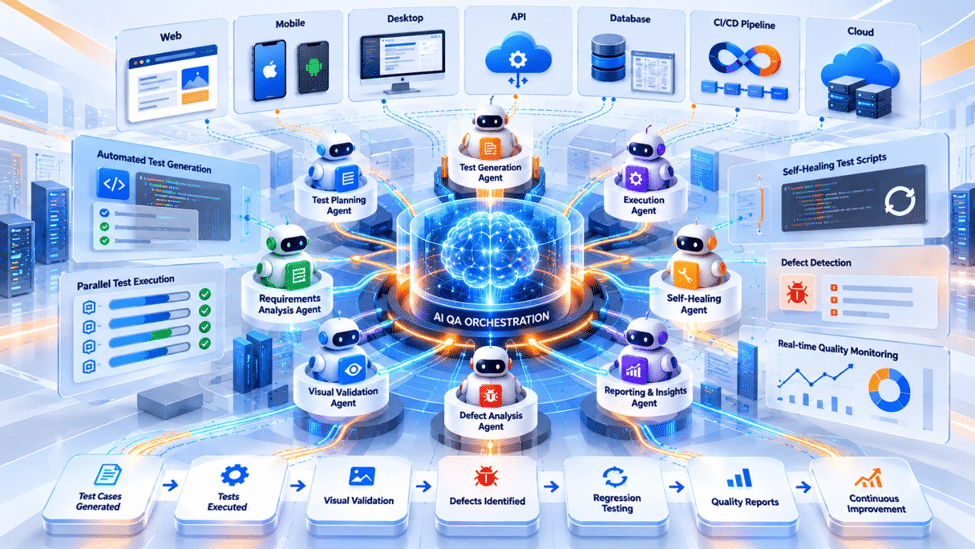
Instead of relying entirely on manually designed test cases and conventional automation scripts, autonomous QA systems use specialized AI Agents to understand requirements, generate tests, execute validation workflows, identify defects, adapt to application changes, and trigger regression testing.
The result is a more intelligent quality engineering model that combines human expertise with autonomous AI-driven validation.
What Is Autonomous Quality Engineering?
Autonomous Quality Engineering is an evolution of traditional software testing that combines QA engineering practices, test automation, artificial intelligence, and autonomous agents.
An autonomous QA environment can interpret application requirements, determine relevant test scenarios, generate executable test cases, execute tests across multiple platforms, identify failures, and continuously adapt testing workflows as the application changes.
Rather than treating testing as a final step before deployment, Autonomous Quality Engineering makes quality validation a continuous, intelligent part of the software development lifecycle.
With the right architecture, organizations can automate large portions of the verification lifecycle while allowing QA engineers to focus on complex business logic, exploratory testing, risk analysis, and quality strategy.
Why Traditional Test Automation Is Not Enough
Conventional test automation has already improved software testing significantly. However, automation frameworks can still introduce substantial maintenance overhead.
When an application changes, automation scripts may require updated selectors, workflows, test data, assertions, and dependencies. Large test suites can therefore become difficult to maintain as products evolve.
Common challenges include:
- Manual interpretation of changing requirements
- Time-consuming test-case creation
- High script maintenance requirements
- Flaky tests caused by changing application elements
- Sequential test execution
- Limited coverage across platforms
- Delayed defect identification
- Manual defect reporting and triage
- Repeated regression testing
- Difficulty scaling QA with rapid release cycles
AI-agentic testing addresses these challenges by introducing intelligence and autonomy into the testing workflow.
AI Agents for End-to-End Software Testing
The core of an autonomous QA ecosystem is the AI Agent.
Instead of using one automation script for one predefined workflow, specialized agents can perform different quality engineering tasks throughout the testing lifecycle.
An AI Agent can interpret requirements, identify potential scenarios, generate test cases, execute validation workflows, analyze results, and initiate subsequent actions based on the outcome.
This creates a closed-loop testing model:
Requirement → Test Generation → Execution → Analysis → Defect Detection → Resolution → Regression → Release Validation
The testing process becomes adaptive instead of purely script-driven.
Agent-Driven Test Generation
Test creation traditionally requires QA engineers to manually interpret functional specifications and convert them into test cases.
With agent-driven test generation, AI Agents can analyze requirements and identify:
- Functional scenarios
- Positive and negative test cases
- Boundary conditions
- Validation rules
- Business workflows
- Error-handling scenarios
- Regression scenarios
- API validation requirements
The generated test plans can then be reviewed, refined, and converted into executable automation workflows.
This helps QA teams move from manually writing every test case toward AI-assisted and autonomous test design.
Autonomous Test Execution Across Multiple Platforms
Modern applications rarely exist on a single platform.
A product may include a web application, mobile application, desktop client, APIs, databases, and third-party integrations.
Autonomous QA Agents can coordinate testing across these environments and execute multiple validation workflows in parallel.
Testing can span:
- Web applications
- Mobile applications
- Desktop applications
- REST and GraphQL APIs
- Databases
- Microservices
- Cloud environments
- Cross-browser environments
Parallel execution reduces the time required for large regression suites and enables teams to obtain quality signals earlier in the delivery cycle.
Self-Healing Test Automation
One of the biggest challenges with traditional UI automation is script maintenance.
A minor interface modification can cause an automation workflow to fail even when the underlying business functionality remains unchanged.
Self-healing automation introduces AI-driven adaptability into this process.
When application elements or locators change, an intelligent testing system can analyze the updated interface and identify alternative interaction paths.
Instead of immediately treating every locator change as a broken test, the system can attempt to adapt the automation workflow.
This can significantly reduce unnecessary maintenance and help minimize test flakiness.
Human-in-the-Loop Quality Engineering
Autonomous testing does not eliminate the need for experienced QA professionals.
Human expertise remains critical for areas where context, risk assessment, business judgment, and exploratory thinking matter.
QA engineers can focus on:
- Complex business logic
- Exploratory testing
- Edge-case analysis
- User experience validation
- Risk-based testing
- Compliance requirements
- Security scenarios
- Test strategy
- Release-quality decisions
AI Agents handle repetitive and scalable validation activities while QA professionals provide oversight and strategic direction.
This creates a human-in-the-loop quality engineering model.
From Test Automation to Agentic Test Automation
There is an important difference between conventional automation and agentic automation.
Traditional automation generally follows predefined instructions:
Trigger → Script → Action → Assertion → Result
Agentic automation introduces reasoning and adaptive decision-making:
Understand → Plan → Execute → Observe → Analyze → Adapt → Validate
An agentic testing system can determine what needs to be tested, select appropriate workflows, analyze test outcomes, and initiate subsequent actions.
This makes the testing ecosystem more dynamic and better suited to modern continuous delivery environments.
Closed-Loop Defect Management
Finding a defect is only one part of quality engineering.
The next steps include reporting the issue, notifying the relevant team, validating the fix, and ensuring that the change has not introduced a regression.
Autonomous QA workflows can connect these activities.
For example:
- An AI Agent executes a regression suite.
- A test failure is detected.
- Evidence such as logs, screenshots, and execution videos is collected.
- The defect is automatically documented.
- The issue is sent to the relevant defect management system.
- Development teams receive an alert.
- After the fix is deployed, regression testing is triggered again.
- The result is reported back to the QA workflow.
This creates a closed-loop quality engineering process instead of an isolated testing event.
Integrating Autonomous QA Into CI/CD
Continuous integration and continuous delivery require testing to keep pace with development.
Autonomous QA Agents can be integrated into CI/CD pipelines to create automated quality gates.
A typical workflow can look like:
Code Commit → Build → Unit Tests → AI-Agent QA Validation → API Testing → UI Testing → Regression → Quality Gate → Deployment
When validation fails, the pipeline can stop or trigger the appropriate workflow.
When validation succeeds, the release can continue toward the next deployment stage.
This approach makes quality a continuous engineering responsibility rather than a release-stage bottleneck.
Our Unified QA Engineering Approach
At ideyaLabs, our approach combines expert QA engineering with autonomous AI-agentic testing.
The objective is not simply to automate more test cases. It is to create a quality engineering ecosystem that can understand, execute, analyze, and continuously improve testing workflows.
Systematic QA Engineering
Our QA specialists provide the human expertise required to establish the overall quality strategy.
This includes:
- Functional testing
- Regression testing
- Integration testing
- API testing
- Performance testing
- Security testing
- Exploratory testing
- Usability validation
- Compliance validation
Autonomous QA Agent Automation
AI Agents extend this foundation by automating repetitive and scalable testing activities.
Key capabilities include:
Intelligent Test Generation
AI Agents analyze requirements and generate structured test scenarios and executable validation workflows.
Self-Healing Automation
Automation workflows can dynamically adapt to application changes, helping reduce maintenance effort and test flakiness.
Parallel Test Execution
Testing workflows can run simultaneously across web, mobile, desktop, APIs, and databases.
Visual Validation
Automated visual comparisons help identify unexpected interface changes across supported environments.
Automated Defect Management
Test failures can be converted into actionable defect reports with supporting execution evidence.
Continuous Regression
Regression workflows can be automatically triggered after application changes or defect fixes.
Seven-Step Autonomous QA Lifecycle
A scalable quality engineering program needs a structured lifecycle.
1. Planning & Requirements Analysis
QA engineers and AI systems analyze requirements, identify quality objectives, define scope, and establish testing priorities.
2. Test Design & Strategy
Test scenarios, datasets, automation strategies, and validation workflows are defined according to application requirements and risk.
3. Test Environment Setup
Dedicated QA environments are configured to replicate production conditions while maintaining secure and controlled test data.
4. Automated Test Generation
AI Agents convert requirements and defined scenarios into executable testing workflows.
5. Parallel Execution & Defect Management
Automated tests run across supported platforms and environments. Failures are analyzed and defects are routed to the appropriate teams.
6. CI/CD Integration
Automated quality gates are embedded into delivery pipelines so that software quality is continuously validated.
7. Release Support & Continuous Optimization
Testing frameworks evolve with the application. New requirements, defects, and production signals are incorporated into future validation cycles.
Autonomous QA Across Industries
AI-agentic testing can be applied across industries where software reliability, security, and continuous releases are critical.
Banking & Financial Services
Validate payment workflows, transaction processing, authentication, ledger operations, and financial APIs.
Healthcare
Test healthcare applications, EHR workflows, data integrations, encryption controls, and compliance-related processes.
Retail & eCommerce
Automate product search, checkout, payment gateway, inventory, pricing, and order-management workflows.
Media & Entertainment
Validate streaming workflows, playback compatibility, device behavior, content delivery, and performance.
Automotive
Test infotainment interfaces, connected vehicle applications, OTA update workflows, and supporting APIs.
Telecom
Validate OSS/BSS workflows, network APIs, service provisioning, and customer-facing applications.
Travel & Hospitality
Automate booking engines, pricing rules, payment workflows, loyalty systems, and reservation management.
Logistics & Transportation
Test fleet tracking, route optimization, dispatch workflows, supply-chain systems, and real-time telemetry.
Insurance
Validate policy enrollment, claims processing, premium calculations, customer portals, and insurance APIs.
Education
Test learning platforms, virtual classrooms, student portals, assessment workflows, and education databases.
Real Estate
Validate property search, listing workflows, payment systems, digital agreements, and customer portals.
Energy & Utilities
Test telemetry systems, smart-grid applications, sensor data pipelines, monitoring dashboards, and operational workflows.
Measuring the Impact of Autonomous Quality Engineering
The value of AI-agentic testing should be measured through meaningful engineering and business metrics.
Organizations can track:
- Test coverage
- Regression execution time
- Automation maintenance effort
- Defect escape rate
- Test execution frequency
- Release cycle time
- Mean time to detect defects
- Mean time to validate fixes
- Test flakiness
- QA resource utilization
The goal is not simply to increase the number of automated tests. The goal is to create a faster, more reliable, scalable, and continuously improving quality engineering system.
The Future of Software Testing Is Autonomous
Software development is moving toward increasingly autonomous engineering workflows. Requirements can be analyzed by AI, code can be generated with AI assistance, infrastructure can be provisioned automatically, and deployments can be continuously orchestrated.
Quality engineering must evolve alongside these changes.
Autonomous QA Agents bring intelligence into the testing layer, allowing organizations to move beyond static automation toward adaptive, continuous, and agent-driven validation.
The future of testing is not about replacing QA engineers with AI.
It is about giving QA teams intelligent systems that can handle repetitive validation at machine speed while experienced engineers focus on the problems that require human judgment.
With Autonomous Quality Engineering, AI-agentic test automation, self-healing automation, parallel execution, and closed-loop validation, organizations can build software with quality engineered into every stage of the development lifecycle.
Build an Autonomous QA Strategy
Whether you are modernizing an existing automation framework or building an AI-driven quality engineering ecosystem from the ground up, the right combination of QA expertise, automation, AI Agents, and CI/CD integration can transform how your organization validates software.
Ready to move from traditional test automation to autonomous quality engineering?
