

A practical guide to building resilient, connected, AI-ready transportation and logistics operations
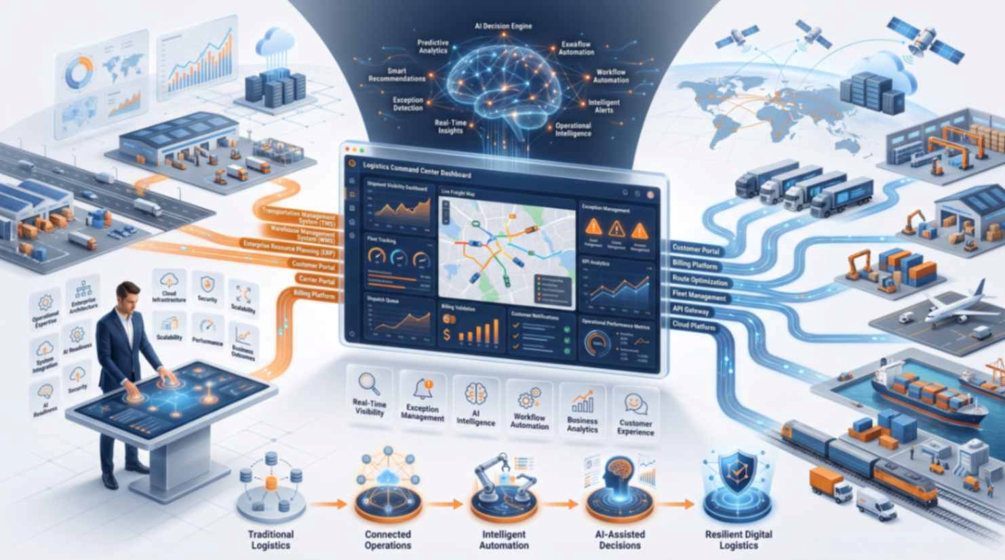
A logistics software development company is no longer selected solely for its ability to build screens, databases, or mobile apps. The right partner has to understand how freight actually moves: planning windows, dock constraints, rate rules, carrier handoffs, shipment exceptions, billing disputes, customer communication, and the handoffs between them. That operational context is what turns a technically sound product into software that a transportation team trusts during a late-night disruption.
This guide explains what modern logistics software development should deliver, which capabilities matter most, how to compare vendors, and how to de-risk implementation. It is written for leaders responsible for transportation, 3PL, warehousing, distribution, freight forwarding, last-mile delivery, or supply-chain technology. The central idea is simple: build one dependable operating system for decisions and execution, then improve it continuously with data, integration, and governing AI.
QUICK TAKEAWAY: Choose a partner that can connect operational expertise, product engineering, integration discipline, and measurable rollout outcomes. A polished demo is not proof that the platform will manage exceptions under production pressure.
Key Takeaways
- Prioritize a shared operational data model across planning, dispatch, linehaul, dock activity, billing, and customer service.
- Treat integrations, event recovery, data quality, and role-specific workflows as production requirements, not later enhancements.
- Use agentic AI for evidence-grounded, bounded actions with a clear human escalation path.
- Measure success through operational outcomes such as exception-resolution time, billing accuracy, service consistency, and adoption.
What Does a Logistics Software Development Company Do?
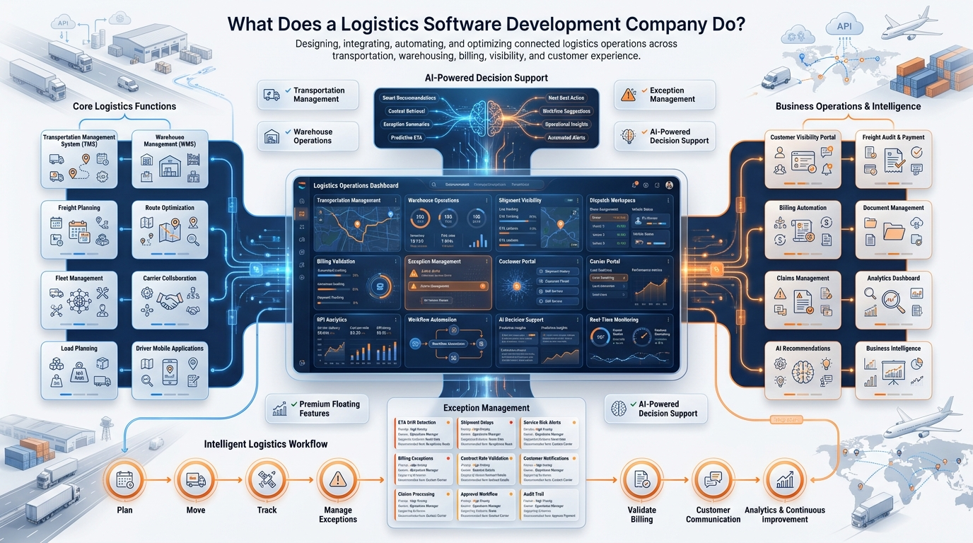
A logistics software development company designs, builds, integrates, tests, and supports digital products that help organizations plan, move, track, settle, and improve the flow of goods. Depending on the business model, that work may include a transportation management system (TMS), warehouse management extensions, carrier portals, driver applications, customer visibility tools, freight audit and payment automation, analytics, or bespoke workflow software.
The strongest providers begin with the operating model rather than a feature checklist. They map who makes a decision, what data is needed, what happens when the data is incomplete, which system is authoritative, and where a human must approve an action. This avoids a common failure mode: digitizing the happy path while leaving the real work – exceptions, corrections, claims, overrides, and escalations – in email and spreadsheets.
For example, dispatch software should not stop at showing a truck on a map. It should help teams identify ETA drift, assess service risk, prompt the right recovery action, record the reason for the decision, and make the update visible to the customer-facing team. Billing software should not merely ingest invoices. It should validate contracted rates, flag accessorial discrepancies, route exceptions to the right owner, preserve evidence, and support a defensible audit trail.
Why Custom Logistics Software Matters Now
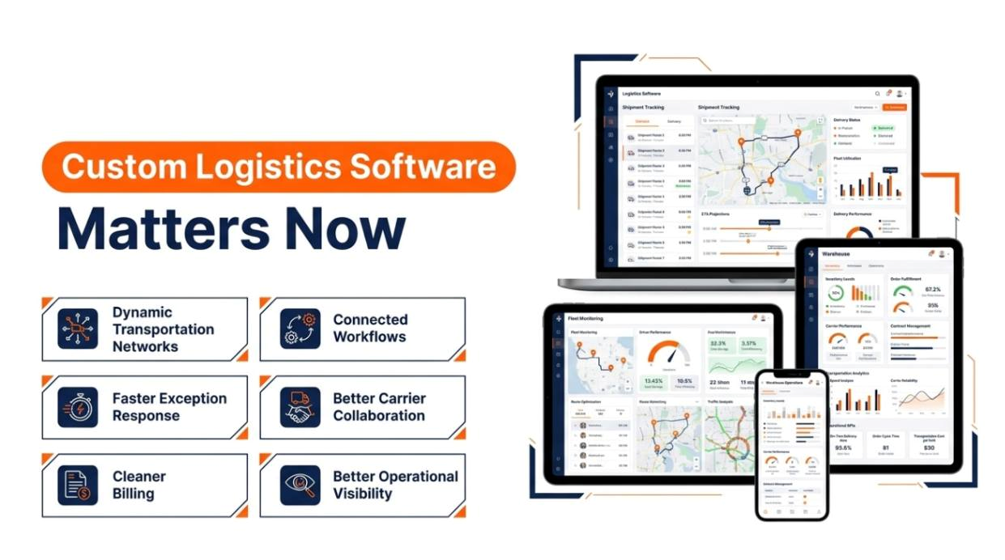
Transportation networks are increasingly dynamic. Capacity, labor, fuel, weather, traffic, customer commitments, and facility conditions all change faster than legacy operating routines were designed to handle. Standard platforms remain valuable, but many logistics businesses need differentiated workflows around them. Custom software closes the gap between a commercial core system and the exact way a company plans, serves customers, manages carriers, and handles exceptions.
A modern solution also reduces the cost of fragmentation. When dispatch uses one tool, finance another, customer service a third, and operations relies on spreadsheets to reconcile them, teams spend too much time searching for status instead of solving the next problem. Connected workflows make the same event, decision, and follow-up visible across functions. They create a more reliable handoff from planning through post-shipment resolution.
The opportunity is not automation for its own sake. It is better execution: fewer preventable service failures, faster exception response, cleaner billing, more consistent carrier collaboration, and a clearer view of operational performance. That is why a qualified logistics software development company must be as interested in process design and adoption as it is in code.
Core Solutions a Logistics Software Partner Can Build
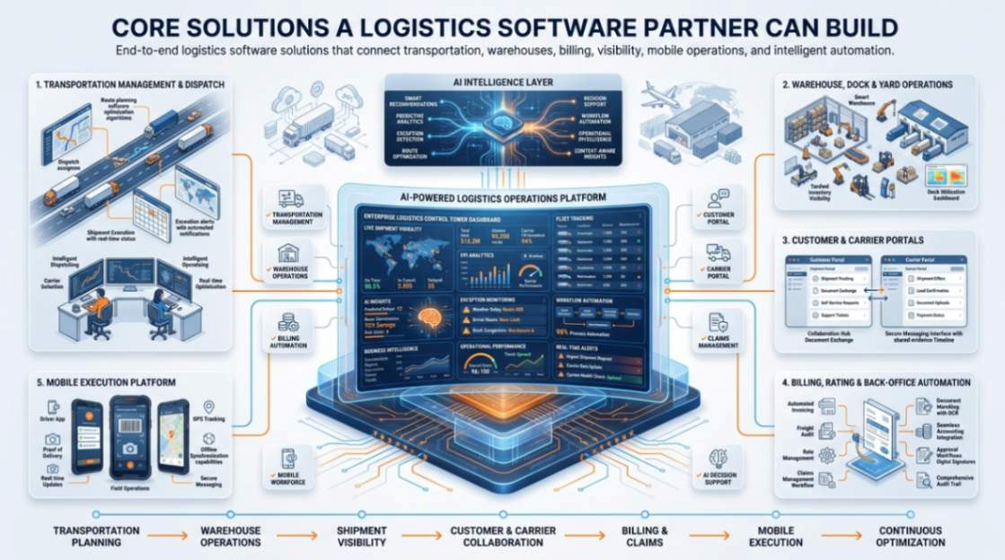
Transportation management and dispatch platforms
A tailored TMS or dispatch layer can support load planning, tendering, appointment coordination, shipment execution, carrier communication, and exception management. It can also provide role-specific workspaces so dispatchers, operations managers, drivers, and customer-service teams see the decisions relevant to them rather than a one-size-fits-all dashboard. The objective is to shorten the interval between an event and a well-informed response.
Warehouse, dock, and yard workflows
Inbound and outbound friction often starts at the facility. Custom dock scheduling, yard visibility, check-in workflows, task assignment, and exception capture help connect the warehouse edge to transportation execution. When these workflows are integrated with shipment status and appointment data, teams can spot a missed handoff before it becomes an avoidable detention charge or customer escalation.
Visibility, customer, and carrier portals
Portals are not simply a presentation layer. They are an operational contract. A strong portal provides role-based access, clear status, document exchange, messaging, self-service requests, and an intentional escalation route. Carriers can provide updates and required documents; customers can track shipments and open support requests; internal teams can resolve issues from a shared evidence trail. Good portal design reduces status-chasing without obscuring the work that still needs attention.
Billing, rating, claims, and back-office automation
Back-office logistics workflows are full of repeatable but high-consequence decisions. Rating engines, invoice validation, document matching, dispute handling, claims workflows, and accounting handoffs benefit from controlled automation. The software should calculate, validate, explain, and route – not simply push data downstream. A development partner with transportation experience will ask about rate versions, accessorial logic, proof requirements, charge codes, credits, approvals, and reconciliation before proposing an automated process.
Mobile execution tools
Driver, dock, field-service, and dispatch-mobile experiences need different design principles from office applications. They must work with intermittent connectivity, limited attention, device constraints, fast evidence capture, and high stakes. Features such as scan-based confirmation, photo capture, geofenced events, task sequencing, secure messaging, and offline synchronization should be designed around the real work environment – not just adapted from a desktop screen.
| Operational area | What the software should enable | Useful success signal |
| Planning & dispatch | Prioritized work queues, load decisions, alerting, and recovery workflows | Faster response to service-risk events |
| Carrier operations | Tendering, document exchange, scorecards, and exception collaboration | Fewer manual status chases |
| Warehouse & dock | Appointments, arrival-to-departure visibility, and task orchestration | Better flow through constrained facilities |
| Billing & claims | Rate validation, exception routing, evidence capture, and reconciliation | Less rework and clearer auditability |
| Customer experience | Accurate tracking, proactive notifications, and self-service support | More consistent service communication |
Technical Architecture for High-Volume Logistics Operations
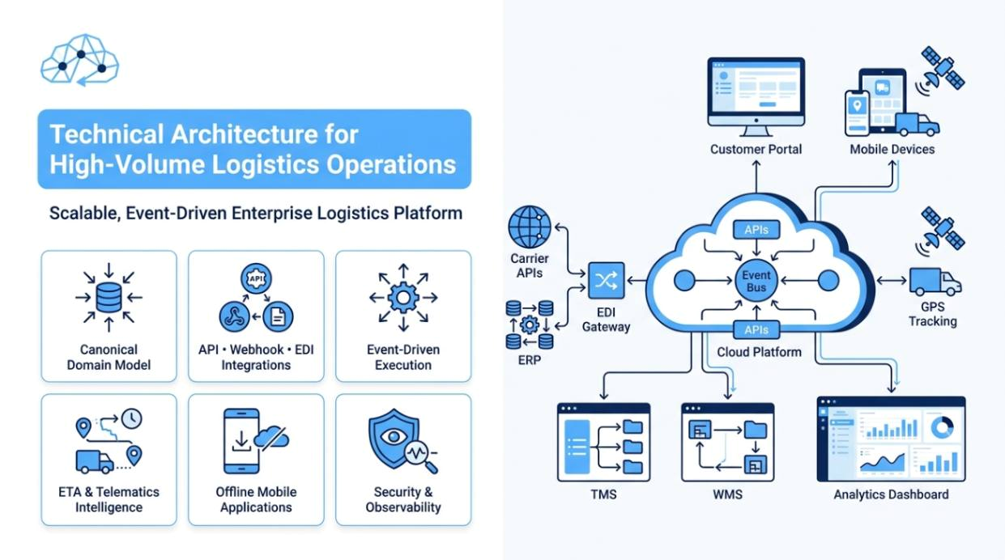
A logistics software development company should design an operating platform, not a collection of disconnected screens. The technical foundation begins with a canonical domain model that gives orders, loads, shipments, stops, equipment, carrier assignments, rate versions, shipment events, documents, invoices, claims, and service cases durable identities. Each object needs lifecycle states, timestamps, source-system references, and a traceable relationship to the people and systems that changed it. This model allows dispatch, linehaul, billing, and client-service workflows to work from the same operational facts.
The data model must distinguish a planned value from an observed value and from a derived value. A planned appointment, for example, is not the same thing as an arrival event; an ETA prediction is not the same thing as a confirmed departure; a contracted rate is not the same thing as an approved charge. When the platform preserves these distinctions, teams can investigate service failures, explain billing decisions, and tune automation without overwriting history.
Integration contracts, not point-to-point connections
Transportation environments typically combine a TMS, ERP or accounting platform, warehouse systems, telematics feeds, mapping services, carrier APIs, customer systems, and document repositories. The integration architecture should establish a source of truth for every business object, a versioned contract for every message, and an explicit reconciliation process. A custom integration is incomplete if it only handles successful responses; it must surface rejected, delayed, duplicate, partial, and out-of-sequence records to an accountable work queue.
A practical integration layer supports APIs, webhooks, scheduled file exchanges, and EDI messages without leaking each partner’s format into the rest of the platform. In freight workflows, that may include EDI 204 load tenders, 210 freight invoices, 214 shipment-status messages, 856 ship notices, and 940 warehouse shipping orders. The implementation should translate external payloads into a controlled internal model, preserve the original payload for investigation, validate mandatory fields, and record an actionable error when a partner message cannot be applied.
This anti-corruption layer keeps a carrier-specific field, an ERP code, or an old TMS identifier from becoming a hidden dependency across every service. It also makes partner changes safer. When a carrier adds a field or changes an API behavior, the adapter can be revised and tested without requiring a broad rewrite of dispatch, billing, portal, or reporting functions.
Event-driven execution and recovery
Shipment execution is inherently event-driven. A load is tendered, accepted, picked up, delayed, arrived, unloaded, delivered, invoiced, disputed, and closed. A resilient architecture publishes these business events through an event bus or queue so that the visibility service, alerting engine, customer portal, billing workflow, and analytics pipeline can react independently. This is far more robust than a synchronous chain where one unavailable downstream system blocks a dispatcher’s action.
Every event should carry a globally unique event ID, event type, schema version, source, occurred-at timestamp, received-at timestamp, correlation ID, subject identity such as shipment or trip ID, and idempotency key. Consumers must tolerate repeated messages because retries and network timeouts are normal in distributed systems. For shipment-specific sequences, the platform should define how it handles late or out-of-order events rather than assuming every partner will deliver a perfect timeline.
Retries need a bounded policy, with failed messages retained in a dead-letter queue for inspection and safe replay. A production support view should show why processing failed, whether a downstream dependency is healthy, how many messages are waiting, and what will happen when the item is retried. This turns integration failure from an invisible technical defect into an observable operational condition with an owner and a recovery path.
Telematics, ETA, and operational signal quality
Real-time visibility depends on data quality as much as data volume. GPS and telematics feeds may report at different intervals, send duplicate points, arrive late, jump locations, or pause when a device loses connectivity. The platform should ingest the raw signal, normalize units and timestamps, associate the signal with the right equipment and trip, and derive trusted operational events such as geofence arrival, departure, dwell, or route deviation. Raw data and derived decisions should remain distinguishable so that teams can understand how a status was created.
ETA logic should combine planned milestones, route context, latest trustworthy position, elapsed dwell, and known exceptions. It should also communicate confidence. A stale location feed should not look as reliable as a recent confirmed event. Dispatch teams need the ability to see the signals behind a predicted delay and correct the state when business context differs from what the model can infer.
Mobile execution that survives the field
Driver and dock applications require offline-first behavior. The client should retain an encrypted local work queue, capture scans, signatures, photos, notes, and status changes when connectivity is weak, and synchronize safely when service returns. Each mutation needs an idempotency token and conflict-handling rule so a delayed upload does not create a duplicate delivery, overwrite a dispatch update, or lose proof of delivery. Users should see whether a task is synchronized, pending, or needs attention; silent failure is unacceptable in field execution.
The experience must also be deliberately small. A mobile worker should be able to complete the next operational action with minimal typing, clear validation, camera and scanner support, and a recoverable path when a barcode, document, or location does not match expectations. That is where domain-aware logistics application development creates adoption: it respects the pressure and connectivity constraints of the work.
Observability, access control, and performance
The platform needs end-to-end operational observability. A user should be able to trace a shipment event from an external source through validation, queueing, workflow action, notification, and financial effect. Engineering teams also need request tracing, integration latency, queue depth, retry counts, error categories, and deployment visibility. Business and technical indicators should meet in the same review process: a spike in carrier-message failures can be correlated with a rise in unconfirmed trips or billing exceptions.
Access should be role-based and purpose-specific: a dispatcher, carrier representative, customer user, finance analyst, and system administrator should not see or change the same records. Every high-consequence change should retain an actor, time, before-and-after value, reason, and linked evidence. Performance targets should be defined by workflow: a dispatch queue, trip update, and billing validation each have different expectations for latency, availability, and peak-volume behavior. A production-grade logistics software development company engineers and tests those characteristics before expanding the release.
Agentic AI for Transportation and Logistics Execution
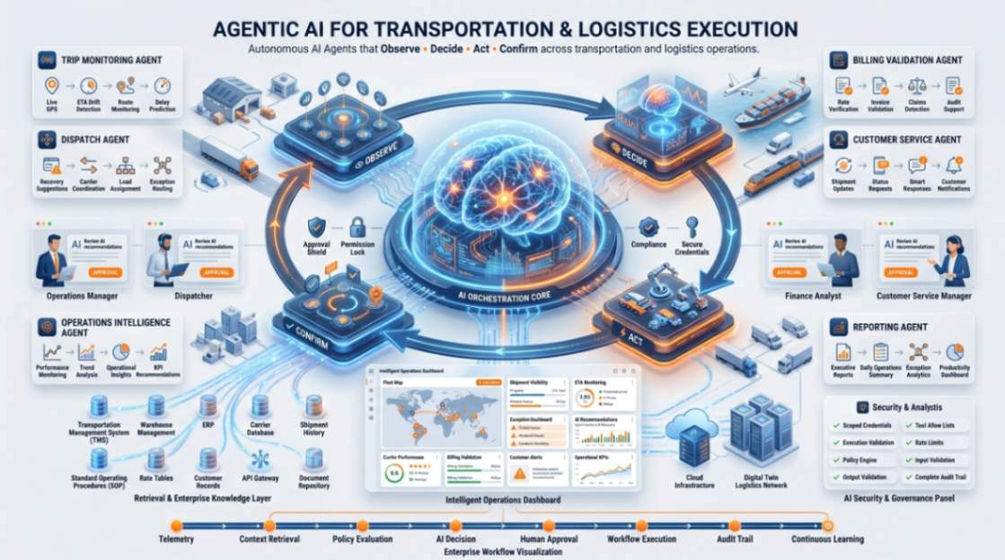
AI produces operational value when it is embedded in a controlled execution loop: observe, decide, act, and confirm. In transportation, that can mean detecting ETA drift, assembling the trip context, checking approved recovery options, creating a draft carrier follow-up, invoking a permitted workflow action, and recording the outcome. The point is not a general chat interface. It is a decision-grade operational capability that reduces coordination time while keeping responsibility visible.
On the ideyaLabs Agentic LayerTM, agents are designed around real operational telemetry and grounded enterprise context. A production agent should receive only the records, knowledge, and tools required for its task. Its prompts and workflow rules should define the objective, boundaries, inputs, expected evidence, and escalation conditions. Retrieval can supply a carrier rule, shipment history, rate context, or operating procedure; tool calls can query or update approved systems; the workflow should retain a trace of the sources, recommendations, actions, and confirmations.
A reliable agent does not treat all information as equally trustworthy. It resolves identifiers, checks timestamp freshness, distinguishes source records from generated summaries, and asks for human review when the evidence conflicts. The orchestration layer should enforce tool allowlists, scoped credentials, execution timeouts, rate limits, and input-output validation. These controls matter because an agent may interact with dispatch, billing, client-service, and reporting systems where a plausible but incorrect action creates extra operational work.
Evaluation is a production discipline, not a one-time demonstration. Build a test set from representative operational tickets and edge cases: a stranded truck, a late carrier event, a missed gate cut, an invoice with a rate mismatch, a duplicate document, or a customer-status request with incomplete data. Evaluate whether the agent retrieves the right context, applies the correct rule, requests approval when needed, uses the approved tool sequence, and leaves an understandable audit trail. Review results after each workflow or model change.
Useful applications include always-on trip monitoring, rescue and repower support, cargo-priority monitoring, rating and billing validation, settings-expiry alerts, cross-team status coordination, scheduled operational reporting, and role-based portals that bring agent assistance into an existing workflow. At ideyaLabs, the service model spans inbound planning, outbound planning, dock automation, dispatch web and mobile, linehaul operations, back-office automation, and client service. The operational objective is consistent: to turn fragmented signals into a timely, explainable next action.
AGENT DESIGN RULE: Automate bounded actions with evidence and reversible controls. Route ambiguity, conflict, and non-standard tradeoffs to the operational owner.
How to Select the Right Logistics Software Development Company
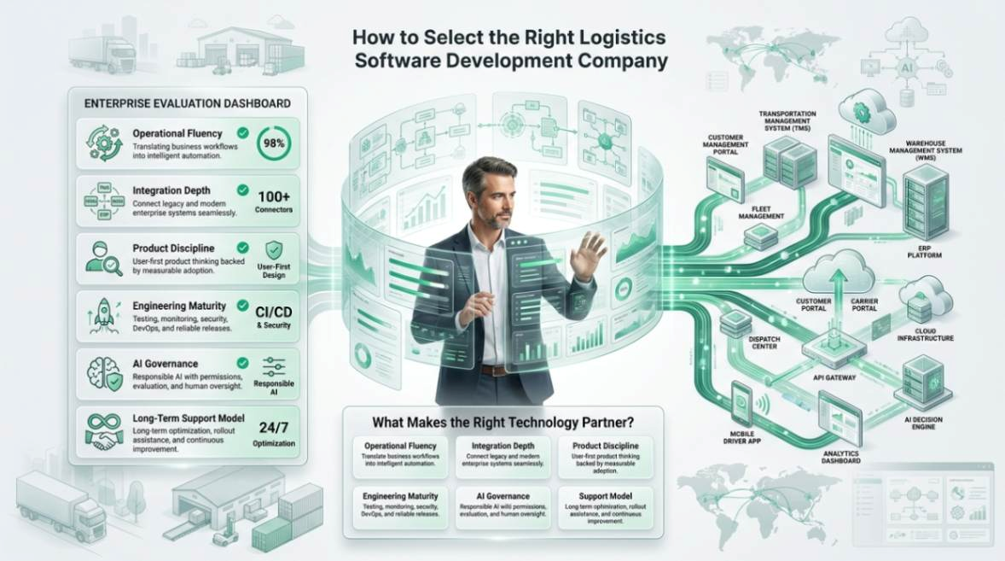
Vendor selection should be an evidence-driven exercise. Ask prospective partners to explain how they would discover your workflows, test assumptions with users, design integrations, handle data quality issues, and phase deployment. Their answers should show that they understand the difference between a feature request and an operational outcome. If every problem is solved with a generic dashboard, the team may not have enough transportation depth.
Look for experience across the workstreams that matter to your business: inbound planning, outbound planning, dispatch, linehaul, final mile, dock or yard operations, billing, pricing, claims, accounting, and customer support. No provider must have an identical past project, but it should demonstrate fluency in the constraints, terminology, exception patterns, and performance expectations of transportation operations.
Technical quality remains non-negotiable. Review how the company approaches domain-driven design, API contracts, data migration, cloud architecture, observability, test automation, accessibility, mobile performance, security, and release management. Ask for examples of decisions made when data was late, duplicated, or contradictory. Those are the moments that separate a prototype from production software.
- Operational fluency: Can the team translate your workflows into usable rules, queues, and decision points?
- Integration depth: Can it connect legacy and modern systems without creating a brittle point-to-point web?
- Product discipline: Does it validate needs with users and measure adoption, not merely ship a backlog?
- Engineering maturity: Does it use testing, monitoring, secure delivery practices, and documented release controls?
- AI governance: If AI is in scope, can it explain data grounding, permissions, evaluation, and human escalation?
- Support model: Will the partner stay accountable through rollout, optimization, and change management?
A Practical Delivery Roadmap
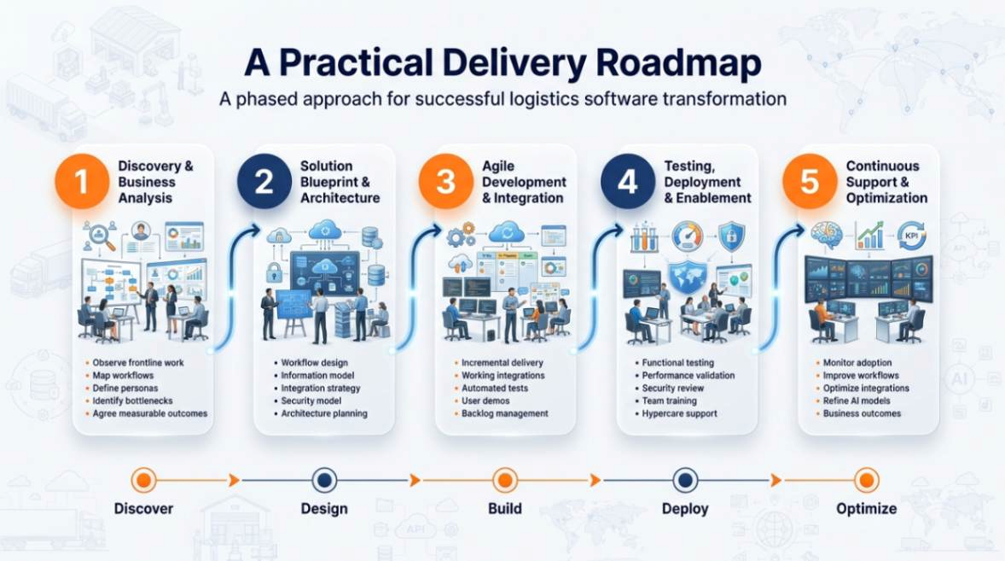
Large logistics transformations rarely succeed as a single big-bang release. A phased roadmap creates early operational value while reducing technical and adoption risk. The first phase should establish the product foundation and prove a workflow that users genuinely care about. Later releases can expand integrations, automation, and sophisticated optimization once the data and operating model are stable.
- Discovery and business analysis. Observe frontline work, map systems and data flows, define personas, identify decision bottlenecks, and agree on measurable outcomes. This is also where the team clarifies what should remain a human decision.
- Solution blueprint and architecture. Create the target workflow, information model, integration plan, security model, operating metrics, and a prioritized delivery sequence. Prototype the difficult experiences early, especially exception handling.
- Agile development and integration. Deliver in small increments with working integrations, automated tests, demos with actual users, and clear acceptance criteria. Keep a visible backlog for data quality, process, and policy decisions – not only features.
- Testing, deployment, and enablement. Validate functional behavior, performance, security, role access, usability, and operational readiness. Train teams with realistic scenarios and establish a hypercare process for production issues.
- Continuous support and optimization. Monitor adoption, performance, exception patterns, and business outcomes. Improve rules, interfaces, integrations, and AI evaluations from real usage rather than assumptions.
Common Pitfalls to Avoid
Building the dashboard before the workflow
A visually impressive dashboard can hide a weak operating design. Start with the action the user must take, the information needed to take it, the authority to act, and the confirmation that closes the loop. Then design the screen. This prevents teams from producing passive visibility when the business needs active orchestration.
Automating bad or undocumented rules
Automation amplifies the process it receives. If rate rules are inconsistent, ownership is unclear, or exceptions are resolved differently by every shift, the first task is to make those rules explicit. Software can then apply them consistently and surface true exceptions for review.
Treating integration as a final milestone
Integration uncertainty is one of the biggest schedule risks in logistics software. Bring critical interfaces into the earliest releases. Test against representative records, error conditions, rate limits, and retry behavior. Build reconciliation views so operational users can trust the handoff between systems.
Measuring output instead of outcome
Story points, screens delivered, or even automation counts are not business outcomes. Tie the project to operational measures such as time to detect an exception, time to resolve it, manual touches per invoice, completion rate for required documents, service consistency, or adoption by the intended user group.
Introducing AI without controls
An AI capability needs a defined purpose, known data sources, permission boundaries, test cases, monitoring, and a human escalation route. Avoid unrestricted access to production actions. Start with read, recommend, and prepare patterns; add controlled action only after the workflow, evidence, and evaluation process are proven.
Building Software That Handles the Real Work
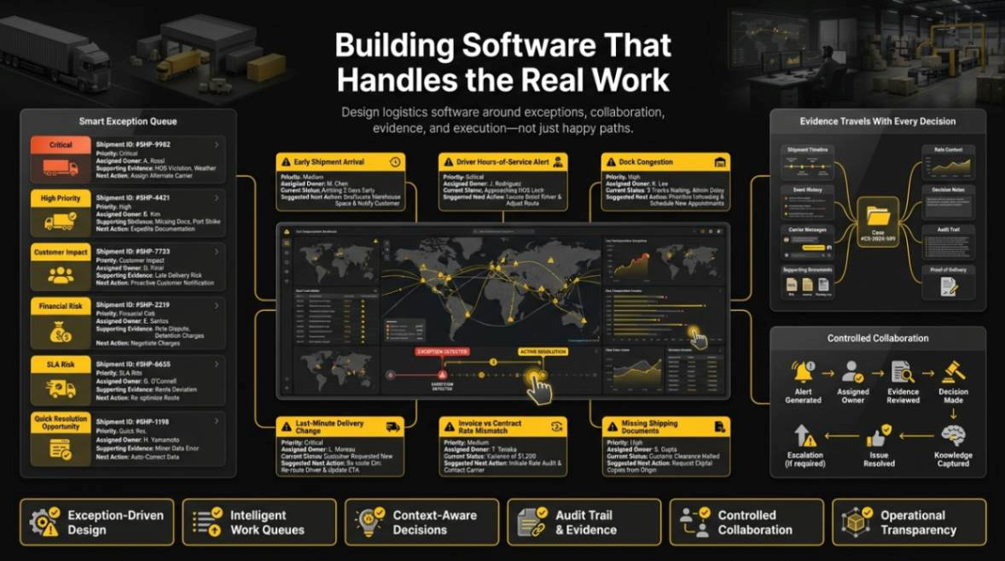
The strongest logistics applications are designed around exceptions, because exceptions are where transportation teams earn trust. A shipment may arrive early, a driver may run out of hours, a dock may be congested, a document may be missing, a contracted rate may not match an invoice, or a customer may change a delivery requirement at the last moment. Each event crosses roles and systems. The software should bring the relevant context together, make ownership visible, and guide the next appropriate action.
This requires deliberate queue design. A dispatcher or billing analyst does not need another undifferentiated list of records. They need work ranked by urgency, customer impact, financial exposure, service commitment, and the likelihood that a simple action can resolve the issue. The application should reveal why an item is prioritized, what has already happened, what rule or signal created the alert, and what options are available. That transparency makes the queue useful for new users as well as experienced operators.
Evidence should travel with the work. Instead of forcing a user to search across email, carrier sites, documents, and separate applications, show the event history, supporting files, messages, rate context, and decision notes within the workflow. A clear audit trail speeds resolution and makes handoffs safer across shifts. It also gives managers a richer record for improving policies, carrier agreements, and process design.
Design for controlled collaboration, not uncontrolled notification. Alerts should have an owner, a reason, and a completion state. Comments should be linked to the object or issue they explain. Escalations should route to a person with the authority to decide, and resolved cases should capture the reason so similar problems can be prevented or handled more consistently in the future. These details may sound small, but they are what transform visibility into dependable execution.
A capable logistics software development company will treat these patterns as product fundamentals. It will prototype the difficult moments, test them with operators, and measure whether the new workflow reduces searching, rekeying, waiting, and ambiguity. That is how the platform becomes useful on an ordinary day and indispensable during disruption.
How to Define Success Before Development Starts
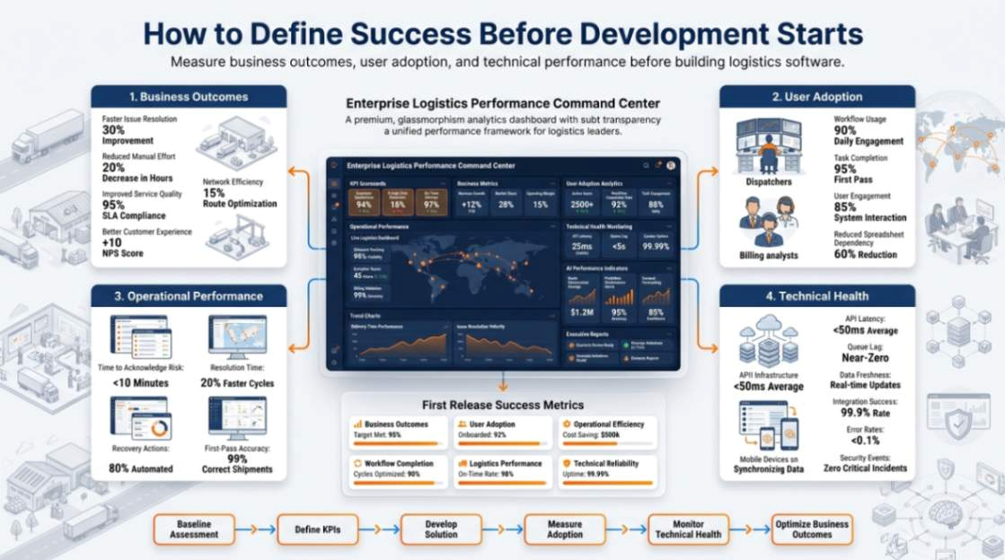
A logistics transformation deserves a measurement plan before the first production story is accepted. The plan should connect business outcomes to user behavior and technical service levels. This matters because a project can meet its delivery date while still failing to improve the work. A new exception screen is not successful simply because it is live; it is successful if the right people use it, see credible information, act faster, and produce a better result for the network or customer.
Start with a baseline. Document the present workflow in practical terms: how many events require manual review, how long it takes to identify a service risk, how many systems a dispatcher opens, how many invoice exceptions require rework, and how often a customer asks for a status that should have been visible. Combine the numbers with qualitative evidence from the people doing the work. Averages can hide the painful tail of the process, such as the few complex loads that consume a disproportionate amount of coordination.
Then choose a small scorecard for the first release. Good measures balance speed, quality, adoption, and control. For dispatch, the scorecard might include time from a risk event to acknowledgement, time to resolution, percentage of trips with a documented recovery action, and the rate of avoidable manual status checks. For billing, it might include straight-through validation rate, exception aging, first-pass accuracy, and the number of transactions that can be explained from an audit trail without a separate investigation.
Adoption measures deserve the same attention as operational measures. Track which roles are using the workflow, whether they complete the intended actions, where they abandon a task, and whether they return to shadow spreadsheets or email. When adoption is low, resist the urge to blame training immediately. The cause may be missing data, an unclear decision rule, a slow screen, a role-permission problem, or a workflow that does not match the sequence of real work.
Technical health underpins all of this. Monitor integration failures, queue lag, API latency, data freshness, mobile sync behavior, error rates, and security events. Establish service-level objectives that reflect business impact. For a critical dispatch or shipment-status experience, an outage during peak execution is more important than a cosmetic issue in a secondary report. Make those priorities visible in the support model and release calendar.
A Vendor Discovery Checklist for Logistics Leaders
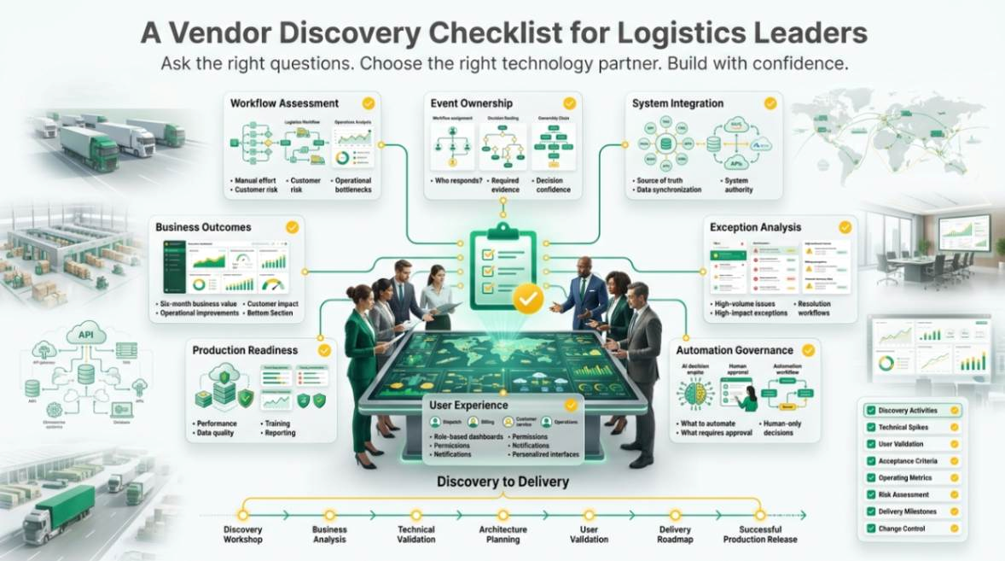
Discovery conversations are more productive when the buyer arrives with a focused set of questions. This is not a request for a rigid requirements document. It is a way to expose assumptions early, understand where a prospective partner brings useful patterns, and determine whether the team will collaborate effectively with operations, IT, finance, and customer-facing groups.
- Which workflow creates the greatest mix of manual effort, customer risk, and operational frustration today?
- What event should trigger a response, who owns that response, and what evidence do they need to act confidently?
- Which systems create or consume the key records, and which one is authoritative when values conflict?
- What are the most common exception types, and which ones are high-volume versus high-impact?
- What decisions can be standardized, what must be approved, and what should never be automated?
- Which user groups need different interfaces, permissions, notifications, and levels of detail?
- What must be true for the first release to be trusted in production: performance, data coverage, training, reporting, or policy changes?
- Which outcome would make the project unquestionably valuable six months after launch?
Ask the prospective logistics software development company to walk through its response to this checklist with a concrete delivery plan. It should identify discovery activities, technical spikes for risky integrations, user validation points, acceptance criteria, and operating metrics. It should also name the assumptions that need verification. A credible partner is comfortable distinguishing what it knows from what it needs to learn.
Commercial structure should support that learning. Early work may be organized around a discovery engagement or a well-bounded initial product increment, followed by a transparent delivery cadence. The important thing is that outcomes, responsibilities, and change control are understandable. Avoid arrangements in which the provider is rewarded only for adding more features; align incentives with usable releases, reliability, adoption, and clearly demonstrated business value.
From Legacy Modernization to a Connected Operating Layer
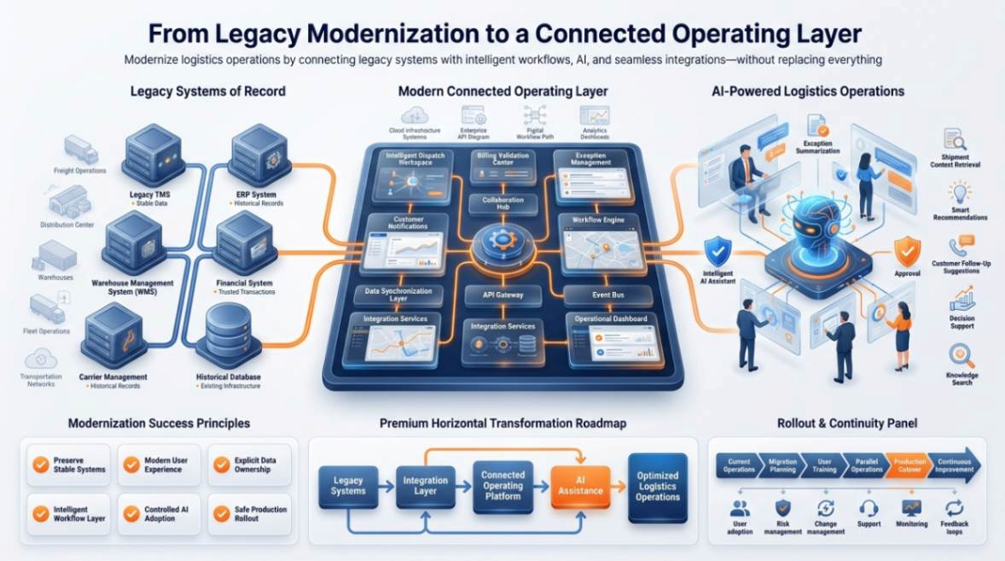
Many logistics organizations do not need to replace every legacy system to make meaningful progress. A pragmatic modernization program can preserve stable systems of record while introducing a modern workflow layer around them. This approach is especially effective when the core platform contains valuable historical data and well-understood transactions, but the user experience, integration speed, exception visibility, or reporting capability has fallen behind operational needs.
The first step is to separate stable responsibilities from painful constraints. A legacy TMS may remain the authoritative source for loads and rating while a new application handles dispatch work queues, collaboration, and customer notifications. An ERP may remain the financial system of record while a purpose-built billing workspace validates charges, collects evidence, and routes exceptions. The new layer should not duplicate data casually; it should make ownership, synchronization, and reconciliation explicit.
This strategy also creates a sensible path for AI adoption. Rather than attaching an assistant to every system at once, begin with a defined operational surface where data can be validated and permissions are clear. The assistant can help users locate context, summarize exceptions, prepare follow-ups, or recommend next steps. As trust grows and results are evaluated, the organization can permit more controlled action through approved integration tools.
Modernization succeeds when the delivery team respects continuity. Users need consistent terminology, reliable cutover plans, clear fallbacks, and a channel to report friction. Leaders need visibility into what changes, what stays the same, and how risk is managed. A logistics software development company that treats rollout as a product capability – not an administrative event – will create a safer transition and a more durable platform.
The Role of Change Management in Logistics Software Delivery
Even excellent software will underperform if it arrives as an unexplained change to the people who depend on established routines. Change management should begin during discovery, when frontline users can show the team where a handoff fails, which workarounds protect service, and which alerts are noise. Their participation improves the design and creates practical champions for rollout.
Prepare role-specific enablement, not a single generic training session. Dispatchers may need recovery scenarios; finance teams may need invoice-exception evidence; managers may need operational reporting; carrier or customer users may need self-service guidance. During hypercare, review questions and friction daily, distinguish product defects from policy gaps, and publish clear decisions. This disciplined feedback loop turns rollout into a learning process and makes the new platform part of normal execution.
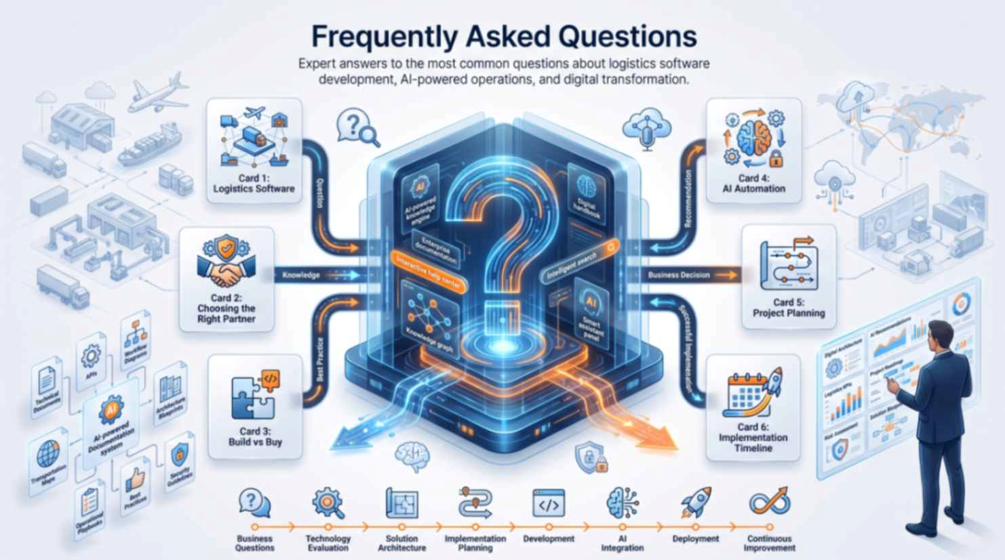
Frequently Asked Questions
What is logistics software development?
It is the design and engineering of applications that support the planning, movement, visibility, settlement, and improvement of freight and warehouse operations. It can include custom TMS modules, portals, mobile apps, billing automation, integrations, analytics, and AI-assisted workflows.
How do I choose a logistics software development company?
Prioritize operational expertise, integration experience, product discovery discipline, secure engineering practices, measurable delivery outcomes, and post-launch support. Ask how the provider handles real exceptions, not only standard workflows.
Should we buy a platform or build custom software?
Most organizations need a combination. Use commercial platforms for standardized capabilities and build custom layers where your workflow, customer experience, integration needs, or differentiating service model require flexibility.
Can AI safely automate logistics decisions?
Yes, when it is grounded in approved data, limited to clear permissions, evaluated with realistic scenarios, logged for review, and designed to escalate uncertainty. Start with monitoring, summarization, recommendation, and bounded workflow actions.
What should a first release include?
Choose a high-value workflow with clear users and measurable pain: a dispatch exception queue, carrier portal, billing validation flow, dock coordination process, or customer visibility experience. Include the integrations and change-management work required to make it usable in production.
How long does a logistics software project take?
The timeline depends on scope, integration complexity, data readiness, and rollout strategy. A focused initial release can be delivered far sooner than a full platform replacement when the team phases the work and validates the highest-risk assumptions early.
What integrations should logistics software support?
A modern logistics platform should connect the systems that create and consume operational decisions, including TMS, ERP or accounting platforms, warehouse systems, carrier APIs, mapping services, telematics feeds, document repositories, and customer portals. Each integration needs a clear source of truth, validation, error handling, and reconciliation workflow.
Can logistics software work with a legacy TMS?
Yes. A logistics software development company can build a modern workflow layer around a stable legacy TMS while preserving it as the source of record for selected transactions. This approach can improve dispatch queues, visibility, billing controls, portals, and integrations without forcing an immediate full-platform replacement.
How does logistics software improve ETA and shipment visibility?
Logistics software combines planned milestones, carrier events, telematics signals, geofence activity, route context, and operational exceptions into a shared shipment timeline. It should show the freshness and source of each signal, identify ETA drift early, and route high-risk trips to the right operational owner.
What makes an agentic AI workflow reliable in logistics?
A reliable agentic AI workflow uses verified operational data, approved tools, bounded permissions, evidence-backed recommendations, and explicit human escalation. It should identify the shipment or transaction correctly, evaluate data freshness, retain an action trail, and be tested against realistic exceptions before it performs any operational action.
How should a logistics team measure software ROI?
Measure software ROI through operational outcomes rather than feature counts. Useful indicators include reduced manual handoffs, faster exception detection and resolution, improved billing accuracy, fewer status-chasing contacts, stronger document completion, higher user adoption, and more consistent service execution.
Conclusion: Build for Reliable Execution, Not Just Digital Features
Selecting a logistics software development company is ultimately a decision about execution. The right partner helps your organization move from disconnected tools and reactive workarounds to governed, visible, and measurable workflows. It connects operational know-how with engineering quality, so the software reflects the reality of planning, dispatch, dock activity, linehaul, billing, claims, and customer service.
The strongest programs begin with a clear workflow, an honest view of data and integration constraints, and a staged path to adoption. They make exceptions visible, preserve evidence, give people the authority to act, and introduce AI where it improves speed and consistency without removing control. When those principles guide the work, custom logistics software becomes more than an application: it becomes a dependable operating layer for growth.
NEXT STEP: Use this guide as a vendor-evaluation checklist. Start with one operational workflow where better visibility, faster decisions, or less manual coordination would create a measurable result.
